A poem about Lent

Trying to get myself in the right mindset (heartset, soulset etc) for Lent.

These forty days of prayer and discipline
are given for us to slowly grow in grace
and learn to be your people once again,
to find our truest home in your embrace.
In pilgrimage, through hours and days and weeks
of changing who we are and what we do,
the human heart may find that which it seeks:
ourselves, once restless, find their rest in you,
our mother hen, whose chicks at last come home
to find the safest place where they may cling;
we need not face the wilderness alone,
but nestle in shadow of your wing.
Oh, forty days of learning how to be
what you have promised us eternally.

Adventy-Christmassy hymn. Slightly recycled.

This used to be a sonnet, but I’m no Malcom Guite, and before that it was a sermon. Anyway, it occurred to me that I could rewrite it as a hymn for the end of Advent, leading into Christmas. It could be sung to ‘Woodlands’ (Tell out my soul). 

Genuinely would love to know if you think it works. And if you like it, you are welcome to use it!

Words of the prophets since the world began
So long before salvation’s human birth
Speaking of God’s tremendous loving plan
for heav’n to touch the long-estrangèd earth.

Those ancient words at last began to be
in flesh and skin and bone and blood unfurled
In maiden womb and half-made family –
so heaven stooped to touch a fallen world.

Amongst the stable beasts behind the inn,
the baby’s eyes saw first a mother’s love;
and though their world, like ours, was full of sin,
yet in their gaze the earth met heav’n above.

We cry aloud for peace, goodwill to all,
and for God’s heaven to touch his earth again,
We bend our ears to hear the angels’ call,
and raise our voice to join the great Amen.

Dusty feet

This is a sonnet-format response to a friend’s facebook post asking if there are any hymns about shaking the dust off one’s feet. It’s not at all what he asked for – sorry Steve!

The dust reminds us of our origin,
from where we’ve come, not where we want to go.
And as it clings, brings with it all we’ve been:
familiar places, things we think we know
and may not like; perhaps we’d like to leave
them all behind, but they have made us who
we are today.  The stuff we now believe,
the wisdom our experience treats as true
is just as much a part of us as all
the atoms of our flesh. And we are kind
of stardust. That’s a fact with its own call
on what we choose to keep or leave behind.
Then, when we shake the dust from off our shoes
we do so, knowing what we have to lose.

What do the stones say?

This is a reflection / poemy thing based on the Palm Sunday gospel (the one with the stones), and making reference, among other things, to the Temptations of Jesus, the averted stoning of the woman in John 8, and the prophecy about the destruction of the temple.  

We could have been the temple,
if we were bigger, or more beautiful,
but we are the despised and the rejected,
our shape and size are wrong,
or we are broken, not quite strong
enough; the House of God surely demands
that only perfect stones
may be accepted.

We are the downtrodden,
trampled in the dust,
we are the cursed,
the cause of battered feet and stumbles,
the playthings of the poorest children,
and for the beggars as they sit in boredom,
Equally unnoticed, equally humble.

We are still stone, when once,
we might have become bread.
And just before he turned to look the devil in the face,
to us he bent his head, ‘Remember this,’ he said.

We are still unbloodied, still unscathed,
when once we could have been picked up and weighed
in the hand, and flung in cruel contempt.
He saw us then, as he leant
down to mark the dust
and whispered to us, once again, ‘Remember this.’

We remember how he saw us, even though we
were not intricately carved or nobly
combined in stately, sacred architecture.
He saw us as we were, the least, the small,
the unimportant, despised, rejected all.
We remember how he saved us from the shame
of becoming unwitting instruments of blame.
We remember how he wished that we were food,
but would never use us for a selfish good.

We remember.

And now we see him, riding like a king amid the raving crowd,
towards the Temple’s lofty towers, so tall and strong.
And just as we begin to wonder if we’d read him wrong,
he looks deliberately at the stony ground,
then raises his head and looks about
and speaks aloud:
If all the crowds were silent,
then the very stones would shout!

Call us as your witness,
hear this testimony,
about a man who saw us
and gave us this, a story.

We tell that story on every rocky path
and in every wayside cairn,
in every church that’s built from rocks
to be a house of prayer and living sign
of the man who was himself
a stumbling block
to all who could not
love him as the corner stone.

Love Life Live Advent – 15th December – poems & pictures

We had a little time left over after we finished our Jesse Tree at children’s chapel on Sunday morning, so we got ahead and did some work on the task of drawing some pictures for the Christmas story for today’s task. christmas pictures
There were quite a lot of angels (because we’d just made the angel bauble for our Jesse Tree) but also the odd other item from the tree – Noah and his rainbow are there, as is a heart/flower combination representing Mary, and a wonderfully complex set of heart symbols for different ideas about God from one of our six year olds!

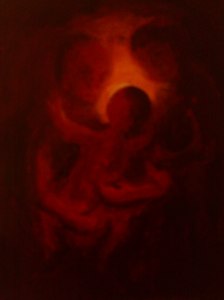
2013-03-08 00.29.35I was too busy picking up pens and pairs of scissors to draw a picture at children’s chapel, so here’s one I made earlier. It’s acrylic paint on canvas, and if you squint a little it’s the Holy Family. Mostly the colours are about the love that exists between the three figures, and that seems to me to be at the heart of Christmas.

For completeness’ sake, here is a poem that I wrote for Christmas last year – it’s really a sermon I wrote (which was based on the lovely Christmas collect that talks about heaven touching earth) then condensed into a sonnet!

Prophetic visions since the world began
(so far before salvation’s human birth)
would speak of God’s tremendous loving plan
for heav’n to touch the long-estrangèd earth.
Those ancient words at last began to be
in flesh and skin and bone and blood unfurled
In maiden womb and half-made family –
so heaven stooped to touch a fallen world.
Amongst the stable beasts behind the inn,
the baby’s eyes saw first a loving mother;
even though their world was full of sin,
yet heav’n touched earth for each in one another.
Now we cry for peace, goodwill to men,
and for God’s heaven to touch his earth again.