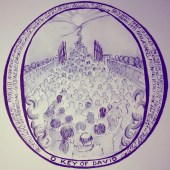
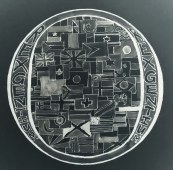
Advent doodle 1: Hills of the North, rejoice

I don’t know yet if I’ll try for (let alone succeed at) a doodle a day again, but here’s day one, based on the readings from today’s Eucharist (bits of Isaiah 2 & Matthew 8) and the hymn that seemed most to resonate with them.

We are those who come
from North and South
and East and West;
We are those who come
not in our own right,
but by the grace of God;
We are those who come late,
unclean, and unprepared;
We are those who, as beloved guests,
sometimes need reminding
that we do not own this:
it is a gift that we may come as we are
to become all we were created to be.


The one with the crumby dog

I finally declared this picture finished…

It’s the story of the Syro-Phonoecian (Canaanite) woman who asks Jesus to heal her daughter (Matthew 15):

22Just then a Canaanite woman from that region came out and started shouting, ‘Have mercy on me, Lord, Son of David; my daughter is tormented by a demon.’ 23But he did not answer her at all. And his disciples came and urged him, saying, ‘Send her away, for she keeps shouting after us.’ 24He answered, ‘I was sent only to the lost sheep of the house of Israel.’ 25But she came and knelt before him, saying, ‘Lord, help me.’ 26He answered, ‘It is not fair to take the children’s food and throw it to the dogs.’ 27She said, ‘Yes, Lord, yet even the dogs eat the crumbs that fall from their masters’ table.’ 28Then Jesus answered her, ‘Woman, great is your faith! Let it be done for you as you wish.’ And her daughter was healed instantly.

She is a woman. She is foreign. She has a disabled/sick child. And she shouts. She’s a reject in pretty much every way. And she’s awesome.

In the painting I tried to do something different from my previous attempts at this story (which had focused on the ‘meeting of minds’ that Jesus and the woman reach by both stroking the hypothetical dog, but I was challenged to have a go at the moment of confrontation itself, which is much harder. So this is the moment when the woman grasps Jesus’ arm and makes him listen. She’s small, but mighty.

Here are some things I’ve tried to do in the painting:

  • On the left, there’s a small gathering of Jesus’ disciples, but they’re a group of individuals. On the right everyone is presented relationally. The woman, by touching Jesus, draws him into the relationality of her family. This, for me, is a mirror image of the usual pattern in which Jesus draws outcasts into relationality (often by touch).
  • The stones on the floor are a recurring theme in scripture. Here, they stand for stumbling blocks – the stumbling blocks that Jesus warned about (in Mark 9), the stumbling blocks that we must not put in the way of ‘any of these little ones’.  The woman demonstrates to Jesus that her daughter is indeed one of the little ones that come within Jesus’ sphere of protection and love.
  • The woman is dressed in blue because her confrontation with Jesus reminds me of the way that Mary, his mother, showed him that his time had indeed come, and that it was the right moment for him to perform his first miracle (John 2).
  • The older lady on the right is grandma, and she’s looking after her other grandchildren so that the woman is free to go and confront Jesus.
  • I’ve always assumed that there was an actual dog.  Dogs can enable people who wouldn’t otherwise engage with one another to reach a place of understanding and generosity.

Harvest resources

It must be time to post something about harvest – here’s a collection of stuff that might be useful.

Some all age ideas

  1. The four corners of God’s love (not my idea – I learnt it from a Sally Army officer ages ago!)
    Start with a large square or rectangular piece of paper, and announce that this is the four corners of God’s love. Say, ‘It’s my piece of paper, so it’s the four corners of God’s love for me.’  Count them out to make sure.
    Ask, ‘What would happen if I cut off one of my corners and gave it away?  I have four, but if I gave one away, how many would I have?’  You may get the answer, ‘three’.
    Cut off one corner, give it to someone in the congregation, and count your corners again. You have five! You had four, you gave one away, and you have five. And the other person has three. That’s eight whole corners of God’s love!
    Try it again with another corner. And get one of the recipients to try it with one of their corners etc. Keep counting up the new total of corners until everyone loses count.
    Reflect on generosity, abundance, giving, God’s providence, blessings given and received….
    Encourage everyone to take their ‘corner’ home as a reminder.
  2. Ready steady cook
    Ask members of the congregation to come forward and pick out five items from the donated produce and say what they’d cook with them – get everyone to vote on the best idea.
    Reflect on how bringing the gifts together means we can do amazing things with them – maybe we each brought only one gift, but God multiplies what we give.
  3. World map
    Draw a rough outline of a world map on a double bedsheet and lay it down on the floor  – as people bring their gifts of produce, invite them to place their gift somewhere near its (possible) country of origin. Have some information displayed about some of the key producing nations and what life is like as a farmer/producer there. During your talk, look at some of the foods, and trace their journey from field/forest/ocean to plate.  You could
    (a) Say a prayer for each stage of the food’s journey
    (b) Talk about fairtrade and related issues
  4. Place mat grace
    Give everyone an A4 piece of paper with a simple place setting drawn on it, and some pens. You can also provide glue, scissors and old food magazines for those who like to cut and stick.
    Invite people to decorate their plate with words or pictures that remind them to say thank you for their food.
    Teach everyone a simple grace that they can use at lunchtime when they get home. Invite them to write it on their placemat. This might be something quite traditional, or something sillier – or have a variety to choose from. Popular options might be:
    (a) For these and all God’s blessings may his holy name be praised.
    (b) Rub a dub dub, thanks for the grub!
    (c) (sung) One, two, three, four, five, thank you God that I’m alive, six, seven, eight, nine, ten, thank you God for food, Amen.
    (d) (sung) Praise God from whom all blessings flow, praise him all creatures here below, praise him above ye heavenly host, praise Father, Son, and Holy Ghost.
    Alternatively, you could write a variety of graces on the reverse of the paper so that they’re all provided.
    If you have the facilities, you could offer to laminate the placemats while people are having coffee after church, so that they’ll last longer.

Poem

Here is the original (longer) version:

We bring our gifts:
The first-fruits of our labour,
or perhaps the spare we do not need,
(an offering to mitigate against our greed).

To the church we bring them,
and into the hands of Christ we place them,
and we say, ‘Take this,
and do with it some miracle:
Turn water into wine again,
or multiply my loaves and fish
to feed a crowd again.’

And Jesus takes them from our hand,
this fruit of the ocean, this product of the land,
and blesses them, accepting back
what always was the Lord’s.
Our gifts will fill the lack
of hungry people,
putting flesh on words
of charity, and making folk
in our small corner of the world
more equal.

We know there is enough for everyone.
But once the leftovers are gone –
taken to the homeless, hungry poor –
what of those twelve empty baskets standing idly by?
Can there yet be more
that we can ask our Lord to multiply?

Into those baskets therefore let us place ourselves,
those parts of us that need transforming,
grace and strength and healing,
the gifts in us that need to be increased and shared
with a greater generosity than we may be prepared
to offer on our own account.

For we are God’s rich and splendid bounty,
seeds, sown and scattered by the Lord in every place.
the human race:
the crowning glory
of the ever-evolving creation story.
We thank the Lord
that he does not just separate wheat from tare,
but takes our very best
then turns us into far more than we are.

And here is the shorter version:

We bring the spare we do not really need
(for surely God will honour all we bring
although it cannot make up for our greed).
And place into Christs’s hands our offering:
“Turn water into wine again,” we say,
“and multiply my token loaves and fish
to feed another hungry crowd today.”
Our gifts, we know, will put some flesh
on words of charity. Then into those
twelve empty baskets, let us place the gifts in us
that need to be increased and shared
with greater generosity than we may be prepared
to offer on our own account.
For we are God’s most rich and splendid bounty,
sown as seeds and scattered by the Lord
in every place.
the human race:
the crowning glory
of the ever-evolving creation story.
We thank God that he does not only separate the wheat from tare,
but takes our very best then turns us into far more than we are.

oOoOo

Clipart and assorted autumnal pictures

  wheat sheaf clipart       The whole world in his handfeeding of teh 5000

harvest     foodharvest festival clipart


hands held out     19th sept 2014 005broken bread


Stations of the Cross

If you haven’t already seen it, take a look at this, the website for the Cambridge Stations. And better still, if you can, go along in person to any or all of the installations and artworks that have been specially commissioned as part of this pop-up reflective project for Lent.  The tradition of following the stations of the cross derives from the still earlier tradition of pilgrimage, especially pilgrimage to the Holy Land, in which pilgrims would seek literally to walk in the footsteps of Christ.  For those unable to make what was a long and arduous journey, the Stations provided a way to make a ‘virtual pilgrimage’.

The pattern of the Stations familiar to many of us contains not only events in the passion of Christ taken directly from scripture, but also some from tradition, such as Jesus’ encounter with Veronica, who wipes his face with a cloth on which he leaves the imprint of his face, a ‘vero icon’ – a true image – of Jesus. The Stations used for this project are those found in the gospels themselves, and on the Cambridge Stations website each short passage of scripture is provided for your own reflections. Some of the artists have also provided further thoughts that can be read alongside seeing the artwork itself in situ.

My own church is too far off the beaten track to be part of the Stations route, so I was allocated St Botolph’s Church, right in the centre of town as a venue, and Station 13: Jesus dies, as my title. Here’s what I did (right).

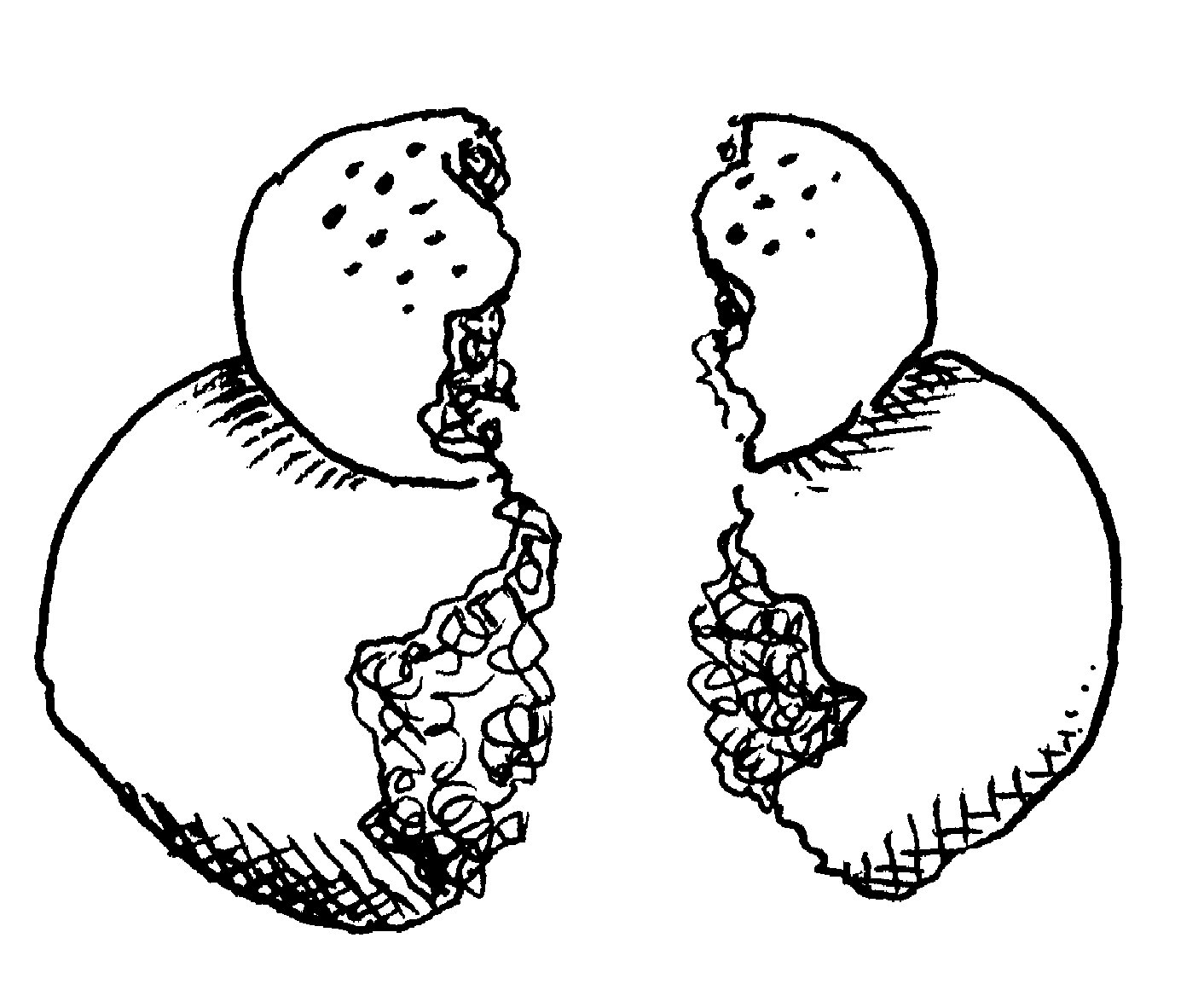
As soon as I started looking at this crucial part of the story of Jesus’ passion I was drawn to the image of the temple curtain being torn in two, coupled with the earthquake that split the rocks (in Luke and Matthew’s account). I decided I wanted to experiment with ripping the actual canvas on which I was painting.

The second thing that occurred to me was how, in icon writing, the gold leaf is applied first, and is allowed to shine through the halo of the depicted saint – it is a glimpse of the always-present reality of the kingdom of God, breaking through into the material world. I decided to honour this by using gold leaf to line the tear in the canvas, and on a board behind the tear. At the moment of Christ’s death – the moment of darkness and desolation – the kingdom of heaven was near. How else could the Centurion proclaim that, ‘Surely, this man was the Son of God’?

Finally, having decided on gold leaf, I came across the Japanese tradition of ‘Kintsugi’ – mending broken pottery with gold, so that the wounds in the pottery become shining scars, and the mended vessel becomes more beautiful than when it was first made.  It struck me that the gold leaf lining the tear in the canvas, in the temple curtain, in the very fabric of reality, is a way of affirming the wholeness and healing that was possible through the suffering and death of Christ. The risen Jesus still bears the scars from his passion, but they are signs of hope and wholeness – following the iconographic pattern of this painting, the broken skin would be healed with gold. And just as Thomas did when he met the risen Christ, you can actually place your finger into the tear in the canvas and feel the rough edges.

Please excuse the quality of the photograph – it is rather blurred, while the actual painting is rather more crisp and vibrant!  If you can, pop along to St Botolphs and see it for yourself, and why not go and visit all 14 stations?


Things pertaining to Advent

Here’s a whole load of stuff for Advent, gathered in one place for your convenience!
Enjoy, and help yourself to anything you think might be useful.

Advent Wreath Song
to the tune ‘Father we place into your hands’

Mothers and fathers of the faith, who lived in times of old,
Leaders and judges, kings and queens were faithful, true and bold,
Travelers, heroes, shepherds, all with stories to be told:
Still they show us how to follow you.

Prophets and seers who spoke the truth in answer to your call,
finding new ways to bring your word to people great and small,
living their lives to show your love was meant for one and all,
still they show us how to follow you.

John, in the desert calling out, ‘The Kingdom has come near.’
‘Come and repent, and be baptised, there’s nothing then to fear.’
‘Jesus is coming now, the One you’re waiting for is here.’
Still he shows us how to follow you.

Mother of Jesus, angels called her favoured, full of grace,
Holding the Son of God, the Prince of Peace, in her embrace,
She is the one whose ‘yes’ helped God to save the human race,
still she shows us how to follow you.

And this last verse, for Christmas day, is by my friend and colleague Gill Robertson:

Jesus our Saviour, born a king, we welcome you today,
Lord of all time, Immanuel, with joyful hearts we say:
You are the Christ who came to earth for us; and now we pray,
Help us all to daily follow you.


This next song was intended to make a link between the ‘Jesse Tree’ / Salvation History pathway through advent, and the Advent Sunday theme of keeping alert and being ready.
Tune: Sing hosanna

There’s a story to tell of creation,
And the patriarchs’ faith of old,
There are stories of prophets and sages,
We’ll repeat them ‘til the world’s been told:

Sing together! sing together!
Sing to welcome in the King of Kings.
Sing together! Sing together!
Sing to welcome in the King.

There are stories of sin and forgiveness,
Of a Kingdom of truth and love.
Of a girl who gave birth to a baby,
To fulfil God’s promise from above:

As God’s people prepare for his coming,
And remember those days long gone,
Our own stories are yet to be written,
As we live to make God’s kingdom come:

We will patiently wait for the morning,
Through the night we will watch and pray,
As we look for the light that is dawning,
We’ll be ready at the break of day:


Advent Hymn
Tune: Picardy

Longing for a hope-filled morning,
Kingdom of the Son, draw near!
Waiting for the day soon dawning,
Light of love that casts out fear.
Dayspring, come from heav’n, in lowly birth,
Come to warm this cold, dark earth.

Sorrow through the world is sweeping,
Bitter conflict rages still,
Heaven hears its children weeping:
cost of humankind’s freewill.
Come, O Price* of Peace, in lowly birth,
Come to mend this broken earth.

Pattern of the world’s salvation,
God and human side by side.
Colour, language, creed or nation,
No more should the world divide:
Come, Emmanuel, in lowly birth,
Show how heav’n embraces earth.

*This word started off as a typo, but I quite like it, as it echoes the ‘cost’ of the previous line…  If you use the hymn, you can choose whether to use Price or Prince🙂  And thank you to the lovely Uptonpc for suggesting that Price could stay as an option!


Some pictures to go with the ‘O’ antiphons:
OSapientiawp-1450401867681.jpgORootOfJesseOKeyofDavidORexGentium2OOriensOEmmanuel