
The eastern sky was liquid-red this morning.
Though the sun’s well up, the air is cold,
There’s something dark – a shepherd’s warning?
That’s the phrase, I think. And I’ve been told
They had a shepherd-king, once, long ago.
A king! Imagine that. Who’d want to rule
A people who, in fear, would stoop so low?
They’d throw their own man to the wolves. The fool!
He had his chance to plead his cause and sway
My judgement. I am not the one to blame.
Is this the truth? I don’t care either way.
Die now or later? End result’s the same.
I take the bowl and watch the ripples still.
“You have no power over me” he said.
He’s right. I soak my dirty hands until
Some quirk of sunlight turns the water red.
Tag: Jesus
Bible Sunday 2016
Sermon for St John’s Hills Road, Cambridge
Bible Sunday, 2016
Many years ago as I was planning an All Age service for Bible Sunday I lamented to a colleague that there weren’t many hymns about the Bible. The Colleague rightly pointed out that this was because hymns are songs of worship, and we don’t, in fact, worship the Bible as the written word, but rather the Living Word of God, Jesus Christ. There still aren’t many decent hymns about the Bible, for that very reason.
When the gospel is read in some churches, the reader kisses the gospel book – this is something I do, in fact, as you probably noticed – I don’t know if you’re used to he here or not. But what does that mean? Why do it? Am I really kissing a book – an object – print on paper, with a nice binding? What if I’d printed out the reading and ended up kissing just the bit of paper from my printer, as I said, ‘This is the gospel of the Lord’? Or what if I’d been reading off an ipad? Surrounded as we are by beautiful bibles of every kind, and with means to ‘read, mark, learn and inwardly digest them’ this is an interesting question. When we say ‘this is the gospel of the Lord’, what is, in fact, ‘this’? We’ll come back to this question a little later.
Our gospel reading tells of Jesus reading from Isaiah, and telling the gathered faithful that today those words come true – he’s going to show them what the words look like in real life. What an amazing thing to hear. ‘Today this comes true.’ ‘Today you find out what the word of God looks like in action.’ It’s Jesus’ manifesto in which he connects the words of the scroll with his own identity as the living Word of God.
Let’s look more closely at what’s there. What is is that Jesus promises to bring to life? The Isaiah passage speaks of freedom and wholeness and good news….
And only three chapters later, we hear him again refer to the same passage about his ministry:
This word about him spread throughout Judea and all the surrounding country. The disciples of John reported all these things to him. So John summoned two of his disciples and sent them to the Lord to ask, ‘Are you the one who is to come, or are we to wait for another?’ When the men had come to him, they said, ‘John the Baptist has sent us to you to ask, “Are you the one who is to come, or are we to wait for another?”’ Jesus had just then cured many people of diseases, plagues, and evil spirits, and had given sight to many who were blind. And he answered them, ‘Go and tell John what you have seen and heard: the blind receive their sight, the lame walk, the lepers are cleansed, the deaf hear, the dead are raised, the poor have good news brought to them. And blessed is anyone who takes no offence at me.’
We need not stick just to Luke 4 – there are plenty of other places where we are given challenging manifestos – blueprints, in word form, of what the heart of the gospel looks like when it’s lived out, and which we can see in the life of Christ, and then in the life of he saints through the ages. We might think of the beatitudes, the ten commandments, the summary of the law, the parables, even the Lord’s Prayer… so much of scripture consists of words that are to be lived. There might be some words that you have found to be formative on your journey of faith, words that you’ve gone back to again and again as you’ve worked out what being a Christian means not just in church but in daily life.
You’re welcome to make your own suggestions…
You might want to pick just one from all these and focus on how you will live it today, this week, this month… how will it form you, change you?
Now look back at Luke 4, at the very beginning of the quotation from Isaiah: The Spirit of the Lord is upon me… It’s the Holy Spirit who brings the words on the page to life in our lives. The breath that gives voice to the word, as at creation. The breath that makes us come alive, and live as people of God.
The ‘this’ that is the gospel of the Lord, isn’t the physical object the page itself – though we do quite rightly treat the bible with reverence and respect – nor is it even the content, the words on the page. It’s more as if the gospel resides in the proclaiming and hearing of it – the way that it’s spoken aloud and heard, in public, so that we become like the crowds who first heard the words of Christ and saw him put them into action, the way that the Spirit inspires the proclamation, moves through and informs the hearing, and empowers the doing of the word. The gospel, ‘this’, is the contemporary living out of the words on the page, as the Spirit gives us power. This is how the word of God is ‘living and active’ – constant, and yet always fresh, always being made incarnate in the lives of God’s people.
So as you look at the bibles on display around the church today, don’t just look on them as objects – think of the fingers that have turned those pages, the eyes that have read them, the voices that have read them aloud… all the people who, through the generations have been been shaped and formed through their encounters with Christ in scripture, who have connected their story with God’s story, and lived the gospel.
This is how we are the body of Christ on earth. As Once the prophets Jeremiah and Ezekiel ate the scrolls on which the word of God was written, so we, in the words of the collect, ‘inwardly digest’ the Word of God, through our reading, our hearing, our speaking, and indeed through our receiving of the bread and wine, as we ‘become what we eat’ and become the good news that God is sharing with the world.
Hymn about giving / money etc
That reading about paying tax to the Emperor sort of felt like it needed a new hymn (at least, someone suggested it did). So here is one, to the tune Bunessan (Morning has broken).
Here we are giving,
out of our plenty
fruit of thanksgiving,
tribute of love.
Hearts overflowing
cannot stand empty,
constantly growing
grace from above.
Gathered as one, and
thankfully bringing
all that we are, and
all that we do.
Serving and caring,
praying and singing,
building and sharing,
offered to you.
Love beyond measure,
total compassion,
We are your treasure:
wondrously giv’n.
Made in your likeness,
imaged and fashioned,
life that is priceless,
valued in heaven.
Transfiguration doodle

Getting ahead of myself a bit – here is a doodle for Sunday’s gospel, the Transfiguration.
Candlemas
 The first time I saw a reproduction of Rembrandt’s portrayal of Simeon with the Christ child (the late one, not the earlier one) it immediately became my favourite painting. It has all the fuzziness and limited palette associated with the artist’s late works, as well as all of the spiritual and emotional depth – it is the work of an artist for whom physical sight and the detail of appearance has taken second place to the ability see with the eyes of his heart and soul.
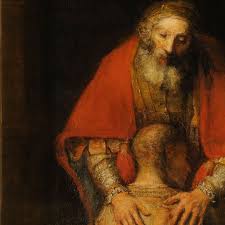 In this painting, just as in his portrayal of the Return of the Prodigal Son (also a late work, and also featuring what could almost be the same model for the figure of the old man), he is depicting someone who, like the artist himself, is also seeing with the eyes of the soul. When you look at Simeon’s face, you know, somehow, that he is blind, and yet it is he who sees the baby Jesus for who he really is. When you look on the prodigal’s father, you know that he is seeing not the wreck that the young man has become, but the son he truly is, and will be again.
 During his last years, Rembrandt returned several times to the project of painting self portraits. I often wonder whether in these two biblical old men he was somehow portraying himself, and whether, in all of these paintings, the self-portraits included, he was, in a way, learning to see himself with the eyes of the heart, and the soul, learning to see himself not in terms of his physical appearance, but in terms of who he truly was. Was he portraying, again and again, his true self, as he felt he was looked upon by God? And was he, then, in a very real sense, preparing for his own death?
Simeon sees Jesus and immediately prays, ‘Lord, now lettest thou thy servant depart in peace’. Perhaps the reconciliation of the family is the last act of the prodigal’s father? In these last paintings, I see a man who has been through a great deal, and made many mistakes, and at the end of his life has learned to see himself for who he is.
Perhaps all this is a bit fanciful – one can never know the mind of an artist, and one of the great joys of art is that we can each look on it and see something different, something that reflects our own experience, our own questions, hopes, dreams or fears. But it was something of this that I had in my mind when I wrote, in my hymn for the Feast of Candlemas, “We come just as we are to you, as one who knows us through and through, and keeps us in your care, in love beyond compare.”
Simeon saw Jesus and recognised him, and at that moment, as Jesus gazed back with the intensity that only a baby can offer, he saw himself as God saw him: beloved. May we learn to do the same.
 reverendally.org