
Here’s a random collection of stuff for Mothering Sunday – all in one post so it’s a one-stop shop. Help yourself, and enjoy.
Some thoughts that might drift into a sermon
 The Bible’s stories of mothering are never twee, sentimental or saccharine – how might you describe the mothers in today’s readings (or whichever combination of lectionary readings you are using)?
- Exodus: cunning, determined, desperate, protective, nurturing (in being the ‘wetnurse’)
- 1 Samuel: passionate, generous, sacrificial, brave, joyful, trusting and faithful
- Luke: faithful, responsible, aware of the double-edged sword of caring
- John: still present even in sorrow, faithful, grieving, caring and cared-for, love that is stronger than death
What if you added to those readings the Old Testament stories of Sarah, Ruth, Rachel and Leah, Rebecca, Hannah, Moses’ mother and sister…. and from the New Testament, the story of the annunciation, the nameless Syrophoenician woman’s refusal to take no for an answer,  and Jesus’s own tears over Jerusalem as a mother weeps for her children,longing to gather them like a hen gathers her chicks. The list of characteristics associated with mothering grows ever longer and more diverse.
Mothering is all those things, and more. Without someone to do those things for us – without someone to look out for our interests, to defend us, to protect us; without someone to enable us to learn our purpose in life, without someone to model trust, faith, and joy; without someone who will love us enough to let us go our own way; without someone to take the risk of loving us, even knowing that that love may bring them pain; without someone to stand with us in our times of greatest suffering – without someone to do those things for us, we are missing something crucial. And if we ourselves have nobody for whom we can do these things, we are also missing out.
 Who does all this for people who would otherwise never experience this kind of mothering? Charities like The Children’s Society protect children in danger, act as an advocate for children in trouble with the law, enable children who are struggling to reach their God-given potential, take a risk and invest in the future of children in the knowledge that they must have their own integrity, and yet at the same time walk with them on their journey of self-discovery, and affirm that all children are, in the words of Moses’ mum “beautiful before God”.
Sometimes the Children’s society, and other charities that work with vulnerable children, is involved in finding out of situations of extreme suffering, tragedy and crisis, new and life-giving ways of creating family and community, just as Jesus did from the cross when he asked his mother and his best friend, John, to care for each other when he had gone, and just as Moses’ mum did when she risked everything to give her son a chance at life.
We might think about our own lives – our experiences of mothering or of being mothered; remembering with thanksgiving the people who have done those things for us. And perhaps we might also think of times when we have been failed by those who were supposed to care for us, or those times when we ourselves have failed.
If mothering were only done my mothers, it would be very hard indeed to ensure that everyone received the nurturing, the protection, the love, the sacrifice, the guidance (etc) that we need to become the people we are meant to be. As a church community, we are called into a role of mothering that sometimes might need to be just as desperate, fierce, loyal, grieving etc as the mothers in today’s readings. If we, as a church, truly love the community in which we are situated, just as God loves it, and if we are to be God’s holy people for God’s needy world, then we will feel the pain of the world’s suffering, and we will be willing to sacrifice something of ourselves in order to bring to birth God’s purposes for the world.
On the cross, God’s love is nailed firmly to the world so as never to let it go – is our love for the world so firmly fixed as this? Are we this passionate about nurturing the world into becoming the place that God created it to be? A truly parental love is one that would give anything and everything for the child. This is the love of God that we see on the cross, but this is also the love that we are called to have for one another and for all of God’s creation. When we love like that, we make our Mothering-God visible in the world.
Other activities
Heroic Bible Mums colouring booklet
Pick the bible mums you’re going to focus on (see sermony thoughts, above) and search google images for a line drawing for each of them – caption them with a sentence explaining what each one’s special gifts and characteristics are. The booklet can then be photocopied and given out for use during the service or as a take home gift. Don’t forget to include bible references so that families can read the stories again.
Bible Mums is the version of the colouring book idea I made one year – I’m afraid the images were downloaded, and the copyright belongs to the artists – no infringement is intended by posting it here.
Heroic Bible Mums activity, for during the talk
Draw round someone on a large piece of paper (maybe two widths of wallpaper liner taped together at the back) and get people to come and write inside the outline words to describe what mothering is like, or the characteristics of someone who is in a mothering role, perhaps taking a lead from the examples of mothering in the readings – pictures are fine too, if writing words is hard. The end result would be super-mum, with all the possible gifts on one person – explain that no one person is perfect at all these things, and that’s why we help each other out, and share some of our responsibilities, and that’s why we look to God for help, and not just to ourselves. Wonder together about which of these gifts you could offer to someone else, and which gifts you think you need help with.
Giant greetings card
Give out small bits of paper shaped like flowers on which people can write a greeting addressed either to mothers, to children, or to others that they feel they want to greet on mothering Sunday, or draw a picture of a mother figure who they want to give thanks for or pray for. It might be particularly appropriate to encourage people to think of the people who have taken a risk for them, or who have invested in them in some way – perhaps including teachers, leaders of cub / brownie packs etc. Invite everyone to come forward and stick their flowers to a large (A3 size or bigger) blank greetings card. After the service the card might be left in church and seen by all the church community, or better still, left somewhere (together with some spare flowers and instructions) where the whole local community can see it and add a flower if they wish to do so.
Flower blessings #1
Prepare some paper flower outlines – a simple centre circle with circle petals round it the same size as the centre, and give them out during the service. Get everyone to write on their flower a simple blessing for those who care for them – it can be just one word if they like. Get them to fold the petals in to the centre (making the creases really nice and sharp) and then bring them forward to a large tray with water in it. Gently lay the folded flowers (with the folded petals uppermost) on the surface of the water. As the water seeps into the paper, they will magically unfold!
Variation on this: if you have too many people for this to work (eg if you’re doing it in a school assembly) and you have access to an OHP and screen, then write people’s ideas on a hand full of flowers and float them in a glass dish of water carefully balanced on the OHP – the paper will cast beautiful shadows of the flowers gradually opening.
Flower blessings #2 (blessings by post)
You can make flowers as above, but tell people to take one home and use it as a tiny letter to someone they love but don’t often see – maybe a parent or a child who lives far away. Invite them to write a blessing or other message on the flower, fold the petals in, and then send it by post together with instructions on how to float it open. I’d love to get an interactive Mothering Sunday card like this – wouldn’t you?
Here are some pictures so you can see what they look like – and you can use the first one as a template:

Cut it out, then write your message:
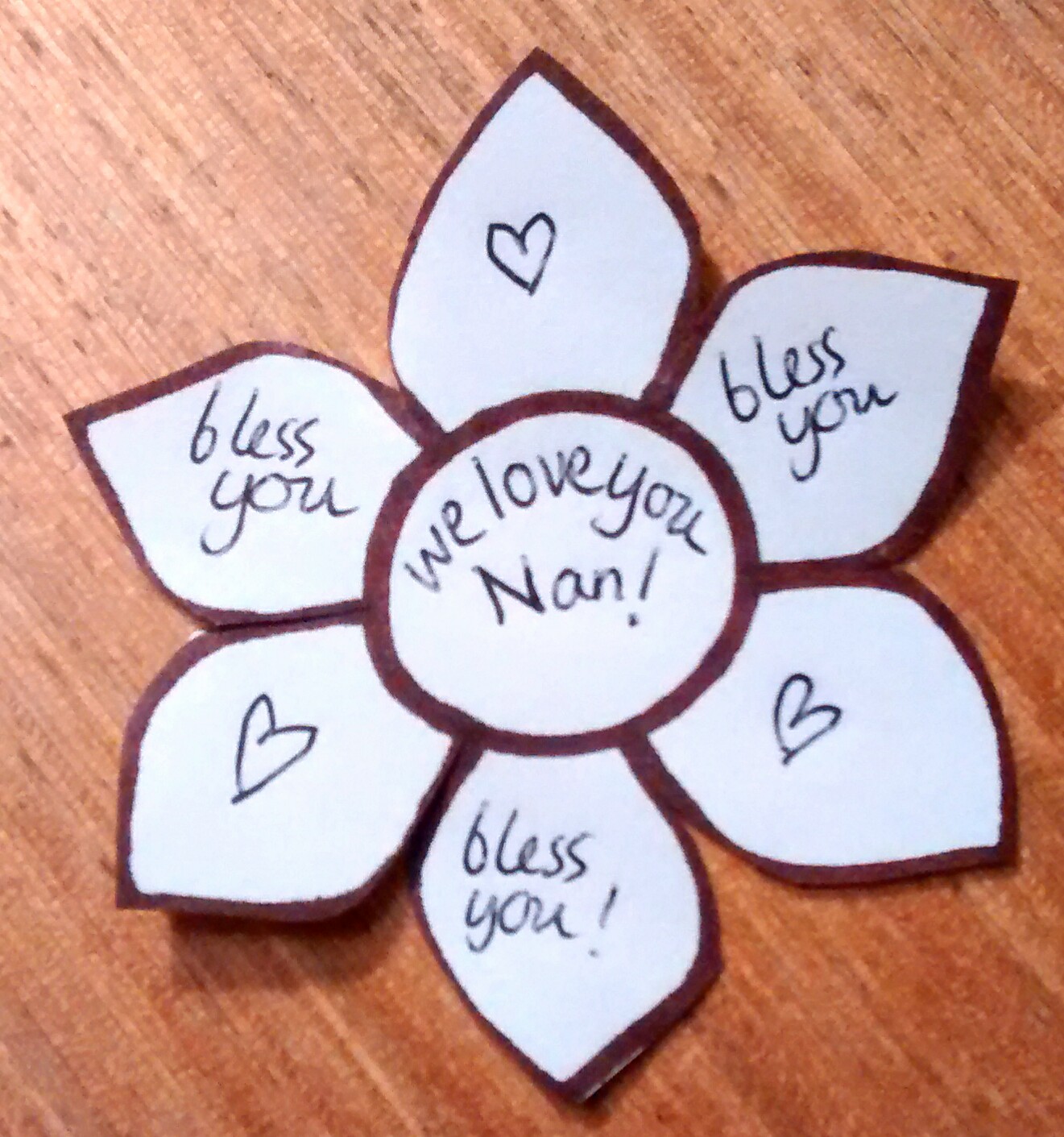
then fold the petals in, and float it on water- and watch them open:


The posies
 Who gets them? Just mums? All women? Just parents? Everyone? It’s one of the recurring dilemmas of Mothering Sunday, so here are some funky ideas that neatly distract from having to answer the underlying question about who gets the posies:
1. Do enough posies so that there’s not only enough for everyone, but enough for spares that can be taken to the housebound, and make sure people know they can take one for their neighbours
2. Do enough posies so that people whose loved ones have died can have one to put on the grave
3. Suggest that for people whose mothers live far away and aren’t going to be visited on the day, the flowers from the posie might be dried in a flower press, and stuck to a card and posted!
4. Offer daffodil bulbs as an alternative, so that they can be grown at home and given to geographically distant mums at the next visit.
5. Take a collection to buy a gift from www.presentaid.org – there are sections related to ‘green fingers’ and to children, either of which might be a suitable alternative to giving flowers on mothering Sunday.
 6. Give out sunflower seeds, with spare packets available for people to take to their neighbours, to start a community sunflower festival – pick a date later in the year when the sunflowers will have all grown, and invite everyone back for a special service.
7. Here’s a radical idea: what if someone in each church in the whole country offered to be the local contact point for people who live a long way away but who love it if someone local would visit the grave of a loved one on their behalf on Mothering Sunday and place some flowers there?
Two hymns for Mothering Sunday
All our blessings
Tune: All things bright and beautiful
All our blessings, all our joys
With thankful hearts we sing,
God of love and faithfulness,
Accept the praise we bring.
For parents and for children,
For partners and for friends,
For those whose care enfolds us
With love that never ends.
For fellowship and friendship
For all we have to give,
For those who’ve shared our journey
And taught us how to live.
For all who’ve shared our sorrow,
Walked with us in our pain,
Who’ve held our hand through darkness
And showed us light again.
In sacrifice and service
Your love is clearly shown,
Your outstretched arms embrace us
to bring us safely home.
For those who give us life and breath
Tune: O Waly Waly
For those who gave us life and breath,
For love that’s stronger far than death,
Today we bring our thankful hearts,
For all a mothering love imparts.
For kindness, patience, warmth and care,
For each embrace, each smile, each tear,
Each word of peace, each healing touch,
These simple gifts which mean so much.
We look to you, our mothering Lord,
Who shows love’s cost, and love’s reward,
Your passion fiercer than the grave,
Nailed to the world you came to save.
So teach your people how to live,
How to endure, how to forgive,
Teach us to trust, to sacrifice,
To share the love that has no price.

 reverendally.org