
Bible Sunday 2016

Sermon for St John’s Hills Road, Cambridge
Bible Sunday, 2016

Many years ago as I was planning an All Age service for Bible Sunday I lamented to a colleague that there weren’t many hymns about the Bible. The Colleague rightly pointed out that this was because hymns are songs of worship, and we don’t, in fact, worship the Bible as the written word, but rather the Living Word of God, Jesus Christ. There still aren’t many decent hymns about the Bible, for that very reason.

When the gospel is read in some churches, the reader kisses the gospel book – this is something I do, in fact, as you probably noticed – I don’t know if you’re used to he here or not. But what does that mean?  Why do it?  Am I really kissing a book – an object – print on paper, with a nice binding?  What if I’d printed out the reading and ended up kissing just the bit of paper from my printer, as I said, ‘This is the gospel of the Lord’? Or what if I’d been reading off an ipad?  Surrounded as we are by beautiful bibles of every kind, and with means to ‘read, mark, learn and inwardly digest them’ this is an interesting question. When we say ‘this is the gospel of the Lord’, what is, in fact, ‘this’?  We’ll come back to this question a little later.

Our gospel reading tells of Jesus reading from Isaiah, and telling the gathered faithful that today those words come true – he’s going to show them what the words look like in real life. What an amazing thing to hear. ‘Today this comes true.’ ‘Today you find out what the word of God looks like in action.’ It’s Jesus’ manifesto in which he connects the words of the scroll with his own identity as the living Word of God.

Let’s look more closely at what’s there. What is is that Jesus promises to bring to life?  The Isaiah passage speaks of freedom and wholeness and good news….

And only three chapters later, we hear him again refer to the same passage about his ministry:

This word about him spread throughout Judea and all the surrounding country.  The disciples of John reported all these things to him. So John summoned two of his disciples and sent them to the Lord to ask, ‘Are you the one who is to come, or are we to wait for another?’ When the men had come to him, they said, ‘John the Baptist has sent us to you to ask, “Are you the one who is to come, or are we to wait for another?”’ Jesus had just then cured many people of diseases, plagues, and evil spirits, and had given sight to many who were blind. And he answered them, ‘Go and tell John what you have seen and heard: the blind receive their sight, the lame walk, the lepers are cleansed, the deaf hear, the dead are raised, the poor have good news brought to them. And blessed is anyone who takes no offence at me.’

We need not  stick just to Luke 4 – there are plenty of other places where we are given challenging manifestos – blueprints, in word form, of what the heart of the gospel looks like when it’s lived out, and which we can see in the life of Christ, and then in the life of he saints through the ages. We might think of the beatitudes, the ten commandments, the summary of the law, the parables, even the Lord’s Prayer… so much of scripture consists of words that are to be lived. There might be some words that you have found to be formative on your journey of faith, words that you’ve gone back to again and again as you’ve worked out what being a Christian means not just in church but in daily life.

You’re welcome to make your own suggestions…

You might want to pick just one from all these and focus on how you will live it today, this week, this month… how will it form you, change you?

Now look back at Luke 4, at the very beginning of the quotation from Isaiah: The Spirit of the Lord is upon me… It’s the Holy Spirit who brings the words on the page to life in our lives.  The breath that gives voice to the word, as at creation. The breath that makes us come alive, and live as people of God.

The ‘this’ that is the gospel of the Lord, isn’t the physical object the page itself – though we do quite rightly treat the bible with reverence and respect – nor is it even the content, the words on the page. It’s more as if the gospel resides in the proclaiming and hearing of it – the way that it’s spoken aloud and heard, in public, so that we become like the crowds who first heard the words of Christ and saw him put them into action, the way that the Spirit inspires the proclamation, moves through and informs the hearing, and empowers the doing of the word. The gospel, ‘this’, is the contemporary living out of the words on the page, as the Spirit gives us power. This is how the word of God is ‘living and active’ – constant, and yet always fresh, always being made incarnate in the lives of God’s people.

So as you look at the bibles on display around the church today, don’t just look on them as objects – think of the fingers that have turned those pages, the eyes that have read them, the voices that have read them aloud… all the people who, through the generations have been been shaped and formed through their encounters with Christ in scripture, who have connected their story with God’s story, and lived the gospel.

This is how we are the body of Christ on earth. As Once the prophets Jeremiah and Ezekiel ate the scrolls on which the word of God was written, so we, in the words of the collect, ‘inwardly digest’ the Word of God, through our reading, our hearing, our speaking, and indeed through our receiving of the bread and wine, as we ‘become what we eat’ and become the good news that God is sharing with the world.
The Good Samaritan

Maybe I am doing him a disservice, but the lawyer reminds me of one of those people who ask a question to which they already know the answer, so that they can demonstrate their expertise. He knows the right words to say, he correct formula, but he’s clearly struggling with the implications. He’s not quite grasping the all-encompassing nature of love. To attempt a definition of ‘neighbour’ is almost certainly to try to limit the sense of obligation and accountability and generosity that the Summary of the Law implies. Love has no limits, and the lawyer hasn’t really grasped that yet. Hence the story that follows.

But the story is all wrong.

Most people, when they hear a story, will gravitate to the first or main character, and assume, subconsciously that this is ‘someone like us’. Straight away we are wrong footed, because the person with whom we have begun to identify, albeit only briefly, turns out to be the victim and not the hero. His main role is to be beaten and then lie, passively, in the gutter, at the mercy, or lack of mercy, of whoever may see him.

We’d like the victim to be someone else. Secretly, we’d probably prefer it if the victim is ‘not like us’. The foreigner, the low-class outcast, the Samaritan – that’s who ought to be the victim, so that we can be the hero. We can do our charitable bit, reach down from our uprightness and respectability, and help those less fortunate than ourselves. And there’s nothing wrong with this. It’s one of the things that makes societies work.

But if we’re the ones in the gutter, it’s much less comfortable, much less satisfying. Lying there, beaten, who do we want to come to our aid?  I remember once at theological college, I had just recovered from flu, and for some stupid reason I had decided to go for a run before morning prayer. It didn’t go well. Almost at the end of the service, I started feeling woozy, and tried to leave discreetly – I got half way to the back of chapel and then passed out. I remember coming to and hearing a particular person (whom I will not name) saying, loudly, ‘Don’t worry, I know first aid!’ and thinking, to my shame, ‘Oh no, anyone but you!’

Receiving help is not easy. Depending on the charity of others is not easy. It makes us vulnerable, it can chip away at our pride and self-respect, especially when have to look up from the gutter at those who are helping us from their position of benevolent power – a position that really should be ours…. Who would it be hardest to accept from, right now? We might all give a different answer, but each of our answers challenges us, through this best known of gospel stories.

And the end of the story is wrong too. Jesus’ closing question turns the definitions around. ‘Who is my neighbour?’ at the start is a question that assumes that we are strong ones, and the neighbour is someone who, in their weakness, needs our charity. ‘Who was a neighbour to him?’ assumes that the neighbour is not the victim but the saviour, the one who gives the love.

So, when Jesus says, ‘Go and do likewise’ he is telling us to get up from our gutter, where we had unexpectedly and uncomfortably found ourselves, and go and be the Samaritan, go and be the outcast, the low-life, the one who stopped and helped because he knows what it’s like to be at the bottom of the heap. ‘Go and do likewise’ Jesus says, ‘remembering that you, too, are dust, that you, too, come from the gutter.’

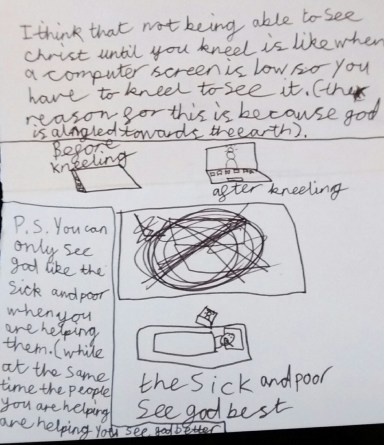
Christological laptop.jpgMy son, who is nine, came up with an interesting theory about this a few months ago. He noticed that he can only see what’s on his laptop screen when he looks straight at it – if it’s tilted at the wrong angle, the image distorts and then disappears. He said to me: ‘It’s like God is the image on a laptop screen, and the screen is tilted downwards.  You can only see God if you’re really low down. Like if you’re ill. Or if you’re not very important. The people who can see God most clearly are the ones who are right at ground level, not the people who can stand upright. So, if we want to see God clearly, we need to get down on the level of the people who are ill, or poor, or not very important. Helping people where they are is how we are most close to God.’


And he’s right, of course. If we really do get down on our hands and knees, as it were, and come alongside others in their hour of need, we are likely to find Christ already there. But if we look down from above, we’ll see no clearer.

The responses to some of the recent terrorist and other attacks around the world express this sense of solidarity rather clearly. It started with “Je suis Charlie” in the aftermath of the attack on the Charlie Hebdo offices in Paris. And it has continued, more recently in Carol Ann Duffy’s poem, Gay Love, which you may have seen, in response to the murder of 49 people in a gay nightclub in Orlando. This, too, expressed the sort of solidarity that St Paul hinted at in 1 Corinthians 12: ‘When one member suffers, the whole body suffers’.  This is the sort of solidarity, when words flow into loving action, that points to the fundamental truth at the heart of the Summary of the law: Love your neighbour. Be that neighbour. Be loved by that neighbour. These are all one command: mutual, reciprocal, humble, generous, joyful. The sort of love that allows help to be given and received without condescension.  The love that rejects the pursuit of power, the preservation of hierarchies, and instead basks in the belovedness that we all have in God, which underpins all our own giving and receiving  and invites us to see one another, to love one another, and indeed, to love ourselves, as God loves us.

In the nation at the moment, the question ‘who is my neighbour’ confronts us constantly. It is being asked in our local communities, in the news media, in the political arena, and implicitly in our awareness of the very many challenges that we face in our current political and social turmoil.  We need the story of the Good Samaritan, together with the Summary of the Law, now more than ever, to teach us afresh what is means to be children of the same heavenly Father, builders of his kingdom on earth – a community of people who need each other. It’s been wonderful to see the grassroots movements that have been springing up in the last few days: #loveyourneighbour and #movementoflove spring to mind, encouraging ordinary people to go the extra mile for one another, in ordinary and extraordinary ways. The challenge is great, and the story is exactly what’s required, though it may be hard to hear it, and harder still to live it out – but there is no greater command than this: that we love God with our whole being, and love our neighbour as ourselves. mollogo

Easter Hymns

Here are the three Easter hymns that I have written, conveniently copied into one post so you can find them easily.

Easter Morning hymn
The tune is Praise my soul / Lauda anima.

Early, while the world was sleeping,
to the garden Mary came;
lost in lonely grief, still weeping
till in love you spoke her name.
Alleluia, alleluia
Nothing now can be the same.

See, the sunlight, slowly dawning
overwhelms the shades of night,
welcoming this glorious morning,
rising with the Light of Light.
Alleluia, alleluia,
Death and darkness put to flight.

Trusted as the first apostle,
Mary swiftly made her way;
bearing this, the Easter gospel
to a world in disarray.
Alleluia, alleluia,
Good news for the earth today.

Risen Jesus, come and greet us:
Speak our name, we are your own;
In your generous love you meet us:
in our lives that love is shown.
Alleluia, alleluia,
Resurrection life made known.


Eastertide hymn
This one is based on the various encounters that the disciples had with the risen Jesus. It is designed to mirror the Epiphany hymn, ‘Songs of thankfulness and praise’, attempting to capture the lectionary stories of the season, so you’d sing it to whatever tune you use for that.  

Life comes to an upper room,
breaking through the fear and gloom;
walls and door-locks are no bar:
Jesus meets us where we are.
Life dispels the doubt of grief
bringing hope and new belief;
touching scars – these signs of pain
bring us back to life again.

Life comes to a broken heart,
bowed by sorrow, torn apart;
in the darkness of our tears
Jesus speaks to calm our fears.
On our journey life comes home,
in this fellowship made known;
with Christ’s body we are fed:
life revealed in broken bread.

Life comes to a sunlit shore,
sharing food with friends once more;
Fresh new callings banish guilt,
hope and faith and love rebuilt.
Jesus’ vict’ry over death
brings new life with every breath,
to the world it’s freely giv’n,
reconciling earth with heav’n.


A song of Moses and Miriam
A metrical version of the canticle usually used at the Easter Vigil
Tune: Kingsfold (the second part of the tune should be used for the doxology)

O sing aloud to God our strength
whose glory conquers all,
His mighty power has raised us up~
While horse and rider fall.
We sing in worship, for to God
All praise and thanks belong,
Our voices raise the melody
Of our salvation’s song.

This is our God, whom we exalt
Until the world shall end;
The Lord who saved our fathers will
To us his love extend.
He did not leave us in our plight
But to the rescue came,
Our strong defender in the fight,
Jehovah is his name.

His powerful hand has been our shield
And glorious is his might,
And all the hosts of evil now
are shattered at the sight.
The breath divine that gave us life
The mighty flood sets free,
And so the water’s swirling rage
Devours our enemy.

Almighty is the power of God,
His love will never end,
He has redeemed us, set us free,
and leads us by the hand.
And now he brings us to that place
Where we may dwell secure,
The holy house of God shall be
Our haven evermore.

All glory be to God on high,
The Father, Spirit, Son,
To whom we raise the melody
Of our salvation’s song.


Lent doodle: The Table of the Lord

This is a little picture I’ve been toying with for a while. It’s called The Hospitality of Abraham’s Children and is my take on the famous Rublev icon of the Trinity (aka The Hospitality of Abraham). It’s in response to the Images of the Church Lent activity, number 8, The Table of the Lord.

I’m not very good at drawing people, so bear with the quality and enjoy the idea!

table


Lent Doodles: Fish

Here’s my second Lent doodle.  The idea here is that the fish all fit together precisely because they’re not the same as each other. In fact, some of the fish are downright weird looking and a little mis-shapen. But if they weren’t they wouldn’t fit in here, and more importantly, they’d be stopping other fish from fitting in.

Fish