
Teach us to pray…

Some sermony thoughts on Luke 11.1-13

I’ve always found the parable of the persistent neighbour rather troubling. Our habit is to map parables onto the real world – us and God – as an exact one to one allegory, and in this case, that would cast God as the grudging friend with his own family safely behind a locked door who only responds to nagging.

This can’t be right, and setting the parable alongside the teaching of the Lords prayer helps us unpick it a bit.

The first thing to notice is that the late night request for bread isn’t out of the blue. The two are friends – they have an ongoing relationship, and there is probably more to that relationship than asking favours of each other. If the friendship in the story is supposed to tell us something about our relationship with God: relationship with God is not purely transactional, a series of favours being asked and granted. We go to God with praise, with our deepest desires and concerns about the world, with our basic needs, with our guilt and our bitterness, and our fear of the evil that others may do do us, or that we may do ourselves. In fact, all the things that the Lord’s Prayer describes, and which we can find unfolded both in our worship (try it, you’ll see what I mean) and in our daily lives.

The second thing to notice is the key phrase towards the end of the reading: ‘How much more…?’  What God does for us is more than we can expect from a human relationship. And the imagery switches back from the friendship model to the parent-child model, indicating perhaps that this is a closer comparison.  Jesus invites us to call God ‘Abba’ – an intimate, unguarded term, reassuring us that we are not randomly demanding neighbours banging on God’s door at midnight, but rather we are (or we can be) the children tucked up safely in the bed.

The friends/neighbours vs family issue here reminds me very much of the phrase ‘children of Abraham’ that appears a few times in the gospels. At the time of Abraham, God was experienced as the family God, and Jesus’ own contemporaries placed huge significance on their heritage as part of the family that God promised to Abraham would be more numerous than the stars in the sky and the grains of sand in the desert. And yet we can also read in the gospel that, ‘God can raise up children of Abraham from these stones’.  This story too, invites us to work out where we are in relation to God, and to reflect on our identity as children of God, members of God’s household, and all that that means, and all that might get in the way of that.

One of the things that that means becomes apparent if we let go of the one-to-one mapping of the parable, and instead mix things up a bit. What if the comparison is not so much that we can extrapolate who God is not by saying ‘God is like us in this story, but better?’ What if, instead, we say, ‘Our neighbourliness and our relationships must be modeled on God our heavenly Father, and what we know of God from the testimony of scripture and the life of Christ?’  What would it mean if we looked at the story not from the point of view of the neighbour knocking on the door, waiting for our prayers to be answered? What if we approached the story as the children in the bed, who, hopefully, take after their parent, and who know that their heavenly Father is a generous God, and that there is enough bread in the house to feed many neighbours and travellers?

Would we, on behalf of our Father, climb out of the bed and open the door, and offer God’s hospitality?  Of the many wise things Pope Francis has said, one of my favourites is this:
“You pray for the hungry. Then you feed the hungry. That’s how prayer works.”
 

The Good Samaritan

Maybe I am doing him a disservice, but the lawyer reminds me of one of those people who ask a question to which they already know the answer, so that they can demonstrate their expertise. He knows the right words to say, he correct formula, but he’s clearly struggling with the implications. He’s not quite grasping the all-encompassing nature of love. To attempt a definition of ‘neighbour’ is almost certainly to try to limit the sense of obligation and accountability and generosity that the Summary of the Law implies. Love has no limits, and the lawyer hasn’t really grasped that yet. Hence the story that follows.

But the story is all wrong.

Most people, when they hear a story, will gravitate to the first or main character, and assume, subconsciously that this is ‘someone like us’. Straight away we are wrong footed, because the person with whom we have begun to identify, albeit only briefly, turns out to be the victim and not the hero. His main role is to be beaten and then lie, passively, in the gutter, at the mercy, or lack of mercy, of whoever may see him.

We’d like the victim to be someone else. Secretly, we’d probably prefer it if the victim is ‘not like us’. The foreigner, the low-class outcast, the Samaritan – that’s who ought to be the victim, so that we can be the hero. We can do our charitable bit, reach down from our uprightness and respectability, and help those less fortunate than ourselves. And there’s nothing wrong with this. It’s one of the things that makes societies work.

But if we’re the ones in the gutter, it’s much less comfortable, much less satisfying. Lying there, beaten, who do we want to come to our aid?  I remember once at theological college, I had just recovered from flu, and for some stupid reason I had decided to go for a run before morning prayer. It didn’t go well. Almost at the end of the service, I started feeling woozy, and tried to leave discreetly – I got half way to the back of chapel and then passed out. I remember coming to and hearing a particular person (whom I will not name) saying, loudly, ‘Don’t worry, I know first aid!’ and thinking, to my shame, ‘Oh no, anyone but you!’

Receiving help is not easy. Depending on the charity of others is not easy. It makes us vulnerable, it can chip away at our pride and self-respect, especially when have to look up from the gutter at those who are helping us from their position of benevolent power – a position that really should be ours…. Who would it be hardest to accept from, right now? We might all give a different answer, but each of our answers challenges us, through this best known of gospel stories.

And the end of the story is wrong too. Jesus’ closing question turns the definitions around. ‘Who is my neighbour?’ at the start is a question that assumes that we are strong ones, and the neighbour is someone who, in their weakness, needs our charity. ‘Who was a neighbour to him?’ assumes that the neighbour is not the victim but the saviour, the one who gives the love.

So, when Jesus says, ‘Go and do likewise’ he is telling us to get up from our gutter, where we had unexpectedly and uncomfortably found ourselves, and go and be the Samaritan, go and be the outcast, the low-life, the one who stopped and helped because he knows what it’s like to be at the bottom of the heap. ‘Go and do likewise’ Jesus says, ‘remembering that you, too, are dust, that you, too, come from the gutter.’

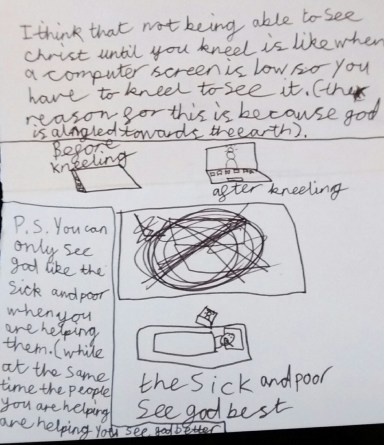
Christological laptop.jpgMy son, who is nine, came up with an interesting theory about this a few months ago. He noticed that he can only see what’s on his laptop screen when he looks straight at it – if it’s tilted at the wrong angle, the image distorts and then disappears. He said to me: ‘It’s like God is the image on a laptop screen, and the screen is tilted downwards.  You can only see God if you’re really low down. Like if you’re ill. Or if you’re not very important. The people who can see God most clearly are the ones who are right at ground level, not the people who can stand upright. So, if we want to see God clearly, we need to get down on the level of the people who are ill, or poor, or not very important. Helping people where they are is how we are most close to God.’

And he’s right, of course. If we really do get down on our hands and knees, as it were, and come alongside others in their hour of need, we are likely to find Christ already there. But if we look down from above, we’ll see no clearer.

The responses to some of the recent terrorist and other attacks around the world express this sense of solidarity rather clearly. It started with “Je suis Charlie” in the aftermath of the attack on the Charlie Hebdo offices in Paris. And it has continued, more recently in Carol Ann Duffy’s poem, Gay Love, which you may have seen, in response to the murder of 49 people in a gay nightclub in Orlando. This, too, expressed the sort of solidarity that St Paul hinted at in 1 Corinthians 12: ‘When one member suffers, the whole body suffers’.  This is the sort of solidarity, when words flow into loving action, that points to the fundamental truth at the heart of the Summary of the law: Love your neighbour. Be that neighbour. Be loved by that neighbour. These are all one command: mutual, reciprocal, humble, generous, joyful. The sort of love that allows help to be given and received without condescension.  The love that rejects the pursuit of power, the preservation of hierarchies, and instead basks in the belovedness that we all have in God, which underpins all our own giving and receiving  and invites us to see one another, to love one another, and indeed, to love ourselves, as God loves us.

In the nation at the moment, the question ‘who is my neighbour’ confronts us constantly. It is being asked in our local communities, in the news media, in the political arena, and implicitly in our awareness of the very many challenges that we face in our current political and social turmoil.  We need the story of the Good Samaritan, together with the Summary of the Law, now more than ever, to teach us afresh what is means to be children of the same heavenly Father, builders of his kingdom on earth – a community of people who need each other. It’s been wonderful to see the grassroots movements that have been springing up in the last few days: #loveyourneighbour and #movementoflove spring to mind, encouraging ordinary people to go the extra mile for one another, in ordinary and extraordinary ways. The challenge is great, and the story is exactly what’s required, though it may be hard to hear it, and harder still to live it out – but there is no greater command than this: that we love God with our whole being, and love our neighbour as ourselves. mollogo

Is ‘none’ really a thing?

This is my sermon for Pembroke College Chapel, 29th May 2016.
It is based on 1 Kings 8.22-23,41-43, 
Psalm 96.1-9, & Luke 7.1-10.
See also this excellent post by Stephen Cherry, and this Guardian article responding to the British Social Attitudes Survey.

If you’ve been keeping any kind of eye on the media recently, you will probably have seen something about the church – and religion generally – being in freefall, with more people now self-identifying as being of ‘no religion’ than as belonging all of the Christian denominations put together.

You can do all sorts of things with surveys – and much depends on what, exactly, is being asked, how the question is phrased, what options are given, and so on. There are certainly various narratives out there that ‘religion’ causes conflict, that ‘spirituality’ is what we share as human beings; that ‘religion’ demands adherence either to things that are impossible to believe, or to norms of behaviour that we no longer believe represent the fullness of human flourishing, while ‘spirituality’ allows each person to find within themselves the path that leads them to becoming who they want to be.

Meanwhile, however, a lot more people are, in fact, coming to church than British Social Attitudes survey would suggest. They may not be coming as part of a regular Sunday morning committed congregation, whatever that means, but they are coming: 200,000 people a year attend a Church of England christening service, and many more may brush up against ‘religion’ at a wedding or funeral. They visit cathedrals and parish churches (when the door is left unlocked).  Chapels, churches and Cathedrals have, in many cases, a several-hundred-year long track record of standing firm through the changes and chances of the life of local families, of whole communities, and indeed of the nation itself. There is something here that taps into a sense of connectedness with the past (think of the massive increase in interest in tracing family history).  When people speak of a ‘thin’ place, this is often what they mean. These are places that allow us to brush up against something bigger than any of us, and nothing in the survey suggests that this is on the wane. These places say, God is here. Not somewhere out there, but here, among his people.

There is something of this in our reading from 1 Kings. Solomon built the Temple, because he wanted a place where the Ark of the Covenant could have a permanent home, as a powerful symbol of God’s presence with his people, and his blessing upon them.

But the trouble with building temples – or churches, or chapels or cathedrals, for that matter – is that they usually have walls. And walls mean you know whether you are on the inside or the outside. If God is here, then there is a danger in inferring that God is only here. There is a danger that the particular signs of God’s presence, be they a temple, an ark, or a chapel, become so particular that they lose their identity as a sign of something universal.

My children, when they were little, helped me think this one through. They used to take great delight in asking me, at length, ‘If God is everywhere, is God in this dirty coffee cup? Is God in this sofa cushion? Is God in this mud on my trainers?’  And so on. Eventually, in desperation, I said to them, ‘No, it’s the other way round. God is not ‘in’ these things. These things are ‘in’ God, because the whole of creation is ‘in God’.  And some of the things that there are in the world are ‘in’ God in such a particular and remarkable way that they allow us to glimpse something of who God is.’ Astonishingly, the explanation worked.  But the conversation stayed with me.

If God is not in the chapel or the Temple, but the chapel and the Temple are both in God, then it is hardly surprising that what the Social Attitude Survey reveals by its silence is the massive extent to which God is at work in all the other things that are, by virtue of their createdness, also ‘in God’, even though they don’t have the label ‘religion’ on them.  For God is, I believe, not only present but active in the whole of creation, and most certainly in the minds and hearts and souls of those who ticked ‘none’ on the survey.  At the simplest level, people pray. My experience has been that there is a heck of a lot of prayer going on outside the church walls – and no survey can ever measure how that works and why it still happens if we’re all supposed to be turning secular.  People pray, and God hears.

This is what Solomon almost understands when he prays in our reading, that the prayers of the foreigner will be heard just as the prayers of the chosen people are heard. This is a moment – an early moment – in a gradual shift in theology, from ‘my family’s God’ through ‘my tribe’s God’ to ‘my nation’s God’ (who is undoubtedly better and bigger than your nation’s God, by the way) all the way through to The God – the end result of this shift is technically known as monotheism.

Once we are aware of God as The God we lose our proprietary claims. It is no accident that the ‘growth’ of God, for want of a better way of putting it, from one tribal God among many to out and out monotheism went hand in hand with a renewed growth in appreciation for the natural world. If God is The Lord, rather than just A Lord then this must be the one who created everything, really everything, the whole universe. So the Bible starts to present to us world of sea monsters and stars and planets and leviathans and distant peoples, all of which become crucial for understanding our own place in God’s affections and purposes.

Universalism, as Solomon almost states it, demands, then, a level of humility that the People of God have often struggled with, it is fair to say, over the last few thousand years. It is a level of humility that says, along with the Centurion in our gospel reading, ‘I am not worthy’ while at the same time declaring with all its might that ‘I am worthy’, but only because we are all worthy. Even the outsider, even the sick slave, even the foreigner who might come and pray in our holy place.

What is going on here is the acknowledgement that if the whole of creation is in God, then there can be no outside. So there can be no outsiders. Because none are uniquely worthy, all are worthy. Equally so. Universalism becomes then not a cop out, but a demanding, difficult process of working towards that unity and equality that is at the heart of our acknowledgement of who God is. What we need most at the moment is a global community that transcends self-interest and tribalism, and seeks instead the restoration of humanity, and indeed of the whole of creation, the very creation that the psalmist hears praising the God of everything.

So, when we talk of ‘spirituality’ (with or without religion) we must be sure that we do not dismiss it lightly; that we are talking about something that goes deeper than subjective feelings, deeper than self-fulfilment or self-expression.  It has to hear and respond to the charge that, in Mandela’s words, to be free, we must not merely cast off our own chains, but also live in such a way that respects and enhances the freedom of others. It must draw deeply from the rich traditions that we have inherited, learn from that history’s mistakes, and renew its accountability now and in the future to the creation in which we have a particular role and vocation.  This is a fully engaged*, ethical, demanding, accountable spirituality that the world – and the church – needs more than anything. Call it spirituality, call it religion, call it ‘none’, but know that the world needs it. Now more than ever.

AMEN

*Thank you to Stephen Cherry for this insight.

Silence

Ely Cathedral, 28th February 

As soon as you walk out of the chilly evening air through the West door,
you know that something is about to begin.
The pool of light in the Octagon draws you closer,
and you walk the length of the darkened nave,
your quiet footfalls on the stone floor.

As you approach the light,
you see that there are others sitting, waiting,
and you pause, wondering…
The air of expectation is palpable.
It’s then you notice that the lit space in front of you is not empty:
there are people standing, forty of them,
in a loose circle around the octagon,
each of them holding what look like a broadsheet newspaper.
Some kind of performance – but what?

Intrigued, you draw closer – almost afraid to come into the light,
and stop just short, taking a seat behind the nearest performer,
and you can just make out what she is holding:
it is no newspaper, it is music,
forty staves, most of them blank and empty,
with just a handful of dots floating among the top few lines,
as if they are yet to succumb to gravity.

As you sit the silence becomes so intense you can almost hear your own heartbeat.
It’s the silence of the Spirit of God sweeping over the deep,
before the universe is spoken into being.
The potential, of all that might be,
and is not yet.

You hardly dare breathe.

And then, into the silence, comes a single voice,
joined by another, and another, like an echo:
Spem in alium’ they sing to one another.
Spem in aliumall my hope on God is founded.
The Spirit moving over the face of the deep
gives breath to the dawning universe,
and it speaks its first word,
sings its first song.

The music grows.
The singer in front of you turns a page,
and the you see the notes falling further down through the lines of music,
like raindrops down a window pane.

You risk a glance around the circle of singers
– the sound has swelled and fills the space,
but still not all are singing.
On the vast sheet of music that those last few lines are still empty.
There they are – the singers who have yet to sing a note.
Are they waiting, perhaps as you were waiting, before it all began?
But watching  them, you see that their silence is active, attentive,
hanging on every pulse of every bar.
It is their silence that allows the others to be heard.
It is their silence that gives hospitality to each new voice,
each soaring phrase that belongs to another.
It is the silence of listening, the silence of generous give and take.
It is the silence of the forgotten people of God
– the women and men whose stories were never told,
and yet whose very presence has hosted the story of salvation.

As you listen to the music ebb and flow, and swell and grow,
your own silence joins the performance,
you feel your own heart start to beat in time with the collective pulse,
you breathe with the arc of each new phrase.
Your silent listening gives a voice to hope, to beauty, to the praise of God.

And so the music flows, and grows, until all forty voices sing,
each line unique, the sound intense and complex
– tiny phrases escape like tendrils of flame caught in echo,
before the music subsides a little, only to build again
into a near-cacophony of disparate voices.

Then suddenly, there’s a single beat of silence when all forty singers breathe as one.
It’s not the silence of potential, nor of generous hospitality,
but a silence that enables common purpose,
a silence that draws many voices into one voice,
the silence that says, ‘here we are, and here is God, with us:
spem in alium: my hope on God is founded’
but it is no longer my hope alone, our separate hope,
it is the hope of all humanity, and that is why we can sing – why we must sing.’
The silent breath is the silence of the Bethlehem hilltop
in the moment just before the angels sing their Gloria,
the silent breath that draws shepherds and magi alike
into the common song of all heaven touching earth.

The music goes on, the voices soar
and each new phrase flies upwards,
settling like doves in the high arches and carvings
of the lantern above you.

Amid the oscillating chords and echoes,
another sudden silence breaks the pattern,
and a startlingly different chord, as if from nowhere, takes us in a new direction,
snapping your attention from the lofty arches back to the ground.
This silence was less a gathering, a collective sigh,
and more an abrupt halt that allows the turning of a corner,
a choice, a new direction.
It is the silence of Elijah’s mountain,
the momentary retreat from the cacophony of warring factions
that lets him hear the still small voice of God speaking:
‘This is the way that you must go’ it says,
‘the way is hard, the path is new,
but take heart, and do this new thing that I am giving you’.
Without the silence, there could be no change,
no strange and striking chord,
no new revelation of God’s grace…

One final silence emerges from the sound, the longest of the three.
A long, long breath, a sigh.
It is almost the silence of Gethsemane, or even of the cross,
it is the silence into which Christ prays, ‘Thy will be done’,
the silence of obedient acceptance.
The choir breathes in: ‘Respice’ they sing,
‘respice’ – be mindful of us, O God, in our humility.
It is the silence when we take all that has gone before,
and place it into the hands of God.
It could be the silence of our own Gethsemane, our own cross.
It is the silence in which we see that we are not forsaken,
but that God is mindful of us,
and that, despite everything,
we are held.

All forty voices reach a final cadence,
and one last chord soaks slowly into the stone walls.
There should be a moment when the last sound is gone,
when one can say at last that ‘it is finished’.
But this silence speaks not of ending, but of beginning,
the anticipation palpable as before it all began.
It is the silence before applause,
before we all start to breathe and move again
and go our separate ways.

It is the silence of the first dark Easter morning,
the silence of the empty tomb,
before the resurrection was made known.
It is the silence into which God speaks your name,
and sends you from the garden, like Mary,
to share what you have heard.
It is the silence into which we speak our own Amen,
our own ‘thy will be done’ to all we’ve heard:
our excitement at creation and re-creation,
our willingness to change and grow,
our desire for the grace to listen generously and be heard joyfully.

O God, give us breath and speech,
that we might join with angels and archangels,
and echo the silent music of your praise.
Amen.

Crumbs

This is the rough gist of what I preached yesterday at Westcott. The text was Matthew 15.29-37.

There are many scriptural paradigms for what we do when we ‘do this’ in remembrance of Jesus, and each of them brings something distinct and valuable to the table, as it were. If we look only to the Last Supper, we miss out.

We can look at the parable banquets, with their slightly uneasy take on inclusion and exclusion; we can look to the barbeque on the beach and its focus on reconciliation and mission; we can look to the Emmaus Road and see the connection between understanding and recognition in the breaking open of the word and the breaking of bread; we can look to the other meals that Jesus shared – the hospitality of Martha and Mary, the prophetic action of the woman at the home of the Pharisee, the transformation of Zaccheus, and so many more that are not even recorded. Each of these stories brings something profound and vital to what we do when we share the bread and wine.

So what does this particular story – the feeding of the slightly less impressive four thousand – bring to this particular table, on this particular Wednesday evening, in this particular place?

Well, first it brings a connection between the sharing of bread and the ministry of healing – interestingly, there is no mention of Jesus telling any parables here, no teaching, no prophecy, exhortation, just a crowd of people who came with needs, and found those needs met in Jesus.  And maybe, at this stage in term, this is precisely what this story brings to the table for you: that we may come to Jesus for healing and for sustenance, and sometimes it’s OK to leave the learning for a while.

It also brings the compassion of Jesus to the fore. There is no Johannine talk here of spiritual bread, but instead a concern for the wellbeing of those who have gathered. ‘We must feed them or they may faint as they journey home’.  They came with needs, and had those needs met, and were given food for the journey.  We might speculate about whether any of them were among the 3000 Pentecost converts, but we will never know.

And where are we in this story?  Are we the 4000 random people who came once and went their way? Or are they the people we will go on to serve in ordinary parishes up and down the country, who come once and may never come again? Are we the 70 who were sent, or even the twelve? Either way, the story brings us one more crucial thing: Leftovers. It’s all about the leftovers.

Break a nice crusty loaf, and the crumbs get everywhere. That’s why you need a dog. Because if you are used to breaking bread, you’ll know that those crumbs have been destined for the dog since before the loaf was even baked.  Those crumbs belong to the dog.  Wouldn’t it be terrible if nothing ever fell from the table? If there were no scraps, no leftovers?

I would encourage you, then, to identify within yourself what it is you are receiving – healing, reconciliation, or whatever – and more importantly, what it is you have spare – your leftovers, once you have taken your fill. Because these are what you take with you when you leave here, these are the loaves that you continue to break and share. These are the loaves whose crumbs fall to the floor – crumbs which, in the purposes of God, already belong to someone and will be just the food they need.