A picture to go with today’s advent blog post:
“How beautiful are the feet of those who bring good news”
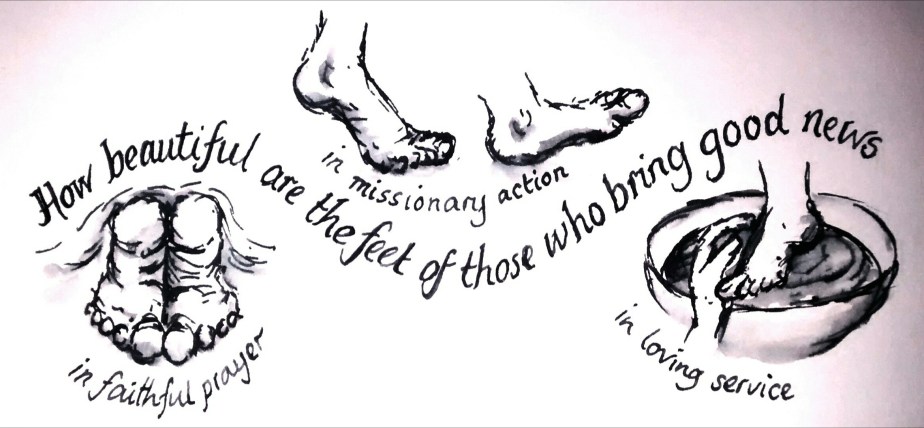

A picture to go with today’s advent blog post:
“How beautiful are the feet of those who bring good news”
‘How beautiful on the mountain are the feet of those who bring good news.’
 Feet are not, generally, all that beautiful. Especially those who have been walking extensively on mountains. Celebrating feast of St Andrew the Apostle, we celebrate that the good news is shared by the faithful walking of the way of discipleship and mission, and that beauty comes not from protecting ourselves from the damage that the world may inflict as we tread out path through it, but from our engagement with the world around us as we bring the love of God to those who do not yet know it.
On that basis, every wrinkle o n Mother Teresa’s face (and I’m sure her feet were just as wrinkled) was a mark of beauty, because they were the product of a lifetime of smiling God’s love on others.
The signs of our life’s journey can be traced on our own bodies and minds. The marks that mar our physical beauty can often be the very things that reveal the beauty of our actions – the sacrifices we have made, the ways that we have been hurt and healed, the burdens we have carried either for ourselves or others.
May we walk faithfully and courageously the path that God sets before us, so that all that makes our feet ugly also makes them beautiful.
This used to be a sonnet, but I’m no Malcom Guite, and before that it was a sermon. Anyway, it occurred to me that I could rewrite it as a hymn for the end of Advent, leading into Christmas. It could be sung to ‘Woodlands’ (Tell out my soul).
Genuinely would love to know if you think it works. And if you like it, you are welcome to use it!
Words of the prophets since the world began
So long before salvation’s human birth
Speaking of God’s tremendous loving plan
for heav’n to touch the long-estrangèd earth.
Those ancient words at last began to be
in flesh and skin and bone and blood unfurled
In maiden womb and half-made family –
so heaven stooped to touch a fallen world.
Amongst the stable beasts behind the inn,
the baby’s eyes saw first a mother’s love;
and though their world, like ours, was full of sin,
yet in their gaze the earth met heav’n above.
We cry aloud for peace, goodwill to all,
and for God’s heaven to touch his earth again,
We bend our ears to hear the angels’ call,
and raise our voice to join the great Amen.
Here’s an easy Christmas song for children to sing – I must have written it last year and forgotten about it. I’m posting it here in case it’s useful. The tune is ‘Here we go round the mulberry bush’.
Sing of the time the angel came, the angel came, the angel came,
Sing of the time the angel came to bring the news to Mary.
Sing of the birth at Bethlehem, at Bethlehem, at Bethlehem,
Sing of the birth at Bethlehem, the baby in the manger.
Sing of shepherds from the hills, from the hills, from the hills,
Sing of the shepherds from the hills, who came to worship Jesus.
Sing of the brightly shining star, the shining star, the shining star,
Sing of the brightly shining star, that led the kings to Jesus.
Sing of the love of God on earth, God on earth, God on earth,
Sing of the love of God on earth, that brings us close to heaven.
Bring us, O Lord God, at our last awakening
into the house and gate of heaven
to enter into that gate and dwell in that house,
where there shall be no darkness nor dazzling, but one equal light;
no noise nor silence, but one equal music;
no fears nor hopes, but one equal possession;
no ends nor beginnings, but one equal eternity;
in the habitations of thy glory and dominion, world without end. Amen.
So wrote the poet John Donne (1572-1631) in a vision for the ultimate reconciliation between God and God’s creation, especially his beloved and often wayward people. The poem speaks of a unity that we seek and long for, but may only catch a glimpse of in the here and now. So as we look forward to Christmas, when the birth of Jesus ‘draws us to kneel in wonder at heaven touching earth’, the season of Advent invites us to experience the reality of contrast and distance. Advent is a season of contrast: between light and darkness, hope and fear, now and not yet. It is the long night that takes us up to the moment just before dawn when everything is as dark and cold as it can be.
And yet, all through Advent we are invited to look for the ways in which God’s reconciliation is chipping away at the world’s hard-heartedness, the ways that the light of God is shining through the cracks in the world’s darkness. Some years it’s really easy to spot the darkness and hard-heartedness, and really hard to spot the light and the reconciliation. This is undoubtedly one of those years. But we must continue to look for the moments of redemption, and to contribute towards the making of more moments, that others may recognise them. For it is these moments, when we perceive them, that remind us that, against the odds, the trajectory of the relationship between earth and heaven is – ultimately – one of reconciliation.
May this season be for us and for the world a time for the power of God’s ultimate reconciliation to break into the conflict and darkness of our time.
 reverendally.org