I was playing over in my mind and reflecting again what my son said the other day about sacraments.
He was painting an abstract/symbolic picture of ‘a battle between warm and cold’. He’s always been very sensory, very huggy, and treats the warmth left behind by another person when they get up out of a sofa or out of bed as something to be treasured, almost revered, because for him, the person has left something of themselves there, of which warmth is the sign.
Anyway, he was painting his picture, and started to talk about how I was warm, and I pointed out that my hands and feet are often quite cold, but that I was warm inside.
He then said, ‘Yes, like a sacrament.’
We unpacked this a bit, and what he meant was that there is an inner warmth in a person you love and who loves you that is somewhere between spiritual and emotional, and that our outer bodily warmth is a sign of that, but not the thing itself. I said to him that that was pretty profound stuff. He said to me, ‘I didn’t make it up, you told me about it last year when I was doing communion preparation.’ As it happens, I do remember telling them about the classic definition of a sacrament as ‘an outward and visible sign of an inward and spiritual grace’ but I don’t remember applying it to people.
He went on to talk about how this works in holy communion:
‘When you drink the wine, and it feels warm when you swallow it, that’s the outward bit of the sacrament, and the inward bit is the warmth of love. That’s why you’re like a sacrament.’
He’s always felt very strongly that unless he’s had wine as well as a wafer, he hasn’t really taken communion properly, and now I know why – it seems from this conversation that, while for many of us, the idea of bread and wine as the body and blood of Christ can be almost ‘abstracted’ from the physical elements, for my son, in his multisensory spiritual world, it is the warmth of the wine, rather than the fact that it is red, or simply the idea of it, that enables it to function sacramentally.
He’s done this before, I now remember. Once when he was much younger, maybe four or five, he came running in from the garden with a big juicy strawberry in his little hand. He held it out to me, eyes like saucers, and said, ‘Mummy, I thought of you as I picked it. Eat it, mummy, can you taste the love?’
I realise that my son is unusually articulate about this kind of thing, but I’m also pretty confident that his experience is not unique. Time and time again in engaging with children (often much younger than my son) I am both inspired and challenged by the way that they can effortlessly and holistically engage mind, body and spirit in the processing of experience, and playfully hold together material and spiritual and emotional reality in a way that many adults find so hard.
Undoubtedly, children can do theology. To be honest, if often feels as if children are natural theologians, and their experience of church can either nurture that innate ability to experience the divine, or crush it. Lord, let my kids always be in a church that honours what they bring, that welcomes them to participate fully, and that engages with the senses as well as with the brain.


 The first time I saw a reproduction of Rembrandt’s portrayal of Simeon with the Christ child (the late one, not the earlier one) it immediately became my favourite painting. It has all the fuzziness and limited palette associated with the artist’s late works, as well as all of the spiritual and emotional depth – it is the work of an artist for whom physical sight and the detail of appearance has taken second place to the ability see with the eyes of his heart and soul.
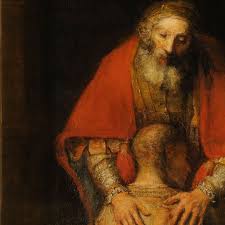 In this painting, just as in his portrayal of the Return of the Prodigal Son (also a late work, and also featuring what could almost be the same model for the figure of the old man), he is depicting someone who, like the artist himself, is also seeing with the eyes of the soul. When you look at Simeon’s face, you know, somehow, that he is blind, and yet it is he who sees the baby Jesus for who he really is. When you look on the prodigal’s father, you know that he is seeing not the wreck that the young man has become, but the son he truly is, and will be again.
 During his last years, Rembrandt returned several times to the project of painting self portraits. I often wonder whether in these two biblical old men he was somehow portraying himself, and whether, in all of these paintings, the self-portraits included, he was, in a way, learning to see himself with the eyes of the heart, and the soul, learning to see himself not in terms of his physical appearance, but in terms of who he truly was. Was he portraying, again and again, his true self, as he felt he was looked upon by God? And was he, then, in a very real sense, preparing for his own death?
 reverendally.org