Things pertaining to Christmas

Now it’s almost advent, here are some Christmassy things that might be worth sharing.

A simple Christmas carol to the tune of the Dance of the Sugar Plum Fairy:

Little baby, sweetly slumbering,
Cradled and cuddled in Mary’s loving arms.
In the sky are angels gathering,
but for now, here below, all is still and calm.

Little baby, our Emmanuel,
God with us, one of us, born to be our king.
Little baby, while you slumber,
Far above you angels sing.

We know you came to save us all…
But how can God become so small…?
For God so loved all he had made
He sent his Son the world to save……

Little baby…

An easy Christmas song for children to sing
The tune is ‘Here we go round the mulberry bush’.

Sing of the time the angel came, the angel came, the angel came,
Sing of the time the angel came to bring the news to Mary.

Sing of the birth at Bethlehem, at Bethlehem, at Bethlehem,
Sing of the birth at Bethlehem, the baby in the stable.

Sing of shepherds from the hills, from the hills, from the hills,
Sing of the shepherds from the hills, who came to worship Jesus.

Sing of the brightly shining star, the shining star, the shining star,
Sing of the brightly shining star, that led the kings to Jesus.

Sing of the love of God on earth, God on earth, God on earth,
Sing of the love of God on earth, that brings us close to heaven.


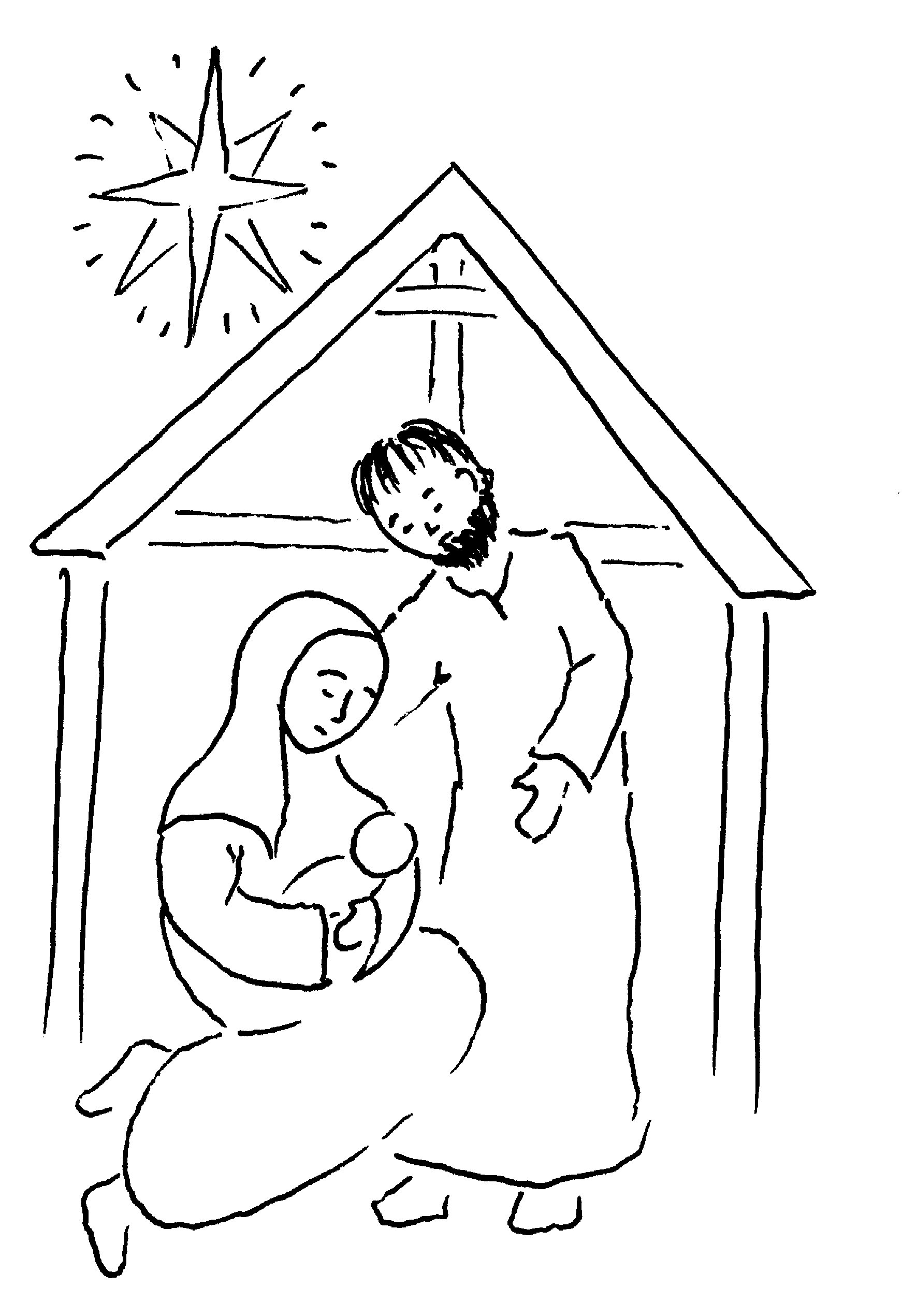
The easiest paper nativity scene ever – instructions and template


Some Christmassy pictures of Mary:


And some other general Christmas doodles / images:


wpid-DSC_1187.jpg
Some more clipart-y images:
advent wreath

annunciation   angel choir


christingle

euch-angels   euch-nativity

mother and child   people in church doorway   praying

DSC_1392         candle clipart


A not-very-good sonnet about Christmas:

Prophetic visions since the world began
(so long before salvation’s human birth)
would speak of God’s tremendous loving plan
for heav’n to touch the long-estrangèd earth.
Those ancient words at last began to be
in flesh and skin and bone and blood unfurled
In maiden womb and half-made family –
so heaven stooped to touch a fallen world.
Amongst the stable beasts behind the inn,
the baby’s eyes saw first a loving mother;
and even though their world was full of sin,
yet heav’n touched earth for each in one another.
Tonight we cry for peace, goodwill to men,
and for God’s heaven to touch his earth again.

And a couple of links to things I’ve come up with for Christingle: 

The original ‘Sparkly Christingle Talk’ (the one with the iron powder)

How to make a Christingle: some prayerful reflections

Looking slightly further ahead: 

The Epiphany Game

A Very Simple Epiphany Song (to the tune of Sing Hosanna)

A hymn about light (that might do for Epiphany if you really squint)

And a picture:


Christmas carol – Sugar Plum Fairy

This was written for a friend, who wanted a new carol to sing as part of a nativity play. It goes to the tune of the Dance of the Sugar Plum Fairy (from Tschaikovsky’s Nutcracker Suite). Nothing profound here, just something to meet a particular need.

Little baby, sweetly slumbering,
Cradled and cuddled in Mary’s loving arms.
In the sky are angels gathering,
but for now, here below, all is still and calm.

Little baby, our Emmanuel,
God with us, one of us, born to be our king.
Little baby, while you slumber,
Far above you angels sing.

We know you came to save us all…
But how can God become so small…?
For God so loved all he had made
He sent his Son the world to save……

Little baby…

A Hymn for St Catharine’s

I owe a huge debt of gratitude to St Catharine’s College, Cambridge for their vision and commitment to empowering young women through music (specifically, by means of their girls’ choir) which has enabled my daughter to have a first rate musical education and experience some things that I never had the chance to do at her age (or indeed ever!).
Here’s what I wrote for the College’s Commemoration of Benefactors service today. At the Director of Music’s request, the tune is chorale Schmucke Dich (usually sung to the words, Deck thyself, my soul, with gladness).

Solemn notes of tribute sounded:
Gratitude and celebration.
By such history surrounded:
Legacy of inspiration.
From that ground new growth is springing,
From those songs new voices singing;
Through each passing generation
Still our hope in God is founded.

All our life in wisdom growing,
God’s good purposes discerning;
Words and deeds of virtue flowing
Through the sacred gift of learning.
When the world seems lost to violence
Hope and love must break their silence,
Grace in human nature turning
To the truths that are worth knowing.

Blessings for our lifetime, lending
Grace for work and love and leisure,
Gladly spent, and gladly spending
all to find our heart’s true treasure.
Choice and chance unfold each story,
May our lives reflect God’s glory,
Then when time complete’s life’s measure
We may know a perfect ending.

The prodigal son

This is a way to tell the story of the prodigal son, using ribbons.
HEALTH WARNING: I’ve done this exercise with both with children and with adults, and it is quite powerful – essentially it’s psychodrama, and you should only do it if you’re confident about facilitating this kind of process. It’s always worth having people on standby for participants to talk to if it stirs up difficult emotions.
Begin with three people (representing the three characters in the story) standing in a triangle, each of them holding the end of a ribbon in their hands, so that the ribbons connect them to each other – ie the people are the corners of the triangle and the ribbons are the edges of the triangle.  I use really nice ribbon, and talk up how a loving relationship is something really precious and beautiful.
When we get to the bit about the younger son running off, I use a blunt pair of scissors to cut the ribbons connecting the younger son from the other two characters. I invite everyone to look at how the ends are raw and ragged, and how the father and the older son are left with the loose ends (and so is the younger son, though he is too busy having run to realise it!). When we get to the part about the younger son returning to his father, we hold up the two ends of the ribbon between those two characters, and look again at their frayed ends. We wonder about what it would take for them to be joined together, and how it looks like the ribbon will never be whole again – the ends are just too frayed. Then I point out that the son had walked home, and the father had run to meet him, and get the two people to take a step closer to each other – close enough that there is enough slack in the ribbon to tie the ends in a knot and then a bow. The ribbon is joined again, and it is more beautiful than before – and the father and son are closer than they had ever been. The son now knows the difference between being his father’s servant and being his father’s child.
Meanwhile, the older son is out in the fields. The ribbon between him and his brother is still in tatters. And when he refuses to come in, he is cutting himself off from them both – here, I cut the remaining ribbon, between the father and the older son. Now it’s the older one who is out on his own.  This is where Jesus ends the story, so that we can decide how to finish it. 
So we wonder together about how we want the story to end. We look at the sad, ragged ends of the ribbon, and the relationships that are still broken, and ask ourselves what it would take to mend all this in real life, not just in an illustration. We reflect that the older son still thinks of himself as a servant, and needs to realise, like his little brother eventually did, that he is his father’s child, and is loved beyond all measure.
Participants are usually desperate to tie up the remining ribbons, so we do that, in the same way, with the three people having to step closer to each other, so that there is enough ribbon for a nice bow on each side of the triangle. We see how the three characters are closer than ever, and we wonder whether that’s what happens with forgiveness – we each have to step towards each other, and the relationship at the end is truer and more beautiful than at the start. We tie the bows slowly to give us time to think about how we go about mending broken relationships in real life.
I end by giving everyone a small length of ribbon to take home – a reminder that sometimes we all have ‘loose ends’ and that forgiveness isn’t easy, but that they could trust God to help them hold the ragged ends, and help us find ways of mending things, but in ourselves and between ourselves and others.  We hold our ribbons as we pray in silence for a while, holding before God the things that are unresolved in our lives. We name silently the people we need to reconcile with, and the people who, for whatever reason, we can’t reconcile with, trusting God to hold their loose ends, too. 

Hymn tune

I don’t normally write hymn tunes, because I’ve generally found that people are pretty resistant to learning new ones, but this one occurred to me earlier today. It would be a less attractive stunt double for Guiting Power if you wrote some words to that tune and then realised that you weren’t allowed to use it 🙂

If you have a look at it and realise that I’ve plagiarised it from someone else, please be assured that it’s an accident, and do let me know – I have a memory like a sieve.

Here it is as a pdf: Wulfstan_Way

And as a picture: