Hymns for All Souls

First, a new one that is simple but functional, and can be sung to Tallis Canon or similar (just help yourself, it’s not on CCLI yet):

O God of love, at close of day,
we gather here to watch and pray;
be present through the hours of night,
to all our shadows, bring your light.

Through song and silence, word and prayer,
we place this world and all its care,
beneath the shadow of your wings,
O God from whom all blessing springs.

We place into your hands to hold
and, in your arms of love, enfold
each lost and grieving weary soul,
that by your grace we may be whole.

We pray for rest and peace at last
for those whose earthly life is past;
may we with them be met with love,
and find our home in heav’n above.

O God, Creator, Christ, the Son,
and Holy Spirit, three in one:
to you our gathered voices raise,
as earth and heav’n unite in praise. Amen.

And one a wrote a while ago, that’s now on Jubilate (so you can stick it on your CCLI):

https://www.jubilate.co.uk/songs/o-lord-your-loving-hands-can-hold-

O Lord, your loving hands can hold
this world and all its care,
the grief and loss and pain we feel,
when desperation makes us kneel
in silent, wordless prayer,
in silent, wordless prayer.

O Lord, your loving hands can hold
the burdens that we bear,
each sorrow, every past regret; 
we ask that in our hearts you’ll set
your peace beyond compare,
your peace beyond compare. 

O Lord, your loving hands can hold
the souls of those we love:
our trust in you is not in vain
that all, through grace and faith, may gain
a place in heaven above,
a place in heaven above.

O Lord, your loving hands can hold
our future and our past:
And as you bless us on our way,
and travel with us night and day,
your love will hold us fast,
your love will hold us fast.

Teach us to pray…

Some sermony thoughts on Luke 11.1-13

I’ve always found the parable of the persistent neighbour rather troubling. Our habit is to map parables onto the real world – us and God – as an exact one to one allegory, and in this case, that would cast God as the grudging friend with his own family safely behind a locked door who only responds to nagging.

This can’t be right, and setting the parable alongside the teaching of the Lords prayer helps us unpick it a bit.

The first thing to notice is that the late night request for bread isn’t out of the blue. The two are friends – they have an ongoing relationship, and there is probably more to that relationship than asking favours of each other. If the friendship in the story is supposed to tell us something about our relationship with God: relationship with God is not purely transactional, a series of favours being asked and granted. We go to God with praise, with our deepest desires and concerns about the world, with our basic needs, with our guilt and our bitterness, and our fear of the evil that others may do do us, or that we may do ourselves. In fact, all the things that the Lord’s Prayer describes, and which we can find unfolded both in our worship (try it, you’ll see what I mean) and in our daily lives.

The second thing to notice is the key phrase towards the end of the reading: ‘How much more…?’  What God does for us is more than we can expect from a human relationship. And the imagery switches back from the friendship model to the parent-child model, indicating perhaps that this is a closer comparison.  Jesus invites us to call God ‘Abba’ – an intimate, unguarded term, reassuring us that we are not randomly demanding neighbours banging on God’s door at midnight, but rather we are (or we can be) the children tucked up safely in the bed.

The friends/neighbours vs family issue here reminds me very much of the phrase ‘children of Abraham’ that appears a few times in the gospels. At the time of Abraham, God was experienced as the family God, and Jesus’ own contemporaries placed huge significance on their heritage as part of the family that God promised to Abraham would be more numerous than the stars in the sky and the grains of sand in the desert. And yet we can also read in the gospel that, ‘God can raise up children of Abraham from these stones’.  This story too, invites us to work out where we are in relation to God, and to reflect on our identity as children of God, members of God’s household, and all that that means, and all that might get in the way of that.

One of the things that that means becomes apparent if we let go of the one-to-one mapping of the parable, and instead mix things up a bit. What if the comparison is not so much that we can extrapolate who God is not by saying ‘God is like us in this story, but better?’ What if, instead, we say, ‘Our neighbourliness and our relationships must be modeled on God our heavenly Father, and what we know of God from the testimony of scripture and the life of Christ?’  What would it mean if we looked at the story not from the point of view of the neighbour knocking on the door, waiting for our prayers to be answered? What if we approached the story as the children in the bed, who, hopefully, take after their parent, and who know that their heavenly Father is a generous God, and that there is enough bread in the house to feed many neighbours and travellers?

Would we, on behalf of our Father, climb out of the bed and open the door, and offer God’s hospitality?  Of the many wise things Pope Francis has said, one of my favourites is this:
“You pray for the hungry. Then you feed the hungry. That’s how prayer works.”


A hymn – really a prayer. Because of everything that’s just too awful in the world right now.

I couldn’t sleep. Too many fears and tears for such a broken world.
So I wrote this as a prayer, to the tune Kings Lynn (aka O God of earth and altar) – though any suitable sombre 7676D tune would work..
As with all my hymns, please do just help yourself: share, sing, print, whatever’s helpful.

O God of all salvation
In this, our darkest hour,
Look down at your creation
With pity and with power.
In all the pain we’re seeing,
For parent, partner, friend,
We’ll cling with all our being
To love that cannot end.

O God, your loving passion
Is deeper than our pain,
Look down, and in compassion
Bring us to life again.
When we are found despairing,
When all seems lost to sin,
We’ll hear your voice declaring
That love alone will win.

O God, when hate grows stronger,
With fear to pave its way,
The cry, ‘Lord, how much longer?’
With broken hearts we pray.
In all that is dismaying
In humankind’s freewill,
We’ll join our voices, praying
That love will triumph still.

O God, whose love will never
Be silenced, stalled or stilled,
Set us to work wherever
There’re bridges to rebuild.
We’ll take our life’s vocation
To make, like heav’n above,
In this and every nation
A kingdom built on love.

(c) Ally Barrett 2016

Prayers for a baby at their baptism

Praying at Christenings – two ideas to involve the family and friends.

Christenings – whether they are in the main church services or separately – always involve a time of prayer for the child, and for their parents and godparents. Many people aren’t sure what sort of thing should be included in a prayer, especially if they don’t pray regularly themselves, but one thing that everyone has in common when they come to a christening is that they are part of a gathering in which there is a huge amount of goodwill focused on one person: the child who is being christened. There is often talk of christening being the start of a journey, so people will also be thinking about the future, and the potential of the child in their midst – the kind of person they will grow up to be, the kind of world they will grow up living in, and the life they will lead.

Here are two ways to harness this goodwill and these hopes, fears, and dreams, into prayer that can be part of the christening service itself, and have a lasting and wider impact afterwards.

A Parents’ Prayer

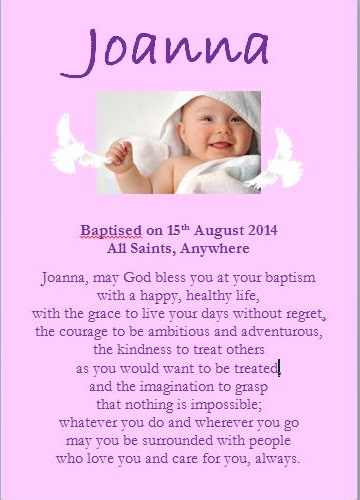
When you visit the family, don’t be afraid to talk about prayer – try and make connections between the promise to pray that they will make in the service and the hopes and dreams and thanksgivings and fears that all new (and not-so-new) parents have when they think about their children.  Invite the parents to work together to come up with either a fully-worked out prayer, or some key words or phrases that you can help them fashion into a prayer.

These prompts may be helpful:

When I think about…. [name of child]
I am thankful for……..
I hope for………..
I worry about………
I desire more than anything…………

Baptism personal prayer for websiteAlso ask the parents to send you a photo of their child.  Once the prayer is finalised, use it, together with the photograph, the name of the child, and the date and place of the baptism, make it look attractive, and put it in a frame (about A6 size works well) so that you can present it to them on the day. Many families will keep this as a treasured possession, display it in their home, and even ask for more copies to send to godparents and grandparents.

  • If you save it as a jpeg and email it to the parents they can share it on social media.
  • You could also use it on a baptism anniversary card
  • How about printing out enough copies on paper (without the frame!) for the family and friends who have come to the christening?
  • If you get a chance to meet the godparents in advance of the service, you could invite them to write a prayer too.
  • You can use prayers written by parents or godparents in the christening itself – they may wish to read them out, or they may prefer the vicar to do it!

A Friends’ Prayer

At a christening there may be dozens of others, not just godparents, but wider family, friends and neighbours, who all have one thing in common: they have come to church to celebrate the life of a child, to be part of something, and to wish that child well.  This goodwill and presence is an immense gift.  How can it be ‘harnessed’ and enfolded prayerfully both in the service and beyond?

Here are a couple of ways you could enable all those who come to a christening to be involved, to contribute their own prayers and hopes:

  • stick a post-it note onto each order of service, and leave pencils in the pews, and invite people (at some point in the service) to write just one word on their post it note, expressing their prayer or hope for the child being baptised. You can ask them to leave their post-it note on the service sheet, and peel them off after the service, or you could gather them in at some point during the liturgy. If your church is well resourced you might even be able to afford ‘posh’ post-it notes (a nice colour, an interesting and appropriate shape etc).
  • Have a graffiti board as people come in (or as they go out, or both) inviting one-word hopes and prayers.

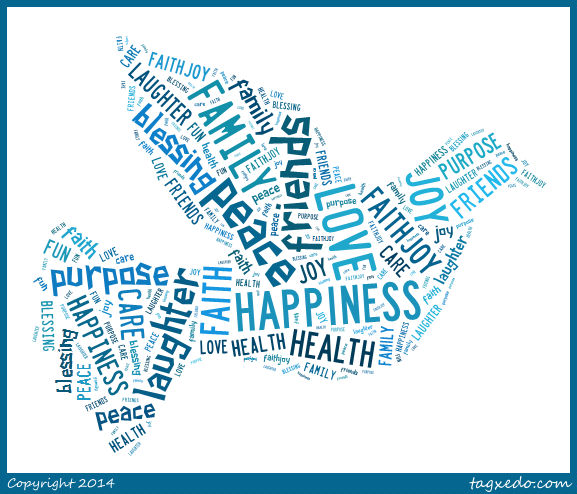
You may get multiple copies of ‘peace’ ‘love’ ‘friends’ ‘happiness’ ‘laughter’ etc, and that’s ok.  People don’t have to write something different from everyone else, they should be encouraged to write whatever feels most important. They can write several contributions if they like – but each should be one word long.

Baptism tag cloud - doveHowever you collect the words, it’s what you do with them after the service that makes this into something beautiful.  Go to www.tagxedo.com or a similar site and type in the words (include each word as many times as it was contributed – if 25 people all wrote ‘love’ then type it in 25 times!), then simply click to create a beautiful piece of word-art that is a prayer for the child written collectively by the whole gathering on the day.  On most tag-cloud creation sites you can configure colours, shapes, fonts etc.

  • If you save it as a jpeg, you can email it to the family and invite them to share it on social media or email it round to their friends who came on the day.
  • The illustration above is just a sample – when creating this for a real child, you could also type in their name (multiple times) so that it is featured in the finished piece of word art, to make it even more personal.
  • Again, you could keep the jpeg and send it to the family for the anniversary of the baptism, and encourage them to share it on social media.
  • The tag clouds don’t include photos, so an album of them could be kept in church without anyone having to worry about the child protection issues around keeping or displaying photographs of children.

Because these ideas involve computers and websites, it may be that you know a teenager who would like to make them for you, as their ministry….  They may have more ideas about how to create something beautiful as a lasting and net-share-able gift for those who come to church for baptism.


Love Life Live Lent – 7th March – Pray about the news

First, there’s the whole “Blimey, there’s so much going wrong in the world where do I start?” question.   And then there’s the less enormous but more personally challenging, “But what exactly am I praying will happen, here?” Then there’s the, “Who am I actually praying for?” question.

Question 1 is dealt with pretty easily: we’ll never cover absolutely everything – even the news doesn’t do that – and in the end we simply have to trust God that the whole world really is in his hands.

Question 2 is really hard.  For some news stories we may well have in mind what we believe is the right outcome. In these, our prayers have to leave God space to reach a different conclusion.   For some news stories we may have simply no idea how it should end; war, in particular, seems more complex all the time, and there are no straightforward answers about what should happen.  In these news stories, perhaps all we can do is hand the whole lot over to God and ask him to pour the oil of his love on the complicated, troubled waters of human behaviour and sin.

Question 3 is harder still.  Sometimes a news story has what appear to be clear goodies and clear baddies. But more often than not, it’s more grey than black and white.  And even when it seems obvious who is the victim and who is the sinner, do not both need our prayers?  “Love your enemies and pray for those who persecute you,” Jesus said.  How hard it is to pray for that politician making a speech that you find morally repugnant, or for that former financier being charged with fraud!  Yet both are human beings, with hopes and dreams and fears, with families and friends, and struggles that we may know nothing about, and motivations that we are not privvy to, and regrets that we may never have to face.  Both are in need of prayer, just as anyone else.

Prayer costs us no money, and only a small amount of time, but sometimes it can cost us a great deal emotionally and spiritually.  This Lent, may God give us hearts generous enough to pray not only the easy prayers, but the difficult ones too.