The Kingdom of heaven is like this: a chocolatier created a box of chocolates…

A random thought on Luke 14.7-14

And Jesus told this parable. The Kingdom of Heaven is like this: A chocolatier invented a variety of chocolates, and made them in his factory, and he called the collection, “Roses”.  He invited his friends round to try his creation, and offered them the box of delicious treats – but they did not know that he himself was the chocolatier. His friends all chose the strawberry cremes and the purple ones with the caramel and the hazelnut, and when they were gone they chose the tangy orange creme and the golden barrel.

Eventually all that was left were the plain country fudges. The man kept offering the box of chocolates to his friends, but they declined, saying, “Country fudge is not interesting, I don’t know why they bother putting them in the box, because nobody likes them.”

So the man said goodbye to his friends, for it was late.  He then gathered up the country fudges that had been rejected, and put them in a special bowl reserved for only the finest chocolates, and poured himself a glass of Bailey’s, and settled down on his comfy sofa to read his favourite book.  And as he read, he ate every single country fudge, and found them all to be delightful – and he would know, because, after all, he was the master chocolatier.

For surely the first shall be last, and the last shall be first. But it is when the first and last come together in a box that the true breadth and depth and height of the Kingdom of God and Love of God are made known – for in transit to the eternal feast the contents may settle, and one never knows when the box is opened on the latter day which of the many and delicious flavours will have risen to the top.

Amen.

For what, exactly, are we supposed to be ready?

A sermon on Luke 12.32-40

What matters most to you?  Take a moment to think about it.
People?  Values?  Things?  “Where your treasure is, there your heart will be also,” says Jesus in today’s gospel.  But he’s not making some simplistic division between earthly things (= bad) and heavenly things (=good) but rather inviting us to live as heavenly people, to live in acknowledgement of the fact that by virtue of being part of God’s creation, we are heavenly people, created to enjoy God for ever and to be part of his family and household. Our treasure is with God because God holds in his hands all that he made, all that really matters.

So how does that relate to the next bit of the reading, the part about the slaves. We may be very uncomfortable with the language, and it may have quite different connotations in our modern society in which we (mostly) tend to assume that slavery is a thing of the past.  But the difference between a slave and a more palatably-titled “servant” is that a slave actually belongs to the household, to the master of the house.  And if the master of the house is God, then belonging to him and to his household may not be such a bad thing after all.

And the work of the slaves is mind-blowingly important work – the master has entrusted his whole household to us, the care of everything that belongs to him, everything that he values. What an awesome responsibility, and what an awesome display of trust and affirmation!  In the household of God the work of the slaves isn’t polishing the silver and sweeping the floor, it’s building the kingdom, it’s working to make sure that everything that belongs to God (and that really is everything!) is how God wants it to be.

To do that work means we have to have some idea of what God wants his household to be like. What are the values by which God would like this household to run itself?  These are the values to which we work. Our work is no less than shaping God’s household into the sort of household he wants. Between us all, that means doing everything, and working out what our own task is within this great and noble work is the most crucial thing we’ll ever work out. And then getting on and doing it is our life’s work.

That’s why we won’t misunderstand all that stuff about being ready.  I have a friend who has a T-shirt with a picture of the Holman Hunt ‘Light of the world’ painting, with the caption, “Jesus is coming, look busy!”  That’s not it at all, being ready isn’t a clever guessing game about when precisely to get off our collective backsides and look as if we’re working hard just as the boss comes home. It’s about simply getting on with the task that God’s given us to do, because it’s the whole household that’s got to be ready, not just individual people in it.  The master doesn’t want to come and find slaves that look busy in a house that’s still a tip.  Being ready means getting on with our part in making God’s world nearer to how he created it to be.

And that incorporates our care and compassion for one another, for the environment and natural world, our economic choices and the impact they have on the world economy, and our lifestyle choices and their impact on our society and community, and much more besides.  We might look on the world around us and despair of it ever becoming more like the kingdom of God.  And we might long for a Revelation-like vision of the whole earth being recreated perfect.  And then we remember that God does, in fact, have a whole army of slaves whose job it is at least to begin this process of transformation and renewal.  It is we who build the kingdom according to God’s design.

Working out what that looks like can be hard – what does God actually most care about?  We should ask him.  We should pray, and read scripture, and think together and discern, and start to develop our own understanding of the values of God’s kingdom, God’s household, so that we know what we’re working towards.

And the end result of all this?  The story doesn’t talk about judgement, about failure, about bad slaves being sacked, or cast into outer darkness. It talks about how the slaves were ready, and that when the master comes home they’re invited to sit round his table and he serves them their dinner.   The slaves weren’t working for some other person’s benefit at all –  it turned out that all that preparation, all that cleaning and clearing of the table, all that polishing of chairs, all that washing up, was so that when the master came home he could sit down with his whole household and be a family.  That’s what they had to be ready for. That’s what they were preparing for all this time.  They had to be ready to be part of the family and household of God.  We have to be ready to be part of the household and family of our beloved heavenly Father.  And I sometimes wonder if we are.

We work to make earth like heaven because we want to be part of it; and the more we help to create the kingdom of heaven the more ready we are for it.  Everything we do here in church is supposed to be a foretaste of heaven, from the welcome when you come in to the sharing of coffee afterwards.  But more than that, everything we do in the rest of life is also supposed to be making earth a little more like heaven  – the encounters we have at work, in the street, in the shops, these are all opportunities for kingdom-making and kingdom-growing and kingdom-building.

And that’s what the story of the ‘ready slaves’ has to do with the treasure in heaven, and why far from being an injunction to separate a bad world from a good heaven it’s actually about being part of God’s ongoing work of reuniting the two.  And it’s about our own readiness to be wholly part of earth at the same time as we are children of heaven.

Argh! I’ve got the Son of God sitting right there on my sofa and I haven’t hoovered!

A little sermony something on Mary and Martha (Luke 10.38-end)

Let’s start with what I’m not going to say:

1. I’m not going to say that this story is an argument against hospitality and a criticism of those who give their time and skill in the service of others: the coffee makers, the cake bakers, the washer-uppers…. not least because I’d probably never again be brought a drink after the service!

2.  I’m not going to say that the story means simply that housework is bad and self-indulgent religious experiences are good.

3. I’m also not going to say that it’s a simple contrast between ‘being’ and ‘doing’, between the interior life of faith and the outward expression of that faith in actions that serve others.

So, if I’m not going to say that this story is about any of those things, what is it about?

First it’s about expectations.

To sit at the feet of a Rabbi was what you did if you were planning on becoming one – you learned the stories of the faith, and you learned to share them, to interpret them for others. You learned the faith so you could teach it.  And in those days, a woman could not become a Rabbi, so there was no point in Mary sitting at Jesus’ feet.  Martha would have seen it as being (at best) self-indulgent and (at worst) cringe-makingly arrogant and inappropriate.

But Jesus says that Mary is, in fact, in precisely the right place, and defends her right to be there. Why?

1. Because Jesus seems to have a rather different attitude to women than most of his contemporaries – briefly, he seems to treat women simply as human beings.

2. He knows that women will be the sharers of the faith – they are already disciples, and by the end of the gospel accounts of his life, death and resurrection, they are also revealed as apostles (the very first apostles, in fact).  Just think first of the Samaritan woman at the well whose testimony brought her whole city to faith in Jesus, and then think on to the women in the garden who first brought the good news of the resurrection.

3. Because God does unexpected things.  He calls Galilean fishermen to be great preachers. He calls tax collectors to be ministers. He calls women to be apostles.  God is clearly incapable of pandering to stereotypes and working purely within our expectations. God does unexpected and odd things, and gives us new and exciting directions to go in and gifts to explore. Just because you’ve always done the washing up or the flower arranging doesn’t mean God can’t call you to lead the intercessions. Or the other way round.  Just because we might not fancy ourselves as apostles doesn’t mean that God shares our narrow expectations, and he may well put opportunities in front of us for the sharing of the faith in word and in deed.

The second thing this story is about for me is quite simply this:  Jesus has come to Mary and Martha’s house. The Son of God, the Messiah, the Second person of the Trinity, is sitting in their living room !!!! I do know that tea making ad washing up are important, but really, what could possibly be more important than the fact that The Son of God has come to my house and he’s come to see me!

When the woman at Bethany annointed Jesus’ feet with perfume, and Judas accused the gesture of being wasteful, Jesus said to him, “You will always have the poor with you, but you won’t always have me.”  He might well say the same to Martha in this story: “There will always be housework to do, but you won’t always have me right here, with you.”  And it needn’t just be housework either, or any other gender-stereotyped activity – it could easily be mending your fishing nets, or making good that hole in your boat.  And if you want to bring it up to date I’m pretty sure we could all add our own list of things that get in the way of us actually spending time with the God who’s come all this way just to be with us.

Spending time with God is incredibly important. The busier you are, the more precious a gift that time is.  Learning the stories of the faith and learning to articulate them for ourselves is equally an incredibly important process, and the less confident we are about it, the more we need to be given space to ask the questions, and the encouragement to share our doubts and ideas.

Serving God is also incredibly important, and we know that when we serve one another, when we offer hospitality to one another, when we metaphorically or actually wash each other’s feet, it truly is Christ we are serving.

But the flip side of that is that Jesus, here among us isn’t only our guest, and our action and busy care are not the only ways that we can serve him.  He is also our host, for it is his world in which we dwell.  Martha sees Jesus sitting in her living room and treats him as a guest, asking herself how she can serve him, faffing around and not actually spending time with him.  Mary sees Jesus sitting in her living room and treats him as a host, asking what he wants to give to her, what wisdom and grace he has in store for her.

It may be a case of “Do not ask what you can do for God, but ask rather what God can do for you.”

We need to do both, to be both. But if we never give ourselves time to stop and bask in the presence of God who has come all this way, in the incarnation, to be with us and among us, then we’ll never have sat still long enough for him to give to us whatever gift it is that he’s brought, just for us.  And we are, after all, what he came for.

A sermony thing for Luke 7.36-8.3

The eyes and hands of Michaelangelo...

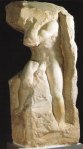
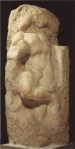
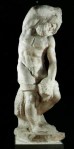
unfinished slave 1unfinished slave 2unfinished slave 4unfinished slave 3

The great sculptor Michaelangelo, who created some of the most beautiful figures ever to be carved from marble was once asked about his method.  He replied, “I simply work on the block of marble, removing all that is not part of the sculpture until only the sculpture remains.”

We can see this most profoundly in his unfinished ‘slave’ sculptures.  Michaelangelo was commissioned to create them in 1505 by Pope Julius, for the Pope’s own tomb – there were supposed to be thirty in total, but the Pope died soon after planning his own tomb, and the project was never completed.  If you ever go to see Michaelangelo’s famous and very perfect statue of David, as you walk through the gallery leading to it you will pass some of these unfinished slaves, exhibited precisely because in their unfinished state they seem to say something profound about humanity.

They seem to emerge from the rock, some gracefully, some full of struggle, seemingly desperate to gain their freedom.   And in them we can see Michaelangelo’s process at work.  His own expressed intention of freeing the figures that already exist within the stone is reflected in his technique. Almost all sculptors who work in stone tend to block out the main shapes of the whole sculpture roughly, and then gradually fill in the details. Michaelangelo, though, chiselled away at the stone, bringing individual parts of the sculpture to a perfect finish before moving on. That’s what makes the unfinished slaves seem to be freeing themselves from the rock that keeps them captive.

Why am I telling you all this?

Well, because if we see a block of stone most of us will see simply that, a block of stone.  It takes a Michaelangelo to see a beautiful figure, waiting to be liberated.

If we see a sculpture that is part finished in the normal way, full of rough edges, we might only see its imperfections, all the ways that it fails to live up to what it should be. We might even say, that’s a bit rubbish. Every extraneous bit of stone that’s marring that perfection is condemned.  It’s not very neat, is it?  It’s not been carefully done.

It takes a Michaelangelo to see the truth: all that needs to happen is for all the stone that is not part of the true sculpture to be carefully removed.

In today’s gospel we see a woman viewed in two completely different ways.

The Pharisee looks at her and passes judgement based on how she’s kept the law – or how badly she’s broken it.  For him, her sin is what she is: “If Jesus really was a prophet he would have known what kind of woman she is: a sinner.”  If that woman were a statue, the Pharisee is judging her based on all the bits that aren’t right, all the rough edges.

Jesus looks at the same woman, and sees her capacity to be forgiven and to love. He is like Michaelangelo, seeing the true figure hidden in the block of marble, trapped by all the things that aren’t part of what that woman was called to be, created by God to be.

The Pharisee sees only the bits of the marble block that are stopping the figure from being true to who they were created to be.

Jesus sees the person as they were created to be and then helps them to strip away all the bits that are stopping them from being that person.

The two views could not be more different. To look on someone and see their sin, or to look one someone and see their capacity to be forgiven.  To look on someone and see only how they have fallen short, or to look at someone and see their potential to become who they were created to be.

Thank God we have a God who is like Michaelangelo, who can see inside all the stuff that clings to us and clogs us up and grinds us down – the weight of past sins, the regrets of things done or not done, said or not said, the resentments and wrongdoing, and then helps us gradually to free ourselves of all the stuff that isn’t part of who we truly are.

Will that be a gentle process?  Not always!  Sculpture does, after all, involves chisels and hammers.  Will it be quick?  No, I suspect it’s a life’s work, and is completed only at the point of our entry into heaven.  But God can make us beautiful – as beautiful as we always were to him, precisely because he can see through all the rubbish to what lies at the heart of us, and his forgiveness chips away at everything about us that isn’t what we should be.

May God give us eyes like Michaelangelo’s, able to see the beauty in one another, even if it’s hidden, able to forgive one another for all the stuff that gets in the way, and in so doing, help us to free one another from all the stuff that keeps us from being who God created us to be.


Trinity Sunday for all ages

You will need: 

  • A strip cut from a bed sheet, approximately 8 to 10 inches wide and the whole length of the sheet.  Make it into a loop, but put in three half twists, then sew the ends together using several independent attachment points so that if you the cut down the length of the loop the stitching wouldn’t come undone. 
  • Scissors
  • Wax crayon
  • Some chidren

How big is God?

Isaiah wondered how to express his experience of God – when he wrote about his vision of God he said that the hem of God’s robe filled the whole temple.  When we look up at the roof of the church, and when we look down at the hem of our own clothes we can get just a glimpse of what Isaiah felt.

But God is bigger than that.  God is bigger than we can possibly imagine.

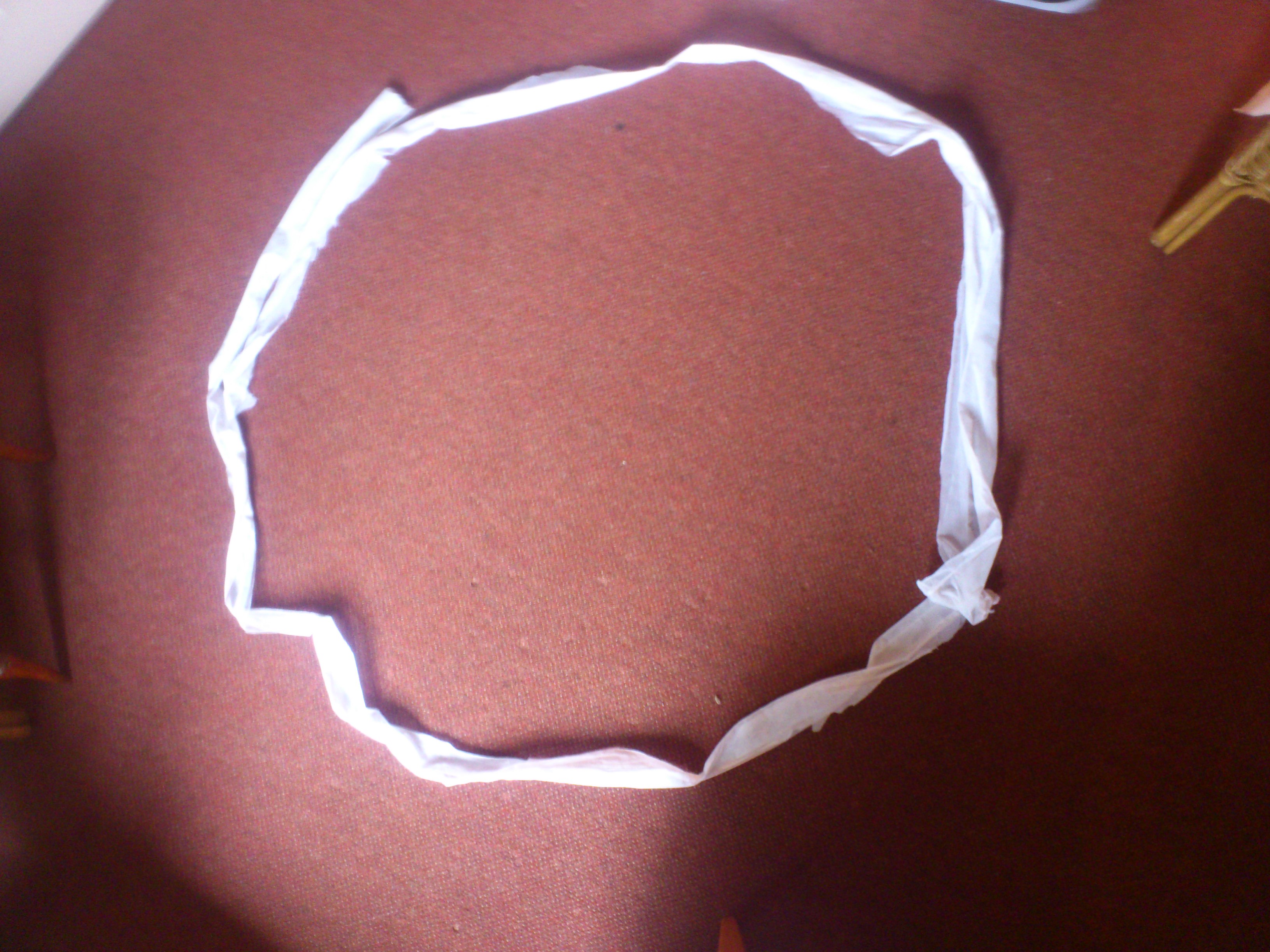
Mathematicians have a word for anything that is impossibly big: infinity. They even have a symbol for it – it looks like an 8 on its side.  We can make it with this big loop of fabric that I’ve brought.

DSC_0810

Like a circle, you can trace it round and round with your finger – and it never stops, it has no ending.  Even if we think of the biggest number we can, it’s always possible to add one to it to make it bigger – infinity is different because we can’t count to it, it’s just impossibly big.

God is infinite – bigger than any number could possibly be, and bigger and more awesome than we can ever really get our minds around, and we can’t ever get to describing God completely, because if we think we have, we’d find that it actually wasn’t God we were describing after all, but something less than God.

Now, there’s something that I haven’t told you about this loop of cloth. It’s actually not a normal loop of cloth, and to prove it, I’d like you to work out how many sides it has. We all know that a piece of cloth has two sides, but this one’s a big different.  You can check by drawing a crayon line all the way along one side of the cloth.

Of course, what you find when you try it, is that when you’ve drawn the line and got back to where you started, you’re on the wrong side of the fabric!  By the time you get back to the beginning of your line, you’ve actually drawn on both ‘sides’ of the fabric – because in fact, a mobius strip is a loop with a twist in it, so it only has one ‘side’!  You can find out more about mobius strips generally on wikipedia, if you want to try them at home.

Some things are just hard to get your head round!  People get very worried about how God can be both three and one, but we can see just from a cut up bed sheet (yes, that’s what this is made of!) that a piece of fabric can have both two sides and one side at the same time….

Now, this big loop is actually a really special kind of mobius strip. It has not just one twist in it, but three.  And a mobius strip with three twists has some special things about it.  I’m going to cut along the middle of the strip, all the way round the loop, and we’ll see what happens.

Do you think we’ll end up with two loops?  Let’s see!

Actually, what you’ll see is that we end up with one loop, with a knot in it! But there’s more we can do with it. I’m going to try something, and while I do, I’d like the children to take the micophone round the congregation and ask people for their suggestions of how we can understand the Trinity – we’ll have all heard lots of them before in sermons!

Some of the suggestions might include:

  • Shamrock leaf (clover leaf)
  • Water, ice, steam
  • Sun, light, heat
  • Jaffa cake(!)

None of these is quite right – they all reduce God to something we can understand and get hold of – none of them really gets to the heart of the mystery of the Trinity – how could they?

And now I’ve finished arranging this new loop, we can see another one of these illustrations of the Trinity – a mobius strip with three half-twists actually cuts up into a perfect interwoven trefoil!

DSC_0809

Yes, this does probably deserve a round of applause(!) but to be honest, it’s a clever trick and a quirk of maths. It doesn’t really tell us much more about the nature of God than a shamrock leaf or a jaffa cake.

We can use the same loop to make a tick to remind us that God is good:

DSC_0811

Or we can use it to make a heart to remind us of God’s love:

DSC_0812

But most of all, we can do this: we can actually get into this loop – there’s room for every child here inside the loop – there is always room within God for all of us, and this is the most important thing about God that we can ever know!  We might even find that once we’re all inside the loop we actually find we suddenly want to hug each other – love can happen more easily when we’re in the heart of God.


DSC_0814

In this simple bit of fabric we’ve found some things that are pretty mind bending, that might help us get why God is a bit mind-bending, but we’ve also found out some of the things that really do matter most about God, and about us and God.