
Thoughts towards a homily on Luke 14.25-33

Luke 14.25-33 is another one of those horrible gospel readings where you read it and think, ‘Really? Jesus said this?’  And then you realise you’re supposed to be preaching on it – in other words, making sense of it not just for yourself but for other people too.   So you’re not just talking about hating your own parents, you’re talking about other people hating theirs, and that’s just another whole lot of tricky.
I realised something as I read this through: the way it’s phrased makes it sound like a genuine choice: this thing or that thing, parent or God, as if the two were in any way equivalent to one another. Perhaps our metaphorical use of ‘Father’ for God compounds this immediate (and unhelpful) sense of the possibility of being equivocal.  But what if instead we took seriously the reality that God is not equivalent to anyone or anything?  That we’re not, after all, being asked to make a choice between two equivalent external sources of authority, validation or love, but rather to take on board who God is and what that means for who we are?
God is, after all, the creator of the universe. That’s everything. Stars, planets, black holes, and all the immensity of stuff in between that we don’t even have a proper name for. All of time and space (and spacetime). Huge things and tiny things, and things that don’t even properly exist in any way that physics can explain.  Animals, vegetables, minerals. The whole lot. Me, you, my parents, your parents, life itself.
If we believe that – really believe it – then the universe only makes sense if we are aware of everything being held in God’s hands.
Two brief diversions:
1. My children used to often ask whether, if God was everywhere, ‘is God in this dirty coffee cup?’ ‘Is God in this teatowel?’ ‘Is God in the mud on the bottom of my trainers that I just trod into the nice clean carpet?’  Exasperated, I eventually answered, ‘It’s the other way round. God is not in those things, those things are in God, because the whole universe is in God. Happy now?’ And remarkably, they were. At least until the next question.
2. If you’ve not read Mother Julian of Norwich’s Revelations of Divine Love, you should. The most famous of her visions is of a tiny round thing the size of a hazelnut, which the holy Mother holds in the palm of her hands. She wonders what it is, the answer comes to her, ‘It is everything that is made.’ She wonders how it continues to exist, for it is so small it might just disappear. Again, an answer comes to her, ‘It exists, and will continue to exist, because God loves it.’
So, in our mental image of God as creator of the universe, holding everything that he has made in his hands, that includes us – you, me, our mothers and fathers, the people we love and the people we hate, and the people we don’t even know and will never meet. As well as the stars and planets and black holes.
God is the ultimate context for all our other relationships – with people, and with creation. And our relationships with one another and with the world can only really make sense that way round, in the bigger context of God. It simply doesn’t work if we try to make anyone other the creator of the universe our “ultimate context” – if another creature (a parent, a lover etc) is given the status of Ultimate Context, that’s way too much pressure to put on them – nobody is big enough to be someone’s whole world, no matter how romantic or loyal that may sound. Only God is big enough, flexible enough, strong enough to be our first call, the ground of our being, our all in all. And if we try to make another human being into those things, even if they could hold us in their hands, they simply cannot hold all our other relationships as well, and they definitely cannot also hold all of God in their hands.  Our relationships with others can be held in the hands of God, but it’s very hard indeed to ask someone else to hold our relationship with God in their hands. It’s just the wrong way round.
In ministry I’ve always been grateful for an image of the hands of God being huge, and careful and gentle and strong and utterly reliable – and placed just under mine, ready to catch all the things that slip through my fingers. There are people who rely on me, for whom I am their first port of call. But I am not their last port of call, because of those big generous hands of God just below mine.
For me, there is something of this in the gospel this week.  And this may be my clumsy way of putting what Rowan Williams puts much more deftly in his book, Being Disciples:

“Being with the Master is recognising that who you are is finally going to be determined by your relationship with him. If other relationships seek to define you in a way that distorts this basic relationship, you lose something vital for your own well-being and that of all around you too. You lose the possibility of a love more than you could have planned or realised for yourself. Love God less and you love everyone and everything less.”

To love God is to realise that you are held in the hands of God, along with everyone and everything else. That tends to put things in perspective.
It’s the 5th time this gospel reading has come up in the lectionary since I was ordained and I still don’t know what to say about it…

This isn’t a sermon, it’s some thoughts that might lead to one.

Luke 12.49-56 is a really hard gospel. I like to find good news in the gospel, and I also like to inhabit the grey areas, but today’s reading leaves me very little scope for either; it seems full of judgement and harsh dividing lines, and destruction. And although I like complex, I like my complexity to be, well, happier.

One of the things I encourage my ordinands to do when they’re preparing to preach is to identify the ‘gospel in the gospel’ –  a process which involves letting the scripture reading converse with the time of year, the occasion, the church context and local/national events, and the preacher’s own perspective, experience and insights. Sometimes (=often) this process results not in a neat and tidy conclusion, but in more of a ‘way in’ – a starting point for what is likely to be a longer journey of reflecting and mulling-over, and responding.

Today is one of those days. There was a particular phrase that I found myself drawn to, and I’ll treat this, if I may, as the rabbit hole through which to explore this gospel, and see where the journey takes us.

“I have a baptism with which to be baptized, and what stress I am under until it is completed!”

This isn’t the first time that Jesus has talked about baptism the context of his coming time of suffering, and his approaching death.  Remember Mark 10.38-39?  You do not know what you are asking, Jesus replied. “Can you drink the cup I will drink, or be baptized with the baptism I will undergo?” “We can,” they answered. “You will drink the cup that I drink,” Jesus said, “and you will be baptized with the baptism I undergo…  In this rebuke to James and John, who are seeking the highest place by Jesus’ side in heaven, Jesus connects both baptism and the drinking of a cup with suffering. It sounds awfully like Baptism and Holy Communion are deeply and inextricably intertwined with suffering, both in the life of Christ and in the life of his followers, since they are key markers of our belonging to him.

In the early church, when many of those new to the faith, who had just begun their journey towards full membership of the church, were martyred before they could be baptised, the church began to teach that their martyrdom was a ‘baptism of blood’ – the blood shed at their death stood in for the water of baptism and united them fully with Christ. It’s possible that Jesus’ references to a baptism of suffering were the early church reading their own experience of martyrdom back into Jesus’ own teaching. It’s a powerful image, and a powerfully hopeful one for a persecuted church.

In today’s gospel there is no cup of suffering, but there is something else: ‘I came to bring fire to the earth, and how I wish it were already kindled!’  The phrase that sprang immediately to my mind, hearing these two images side by side in the reading, is the ‘baptism of fire’ that John refers to in Matthew 3.  It may refer to a purging fire, or perhaps more likely to the fire of the Spirit at Pentecost.  But the way we use the phrase now is as a way of talking about a difficult start, a challenge for which we may not be prepared, but which may test us and allow us to rise to it, proving us capable of facing whatever may come next.  Oddly, given the reference to baptism, it is near-equivalent in meaning to ‘in at the deep end’ – an first challenge that reveals whether we will sink or swim.

If a baptism by fire is  difficult (or at least challenging) start, then it is the start of something new, something that is (hopefully) going to be ongoing, something which we will (hopefully) survive, and through which we will ultimately thrive and grow. Think of the fire that Moses encountered on the mountain – the bush that burned but was not consumed. Think of how his new vocation emerged from this fire, overwhelming him but not destroying him, ‘burning’ him into being the person God was calling him to be.  Think of the fire of Pentecost, both the birth and the baptism of the church, terrifying, yet full of joyful power, enabling the few to grow to thousands.

Fire, in the gospel, is at once destructive and regenerative. It demands our absolute attention right here and now, in the present moment, when it may inspire terror, awe, wonder, fear… and yet it’s orientation is towards the future, towards what it will give birth to, what it will enable. The wound that is cauterized is for the sake of life and health; the forest is managed by controlled fire in order that new growth may replace old; the ore is refined in the flames to bring out the gold.  The references to fire (and even to the weather at the end of the reading) are about the relationship between what is happening now, or about to happen, and the ultimate, more hopeful, trajectory in the future. Suffering, purpose, vocation, life and death, hope and judgement – all of these are bound together, woven together, in this complex and richly allusive (and elusive) gospel.

But what of us?  The two central rites of our membership in Christ – baptism and Eucharist – are both connected by Jesus to his passion. When we are baptised, when we welcome others in baptism, when we share the bread and the cup, we participate in Christ, we are his body on earth, sharing in his death and resurrection, his suffering and his glory. This is our baptismal and eucharistic vocation. And it’s our life’s work to work out what that looks like in real life, and to do it. The hard fact of today’s gospel, much as it pains me to admit it, is that being good does not make for a quiet life free from suffering or from argument. It is in the nature of sin to battle with the good, both between us and within each of us.   Dante, in his Divine Comedy, reserved a special place just on the outskirts of hell for those who ‘lived without praise or blame’ and had therefore ‘never really lived’ at all. These, in Dante’s mind, were presumably those who had lived out their lives in denial of the reality that living in the world and truly engaging with it in a meaningful way will involve making decisions, working out what to believe and then standing up for it, and being willing, once standing, to be counted. Even (or especially) if you stand up and are counted for the sake of truth, justice and righteousness, you will make some enemies and piss a lot of people off (sorry about that). The prophets of the Hebrew Bible, and Jesus himself, are testament to that.

When we read the ‘signs of the times’ (ie what’s happening now, in the church, in our own local community, in the nation, in the world), we are confronted with a question: what sort of Christians, what sort of church, is required? Who do we need to be in response?  What does it look like when we (individually, communally, ecclesially) fulfill our fiery baptismal vocation to be Christ’s presence in the world?

I don’t have an answer for you, but if it is any consolation, I shall take away the same questions for myself.

Teach us to pray…

Some sermony thoughts on Luke 11.1-13

I’ve always found the parable of the persistent neighbour rather troubling. Our habit is to map parables onto the real world – us and God – as an exact one to one allegory, and in this case, that would cast God as the grudging friend with his own family safely behind a locked door who only responds to nagging.

This can’t be right, and setting the parable alongside the teaching of the Lords prayer helps us unpick it a bit.

The first thing to notice is that the late night request for bread isn’t out of the blue. The two are friends – they have an ongoing relationship, and there is probably more to that relationship than asking favours of each other. If the friendship in the story is supposed to tell us something about our relationship with God: relationship with God is not purely transactional, a series of favours being asked and granted. We go to God with praise, with our deepest desires and concerns about the world, with our basic needs, with our guilt and our bitterness, and our fear of the evil that others may do do us, or that we may do ourselves. In fact, all the things that the Lord’s Prayer describes, and which we can find unfolded both in our worship (try it, you’ll see what I mean) and in our daily lives.

The second thing to notice is the key phrase towards the end of the reading: ‘How much more…?’  What God does for us is more than we can expect from a human relationship. And the imagery switches back from the friendship model to the parent-child model, indicating perhaps that this is a closer comparison.  Jesus invites us to call God ‘Abba’ – an intimate, unguarded term, reassuring us that we are not randomly demanding neighbours banging on God’s door at midnight, but rather we are (or we can be) the children tucked up safely in the bed.

The friends/neighbours vs family issue here reminds me very much of the phrase ‘children of Abraham’ that appears a few times in the gospels. At the time of Abraham, God was experienced as the family God, and Jesus’ own contemporaries placed huge significance on their heritage as part of the family that God promised to Abraham would be more numerous than the stars in the sky and the grains of sand in the desert. And yet we can also read in the gospel that, ‘God can raise up children of Abraham from these stones’.  This story too, invites us to work out where we are in relation to God, and to reflect on our identity as children of God, members of God’s household, and all that that means, and all that might get in the way of that.

One of the things that that means becomes apparent if we let go of the one-to-one mapping of the parable, and instead mix things up a bit. What if the comparison is not so much that we can extrapolate who God is not by saying ‘God is like us in this story, but better?’ What if, instead, we say, ‘Our neighbourliness and our relationships must be modeled on God our heavenly Father, and what we know of God from the testimony of scripture and the life of Christ?’  What would it mean if we looked at the story not from the point of view of the neighbour knocking on the door, waiting for our prayers to be answered? What if we approached the story as the children in the bed, who, hopefully, take after their parent, and who know that their heavenly Father is a generous God, and that there is enough bread in the house to feed many neighbours and travellers?

Would we, on behalf of our Father, climb out of the bed and open the door, and offer God’s hospitality?  Of the many wise things Pope Francis has said, one of my favourites is this:
“You pray for the hungry. Then you feed the hungry. That’s how prayer works.”


The Good Samaritan

Maybe I am doing him a disservice, but the lawyer reminds me of one of those people who ask a question to which they already know the answer, so that they can demonstrate their expertise. He knows the right words to say, he correct formula, but he’s clearly struggling with the implications. He’s not quite grasping the all-encompassing nature of love. To attempt a definition of ‘neighbour’ is almost certainly to try to limit the sense of obligation and accountability and generosity that the Summary of the Law implies. Love has no limits, and the lawyer hasn’t really grasped that yet. Hence the story that follows.

But the story is all wrong.

Most people, when they hear a story, will gravitate to the first or main character, and assume, subconsciously that this is ‘someone like us’. Straight away we are wrong footed, because the person with whom we have begun to identify, albeit only briefly, turns out to be the victim and not the hero. His main role is to be beaten and then lie, passively, in the gutter, at the mercy, or lack of mercy, of whoever may see him.

We’d like the victim to be someone else. Secretly, we’d probably prefer it if the victim is ‘not like us’. The foreigner, the low-class outcast, the Samaritan – that’s who ought to be the victim, so that we can be the hero. We can do our charitable bit, reach down from our uprightness and respectability, and help those less fortunate than ourselves. And there’s nothing wrong with this. It’s one of the things that makes societies work.

But if we’re the ones in the gutter, it’s much less comfortable, much less satisfying. Lying there, beaten, who do we want to come to our aid?  I remember once at theological college, I had just recovered from flu, and for some stupid reason I had decided to go for a run before morning prayer. It didn’t go well. Almost at the end of the service, I started feeling woozy, and tried to leave discreetly – I got half way to the back of chapel and then passed out. I remember coming to and hearing a particular person (whom I will not name) saying, loudly, ‘Don’t worry, I know first aid!’ and thinking, to my shame, ‘Oh no, anyone but you!’

Receiving help is not easy. Depending on the charity of others is not easy. It makes us vulnerable, it can chip away at our pride and self-respect, especially when have to look up from the gutter at those who are helping us from their position of benevolent power – a position that really should be ours…. Who would it be hardest to accept from, right now? We might all give a different answer, but each of our answers challenges us, through this best known of gospel stories.

And the end of the story is wrong too. Jesus’ closing question turns the definitions around. ‘Who is my neighbour?’ at the start is a question that assumes that we are strong ones, and the neighbour is someone who, in their weakness, needs our charity. ‘Who was a neighbour to him?’ assumes that the neighbour is not the victim but the saviour, the one who gives the love.

So, when Jesus says, ‘Go and do likewise’ he is telling us to get up from our gutter, where we had unexpectedly and uncomfortably found ourselves, and go and be the Samaritan, go and be the outcast, the low-life, the one who stopped and helped because he knows what it’s like to be at the bottom of the heap. ‘Go and do likewise’ Jesus says, ‘remembering that you, too, are dust, that you, too, come from the gutter.’

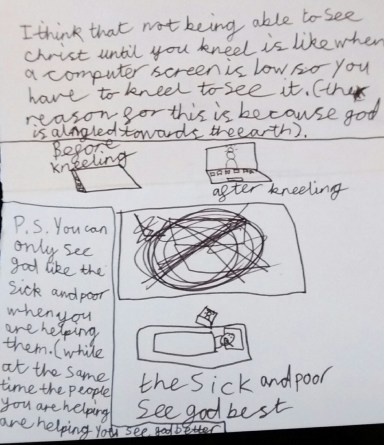
Christological laptop.jpgMy son, who is nine, came up with an interesting theory about this a few months ago. He noticed that he can only see what’s on his laptop screen when he looks straight at it – if it’s tilted at the wrong angle, the image distorts and then disappears. He said to me: ‘It’s like God is the image on a laptop screen, and the screen is tilted downwards.  You can only see God if you’re really low down. Like if you’re ill. Or if you’re not very important. The people who can see God most clearly are the ones who are right at ground level, not the people who can stand upright. So, if we want to see God clearly, we need to get down on the level of the people who are ill, or poor, or not very important. Helping people where they are is how we are most close to God.’

And he’s right, of course. If we really do get down on our hands and knees, as it were, and come alongside others in their hour of need, we are likely to find Christ already there. But if we look down from above, we’ll see no clearer.

The responses to some of the recent terrorist and other attacks around the world express this sense of solidarity rather clearly. It started with “Je suis Charlie” in the aftermath of the attack on the Charlie Hebdo offices in Paris. And it has continued, more recently in Carol Ann Duffy’s poem, Gay Love, which you may have seen, in response to the murder of 49 people in a gay nightclub in Orlando. This, too, expressed the sort of solidarity that St Paul hinted at in 1 Corinthians 12: ‘When one member suffers, the whole body suffers’.  This is the sort of solidarity, when words flow into loving action, that points to the fundamental truth at the heart of the Summary of the law: Love your neighbour. Be that neighbour. Be loved by that neighbour. These are all one command: mutual, reciprocal, humble, generous, joyful. The sort of love that allows help to be given and received without condescension.  The love that rejects the pursuit of power, the preservation of hierarchies, and instead basks in the belovedness that we all have in God, which underpins all our own giving and receiving  and invites us to see one another, to love one another, and indeed, to love ourselves, as God loves us.

In the nation at the moment, the question ‘who is my neighbour’ confronts us constantly. It is being asked in our local communities, in the news media, in the political arena, and implicitly in our awareness of the very many challenges that we face in our current political and social turmoil.  We need the story of the Good Samaritan, together with the Summary of the Law, now more than ever, to teach us afresh what is means to be children of the same heavenly Father, builders of his kingdom on earth – a community of people who need each other. It’s been wonderful to see the grassroots movements that have been springing up in the last few days: #loveyourneighbour and #movementoflove spring to mind, encouraging ordinary people to go the extra mile for one another, in ordinary and extraordinary ways. The challenge is great, and the story is exactly what’s required, though it may be hard to hear it, and harder still to live it out – but there is no greater command than this: that we love God with our whole being, and love our neighbour as ourselves. mollogo

Is ‘none’ really a thing?

This is my sermon for Pembroke College Chapel, 29th May 2016.
It is based on 1 Kings 8.22-23,41-43, 
Psalm 96.1-9, & Luke 7.1-10.
See also this excellent post by Stephen Cherry, and this Guardian article responding to the British Social Attitudes Survey.

If you’ve been keeping any kind of eye on the media recently, you will probably have seen something about the church – and religion generally – being in freefall, with more people now self-identifying as being of ‘no religion’ than as belonging all of the Christian denominations put together.

You can do all sorts of things with surveys – and much depends on what, exactly, is being asked, how the question is phrased, what options are given, and so on. There are certainly various narratives out there that ‘religion’ causes conflict, that ‘spirituality’ is what we share as human beings; that ‘religion’ demands adherence either to things that are impossible to believe, or to norms of behaviour that we no longer believe represent the fullness of human flourishing, while ‘spirituality’ allows each person to find within themselves the path that leads them to becoming who they want to be.

Meanwhile, however, a lot more people are, in fact, coming to church than British Social Attitudes survey would suggest. They may not be coming as part of a regular Sunday morning committed congregation, whatever that means, but they are coming: 200,000 people a year attend a Church of England christening service, and many more may brush up against ‘religion’ at a wedding or funeral. They visit cathedrals and parish churches (when the door is left unlocked).  Chapels, churches and Cathedrals have, in many cases, a several-hundred-year long track record of standing firm through the changes and chances of the life of local families, of whole communities, and indeed of the nation itself. There is something here that taps into a sense of connectedness with the past (think of the massive increase in interest in tracing family history).  When people speak of a ‘thin’ place, this is often what they mean. These are places that allow us to brush up against something bigger than any of us, and nothing in the survey suggests that this is on the wane. These places say, God is here. Not somewhere out there, but here, among his people.

There is something of this in our reading from 1 Kings. Solomon built the Temple, because he wanted a place where the Ark of the Covenant could have a permanent home, as a powerful symbol of God’s presence with his people, and his blessing upon them.

But the trouble with building temples – or churches, or chapels or cathedrals, for that matter – is that they usually have walls. And walls mean you know whether you are on the inside or the outside. If God is here, then there is a danger in inferring that God is only here. There is a danger that the particular signs of God’s presence, be they a temple, an ark, or a chapel, become so particular that they lose their identity as a sign of something universal.

My children, when they were little, helped me think this one through. They used to take great delight in asking me, at length, ‘If God is everywhere, is God in this dirty coffee cup? Is God in this sofa cushion? Is God in this mud on my trainers?’  And so on. Eventually, in desperation, I said to them, ‘No, it’s the other way round. God is not ‘in’ these things. These things are ‘in’ God, because the whole of creation is ‘in God’.  And some of the things that there are in the world are ‘in’ God in such a particular and remarkable way that they allow us to glimpse something of who God is.’ Astonishingly, the explanation worked.  But the conversation stayed with me.

If God is not in the chapel or the Temple, but the chapel and the Temple are both in God, then it is hardly surprising that what the Social Attitude Survey reveals by its silence is the massive extent to which God is at work in all the other things that are, by virtue of their createdness, also ‘in God’, even though they don’t have the label ‘religion’ on them.  For God is, I believe, not only present but active in the whole of creation, and most certainly in the minds and hearts and souls of those who ticked ‘none’ on the survey.  At the simplest level, people pray. My experience has been that there is a heck of a lot of prayer going on outside the church walls – and no survey can ever measure how that works and why it still happens if we’re all supposed to be turning secular.  People pray, and God hears.

This is what Solomon almost understands when he prays in our reading, that the prayers of the foreigner will be heard just as the prayers of the chosen people are heard. This is a moment – an early moment – in a gradual shift in theology, from ‘my family’s God’ through ‘my tribe’s God’ to ‘my nation’s God’ (who is undoubtedly better and bigger than your nation’s God, by the way) all the way through to The God – the end result of this shift is technically known as monotheism.

Once we are aware of God as The God we lose our proprietary claims. It is no accident that the ‘growth’ of God, for want of a better way of putting it, from one tribal God among many to out and out monotheism went hand in hand with a renewed growth in appreciation for the natural world. If God is The Lord, rather than just A Lord then this must be the one who created everything, really everything, the whole universe. So the Bible starts to present to us world of sea monsters and stars and planets and leviathans and distant peoples, all of which become crucial for understanding our own place in God’s affections and purposes.

Universalism, as Solomon almost states it, demands, then, a level of humility that the People of God have often struggled with, it is fair to say, over the last few thousand years. It is a level of humility that says, along with the Centurion in our gospel reading, ‘I am not worthy’ while at the same time declaring with all its might that ‘I am worthy’, but only because we are all worthy. Even the outsider, even the sick slave, even the foreigner who might come and pray in our holy place.

What is going on here is the acknowledgement that if the whole of creation is in God, then there can be no outside. So there can be no outsiders. Because none are uniquely worthy, all are worthy. Equally so. Universalism becomes then not a cop out, but a demanding, difficult process of working towards that unity and equality that is at the heart of our acknowledgement of who God is. What we need most at the moment is a global community that transcends self-interest and tribalism, and seeks instead the restoration of humanity, and indeed of the whole of creation, the very creation that the psalmist hears praising the God of everything.

So, when we talk of ‘spirituality’ (with or without religion) we must be sure that we do not dismiss it lightly; that we are talking about something that goes deeper than subjective feelings, deeper than self-fulfilment or self-expression.  It has to hear and respond to the charge that, in Mandela’s words, to be free, we must not merely cast off our own chains, but also live in such a way that respects and enhances the freedom of others. It must draw deeply from the rich traditions that we have inherited, learn from that history’s mistakes, and renew its accountability now and in the future to the creation in which we have a particular role and vocation.  This is a fully engaged*, ethical, demanding, accountable spirituality that the world – and the church – needs more than anything. Call it spirituality, call it religion, call it ‘none’, but know that the world needs it. Now more than ever.

AMEN

*Thank you to Stephen Cherry for this insight.