Advent 3: this really is good news…

Since I wasn’t preaching today, this is just two random thoughts about today’s gospel (Luke 3.7-18).

Here’s the first:

At first glance it’s all rather grim, especially if one postulates that life-long anglicans are the nearest modern equivalent to those that John criticised for treating salvation like a birthright.

But John’s retort, rather than filling me with dread, fills me with hope. “God can raise up children for Abraham from these stones,” he says.

Praise the Lord for that. Because I don’t want my salvation to be dependent on my track record, or my pedigree.  I want it to be dependent on the grace of God.  Because, frankly, I trust the grace of God more than I trust my own past.  And, yes, I trust the grace of God more than I trust the church and the illusion of solid reliability that is increasingly showing signs of wear and tear.

Here’s the second:

Although I don’t much like justification by works either (see above – I prefer grace), I love the fact that John takes seriously the questions posed to him by the tax collectors and the soldiers.

“Bear fruits worthy of repentance,” John tells them. They hear the words, and they want to live them out, they really do. So do I, I really do.  They ask him, “What do your words look like in real life?  What do they look like in my life?”

And the answers John gives are answers that can last a lifetime.  They’re practical answers that honour the situations in which these people find themselves, and show them, gently but firmly, how to make good choices in difficult times.

This gospel reading prompts me to ask my own question: What do the fruits of repentance look like my life?  And how will God help me, a mere stone on the ground, become a child of Abraham?  I give thanks today, because although John’s words are challenging, with God, everything is possible.
Pray for the ABC-to-be

There are many things about which one might pray at the moment, and while I’m not advocating sacrificing any of them in favour of this particular issue, I do think it’s important.  Please, if you pray, pray for the newly-appointed Archbishop of Canterbury, Rt Revd Justin Welby, currently Bishop of Durham. If you want to know more about him, I can recommend this thoughtful article.

The Church of England does not have a stunning track record for spotting and encouraging prophets, but I am starting to think that we are living in a time that needs prophets more than ever – we need prophets within and outside the church, who can help us see the wood for the trees and start to become the sort of church that God would like to have in the world. And that, in turn, will start to enable the church to become the prophetic voice that the world also needs.

Increasingly, I am afraid of the institution of the church – the sheer weight of it, the sluggish speed of its decision making, the baggage that it carries around, often seeming to leave no hands free actually to be the body of Christ and to undertake his work of blessing and healing and reconciling. We are ‘busy with many things’ and I suspect that many of us do not feel that there is enough slack in the system for us to make brave, prophetic choices about what church looks like and feels like and how church actually works at a local, let alone national or international level. It is as if we have imprisoned the body of Christ in an institution.  Financially, the church is in trouble.  We may well not be able to sustain the standard of living to which we have been accustomed, but when the bailiffs come round they cannot take our silver (because we’re not able to sell it) – instead they repossess our servants (our ministers) leaving half-empty houses full of riches, and nobody to care for them.

OK, so I’m having a bad day, clearly. But even on a good day, I worry. I worry that our new ABC will be the one who presides over the end, and that makes me want to pray for him. But equally I worry that we will continue to limp along for the next 10 years, deluding ourselves that change isn’t necessary, and keeping up with the trappings of our former glory until there’s suddenly nothing left and we all get jobs feeding the pigs.

We need, urgently, to rediscover what God wants us to be and to do.  The question for me is, can our new Archbishop help us get our act together?  Please?

OK rant over.

A harvest poem? Halfway through October? Isn’t that a bit late?

Had a request for a harvest poem. Not sure this really works, but hey, it’s a work in progress.

We bring our gifts:
The first-fruits of our labour,
or perhaps the spare we do not need,
(an offering to mitigate against our greed).

To the church we bring them,
and into the hands of Christ we place them,
and we say, ‘Take this,
and do with it some miracle:
Turn water into wine again,
or multiply my loaves and fish
to feed a crowd again.’

And Jesus takes them from our hand,
this fruit of the ocean, this product of the land,
and blesses them, accepting back
what always was the Lord’s.
Our gifts will fill the lack
of hungry people,
putting flesh on words
of charity, and making folk
in our small corner of the world
more equal.

We know there is enough for everyone.
But once the leftovers are gone –
taken to the homeless, hungry poor –
what of those twelve empty baskets standing idly by?
Can there yet be more
that we can ask our Lord to multiply?

Into those baskets therefore let us place ourselves,
those parts of us that need transforming,
grace and strength and healing,
the gifts in us that need to be increased and shared
with a greater generosity than we may be prepared
to offer on our own account.

For we are God’s rich and splendid bounty,
seeds, sown and scattered by the Lord in every place.
the human race:
the crowning glory
of the ever-evolving creation story.
We thank the Lord
that he does not just separate wheat from tare,
but takes our very best
then turns us into far more than we are.

A Christmas poem? In October? Seriously?

I can’t be the only one planning carol services already, can I?  I hate the fact that Christmas creeps in early, but in a fit or organisation (and knowing that I’ll be out of action for some of November having my tonsils taken out) I scheduled the planning meeting for the village carol service for 17th October. All of which meant that I was in a Christmassy mood as I waited at the level crossing, and found myself starting to write a Christmas poem.

I’ve never written a Christmas poem before, so be nice to it, even if it’s pants.
(In case it’s not blindingly obvious, it’s based on the additional collect for Christmas day).

In the visions of prophets since time began,
and long before God’s loving plan
was brought to birth
there has been talk of a glorious moment
when heaven would touch the dark and long-estranged earth.

In a half-made family,
and in a young girl’s womb
those ancient words began to be
in flesh and skin and bone unfurled;
and as the babe was born
so heaven stooped
to touch a fallen world.

Amongst the cows and camels
in a shed behind the inn,
the world’s true light
opened his eyes to a world of sin.
And yet he saw as his first sight
the love of a mother,
and heaven touched earth for each of them
in one another.

On a darkened hilltop
angels came to sing
to fearful shepherds and startled sheep
of a boy-king, the dayspring
from on High.
They came and saw the child,
and in him, all their hopes fulfilled
as the baby slept to a lullaby.
And in the tiny shoot that sprang from Jesse’s stem
heaven touched earth
for them.

A star high in the Persian sky was gleaming
to guide the long, long journey of the sages,
whose gifts were heavy with meaning;
Heaven touched earth in them,
and showed for all the ages
that there was no place or time
where heaven’s light could fail to shine.

And through the endless years of history
heaven has touched the hearts of young and old alike,
of all who long to enter in its mystery;
In suffering and joy we glimpse this hope
that nothing in the cosmos can destroy,
for there is no force in the universe
that can prevent heaven from touching earth.

Tonight we may arrive with burdens,
cares, and fears, and guilt;
And what of all those things for which we strive so hard?
we bring them to the stable yard,
or even lay them at the manger.
So let us join with choirs of unseen angels
and raise our voice
to cry for peace
goodwill to men,
and for God’s heaven to touch his earth again.

Mary

I never used to understand some people’s fixation with Mary.

That is, until one Christmas when I was at theological college. One of the other students had written a really rather good and thought-provoking nativity play, and I went along to the first read-through as I thought there might be some stuff to do with music that I could help with (I was chapel musician at the time).

The parts were dished out, and by the time it came to me, only Mary was left, so I said I’d read the lines. By the end of the read-through I actually wanted the part, and I got it. It was in that moment of being chosen for something that I hadn’t expected and hadn’t asked for, and then a second, separate moment, of realising that I really wanted it, that I got an insight into why people are so fascinated with Mary and why they venerate her.

Then, on 21st December 2003, which happened to be the fourth Sunday of Advent, I took a pregnancy test first thing in the morning, and then went to church, and, as deacon, read the gospel set for the day: Luke 1.26-38 (the Annunciation), full of the fresh knowledge that I, too, was with child.

I sometimes wonder whether Mary’s been so esteemed by the Anglo-Catholic wing of the Church of England, that the rest of the church hasn’t really known how to honour her.

Her being a virgin has been made into something moral – as if sex is sinful, and as if virginity was somehow an idealised state of womanhood.  All this even when a good few commentators tell us that Isaiah’s prophecy was merely about a ‘young girl’.

Mary’s youth and unquestioning obedience may also elevate her to the status of beautiful-doormat-on-a-pedestal, whereas the real Mary that we read about in the gospels is anything but: she’s thoughtful, courageous, and a prophet of social and political change.

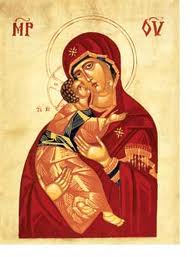
In iconography Mary almost always appears holding the Christ child. Quite rightly, she is often pointing at him, too, as if to say, ‘Don’t look at me, look at him’.

But there are a few images that break the mould – works of art that dare to see Mary as a person in her own right, whose vocation went far beyond being an innocent vessel, and who had a role to play in the growth in body, mind and spirit of the Son of God.

One is the ‘Walking Madonna’ outside Salisbury Cathedral, striding purposefully and full of strength.

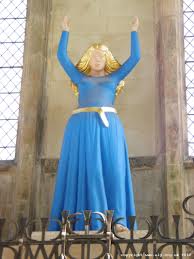
The other is Ely Cathedral’s statue of Mary who appears above the altar in the Lady Chapel, hands raised not just in praise of God at the magnificat, but also as Eucharistic president.