
Prayers for a baby at their baptism

Praying at Christenings – two ideas to involve the family and friends.

Christenings – whether they are in the main church services or separately – always involve a time of prayer for the child, and for their parents and godparents. Many people aren’t sure what sort of thing should be included in a prayer, especially if they don’t pray regularly themselves, but one thing that everyone has in common when they come to a christening is that they are part of a gathering in which there is a huge amount of goodwill focused on one person: the child who is being christened. There is often talk of christening being the start of a journey, so people will also be thinking about the future, and the potential of the child in their midst – the kind of person they will grow up to be, the kind of world they will grow up living in, and the life they will lead.

Here are two ways to harness this goodwill and these hopes, fears, and dreams, into prayer that can be part of the christening service itself, and have a lasting and wider impact afterwards.

A Parents’ Prayer

When you visit the family, don’t be afraid to talk about prayer – try and make connections between the promise to pray that they will make in the service and the hopes and dreams and thanksgivings and fears that all new (and not-so-new) parents have when they think about their children.  Invite the parents to work together to come up with either a fully-worked out prayer, or some key words or phrases that you can help them fashion into a prayer.

These prompts may be helpful:

When I think about…. [name of child]
I am thankful for……..
I hope for………..
I worry about………
I desire more than anything…………
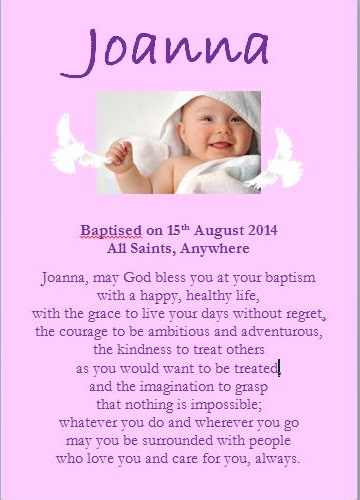
Baptism personal prayer for websiteAlso ask the parents to send you a photo of their child.  Once the prayer is finalised, use it, together with the photograph, the name of the child, and the date and place of the baptism, make it look attractive, and put it in a frame (about A6 size works well) so that you can present it to them on the day. Many families will keep this as a treasured possession, display it in their home, and even ask for more copies to send to godparents and grandparents.

  • If you save it as a jpeg and email it to the parents they can share it on social media.
  • You could also use it on a baptism anniversary card
  • How about printing out enough copies on paper (without the frame!) for the family and friends who have come to the christening?
  • If you get a chance to meet the godparents in advance of the service, you could invite them to write a prayer too.
  • You can use prayers written by parents or godparents in the christening itself – they may wish to read them out, or they may prefer the vicar to do it!

A Friends’ Prayer

At a christening there may be dozens of others, not just godparents, but wider family, friends and neighbours, who all have one thing in common: they have come to church to celebrate the life of a child, to be part of something, and to wish that child well.  This goodwill and presence is an immense gift.  How can it be ‘harnessed’ and enfolded prayerfully both in the service and beyond?

Here are a couple of ways you could enable all those who come to a christening to be involved, to contribute their own prayers and hopes:

  • stick a post-it note onto each order of service, and leave pencils in the pews, and invite people (at some point in the service) to write just one word on their post it note, expressing their prayer or hope for the child being baptised. You can ask them to leave their post-it note on the service sheet, and peel them off after the service, or you could gather them in at some point during the liturgy. If your church is well resourced you might even be able to afford ‘posh’ post-it notes (a nice colour, an interesting and appropriate shape etc).
  • Have a graffiti board as people come in (or as they go out, or both) inviting one-word hopes and prayers.

You may get multiple copies of ‘peace’ ‘love’ ‘friends’ ‘happiness’ ‘laughter’ etc, and that’s ok.  People don’t have to write something different from everyone else, they should be encouraged to write whatever feels most important. They can write several contributions if they like – but each should be one word long.
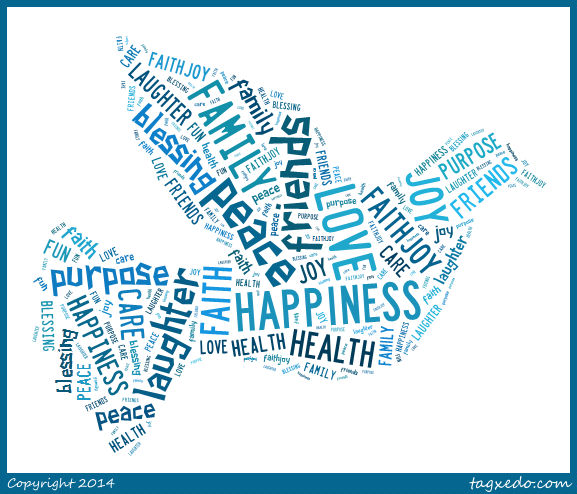
Baptism tag cloud - doveHowever you collect the words, it’s what you do with them after the service that makes this into something beautiful.  Go to www.tagxedo.com or a similar site and type in the words (include each word as many times as it was contributed – if 25 people all wrote ‘love’ then type it in 25 times!), then simply click to create a beautiful piece of word-art that is a prayer for the child written collectively by the whole gathering on the day.  On most tag-cloud creation sites you can configure colours, shapes, fonts etc.

  • If you save it as a jpeg, you can email it to the family and invite them to share it on social media or email it round to their friends who came on the day.
  • The illustration above is just a sample – when creating this for a real child, you could also type in their name (multiple times) so that it is featured in the finished piece of word art, to make it even more personal.
  • Again, you could keep the jpeg and send it to the family for the anniversary of the baptism, and encourage them to share it on social media.
  • The tag clouds don’t include photos, so an album of them could be kept in church without anyone having to worry about the child protection issues around keeping or displaying photographs of children.

Because these ideas involve computers and websites, it may be that you know a teenager who would like to make them for you, as their ministry….  They may have more ideas about how to create something beautiful as a lasting and net-share-able gift for those who come to church for baptism.

The solution to the votive candle problem you’ve all been worrying about

Actually, this solves two problems:
1. After All Souls you have a whole pile of half-used tea lights – you don’t feel right keeping them for next year because you want to give people a ‘fresh’ one, so what do you do with them all?
2. You want to give out those 10cm by 1cm votive candles at a service (let’s not go into why – maybe it’s Easter, or a baptism) but they just don’t stand up on their own, and you have to provide everyone with those little card circles to catch the drips, and it’s a bit of a faff.
So, what do you do?
Simple!
1. Re-light your tea-light, and wait for a small puddle of wax to form, approximately 1cm in diameter.
2. Stick the bottom of your 10cm votive candle into the puddle of hot wax (this will extinguish the flame as it squashes it) and hold it steady for a few seconds as the wax begins to harden.
3. Leave for 10 minutes to harden completely, and hey presto, you have a 10cm candle that stands up on its own, catches its own drips, and makes those old tea-lights feel as if they still have something to offer.
You don’t have to do one at a time, you can do large batches at once, and you can do it while you’re doing something else, such as talking on the phone.

New hymn

I rashly promised I’d try and convert the Ely Diocese Vision Statement into a hymn. Here is the result. The tune is Guiting Power (Christ Triumphant, ever reigning), which is such a good tune I’m pretty sure it deserves better words than mine, but there you go!  There are quite a few verses, so I guess it would work as a processional/recessional/offertory? 

Gracious God, your love has found us,
bound us, set us free.
Take our lives, transform us into
all that we can be.
Call us, one and all, together,
now and evermore, we pray.

Call us to be Christ-revealing,
radiant with your light;
generous as a hilltop city,
visible and bright.
Call us, one and all, together,
now and evermore, we pray.

 Call us all to live the kingdom,
active here and now;
Life affirming, world-renewing.
Church above, below.
Call us, one and all, together,
now and evermore, we pray.

Call us all in love discerning,
strong in word and deed;
sent, commissioned, gladly serving
all who are in need.
Call us, one and all, together,
now and evermore, we pray.

Call us as your loved disciples:
learning, growing, fed;
Send us out, as new apostles,
Leading as we’re led.
Call us, one and all, together,
now and evermore, we pray.

Call us deeply, touch our souls through
worship, prayer and word,
teach our minds to feel in echo
myst’ries yet unheard.
Call us, one and all, together,
now and evermore, we pray.

Call us, as you called creation
when the world began,
Guide our hearts’ imagination
to your loving plan.
Call us, one and all, together,
now and evermore, we pray.

“The thief comes only to kill and steal and destroy, but I came so that they may have life abundant…”

For the last few days the news has finally, and rightfully, been full of outrage and anguish at the news of the abduction of dozens of girls from a boarding school in Nigeria.  Social Media has been full of pleas to #bringbackourgirls.  Our own slice of the world is finally up in arms that these girls, who were trying to make the most of themselves, to be all that they could be, who were learning, growing, and living life as abundantly as they possibly could, have been stolen from their school and from their families. Most strikingly has been the publication of the list of names of those who are missing, along with pleas to speak their names, remember them in our prayers, and to cherish and care about each one of them.

From today’s gospel: “He calls his own sheep by name and leads them out…  The thief comes only to steal and kill and destroy, but I came that they may have life, and have it abundantly.”

God calls us into that life abundant, and calls us by name, at our baptism. I understand that some of the missing girls are Muslim, while many are Christian.  To be honest, I don’t think God cares by what faith they have come to know him: he knows them, each of them, by name, and loves them all.

New parents are hyper-alert to the needs of their child – a new baby can wake its parents in the middle of the night because they are programmed to believe that their child is the most the most important thing in the world.  It’s not the volume of the call that matters, it’s how important we think it is, how carefully we listen for it.  Whenever we call God our Father, we affirm that he is this acutely aware of the pain and distress of each of his seven billion children.

And therefore so must we be.  For to be beloved of God, to be part of Jesus’ flock, is to affirm that our relationship with God is intimately bound up with the welfare of the whole flock.    We are not cats in the household of God, just in a one-to-one relationship on our own terms, we are his sheep, and our relationship with God as our shepherd is inseparable from our relationship with each other.   A sheep that is close to the shepherd is by definition close to the rest of the flock.

And the closer we come to our shepherd, the more we may remember about the gospel message and what it reveals about Jesus’ attitude to the lost, to the weak, to those in distress.  And how in performing acts of mercy, kindness and courage, he told us to go out and do likewise.

Our calling as the body of Christ on earth has to be to continue Jesus’ work of enabling all his people to have life abundant.  This is the start of Christian Aid Week, when we may be thinking of contributing something to the work of a charity which, in the name Jesus Christ, seeks to bring abundant life to those in need (of any faith or none) through the relief of poverty, through education, better healthcare, improved sanitation and so much more.  This is how we start to be not only sheep in his flock, but fellow shepherds.

Our calling is to protect those most vulnerable from ‘the thieves who come to steal and harm and kill’ – and to ask our government to do this in our name when we see acts of violence and injustice being carried out against those who cannot defend themselves.

Meanwhile on the micro scale, we think again of those missing girls.  Pray for them. Speak their names. See them as God sees them. Love them, even from thousands of miles away.

For your prayers, below is the list, provided by the Christian Association of Nigeria, of 180 of those still missing:

1. Deborah ​
2. Awa ​
3. Hauwa ​
4. Asabe ​
5. Mwa ​
6. Patiant ​
7. Saraya ​
8. Mary ​
9. Gloria ​
10. Hanatu ​
11. Gloria ​
12. Tabitha ​
13. Maifa ​
14. Ruth ​
15. Esther ​
16. Awa ​
17. Anthonia
18. Kume ​
19. Aisha ​
20. Nguba ​
21. Kwanta ​
22. Kummai ​
23. Esther ​
24. Hana ​
25. Rifkatu ​
26 Rebecca ​
27. Blessing ​
28. Ladi ​
29. Tabitha ​
30 Ruth ​
31. Safiya ​
32. Na’omi ​
33. Solomi ​
34. Rhoda ​
35. Rebecca ​
36. Christy ​
37. Rebecca ​
38. Laraba ​
39 Saratu ​
40. Mary ​
41 Debora ​
42. Naomi ​
43 Hanatu ​
44. Hauwa ​
45. Juliana ​
46. Suzana ​
47.Saraya ​
48. Jummai ​
49. Mary ​
50. Jummai ​
51. Yanke ​
52. Muli ​
53. Fatima ​
54. Eli ​
55.Saratu ​
56. Deborah
57. Rahila ​
58. Luggwa ​
59. Kauna ​
60. Lydia ​
61. Laraba ​
62. Hauwa ​
63. Confort ​
64. Hauwa ​
65. Hauwa ​
66. Yana ​
67. Laraba ​
68. Saraya ​
69. Glory ​
70. Na’omi ​
71. Godiya ​
72. Awa ​
73. Na’omi ​
74. Maryamu
75. Tabitha ​
76. Mary ​
77. Ladi ​
78. Rejoice ​
79. Luggwa ​
80. Comfort ​
81. Saraya ​
82. Sicker ​
83.Talata ​
84. Rejoice ​
85. Deborah ​
86. Salomi ​
87. Mary ​
88. Ruth ​
89. Esther ​
90. Esther ​
91. Maryamu
91. Zara ​
93. Maryamu
94. Lydia ​
95. Laraba ​
96. Na’omi ​
97. Rahila ​
98. Ruth ​
99. Ladi ​
100 Mary ​
101. Esther ​
102. Helen ​
103. Margret
104. Deborah
105. Filo ​
106. Febi ​
107. Ruth ​
108. Racheal
109. Rifkatu
110. Mairama
111. Saratu ​
112. Jinkai ​
113. Margret
114. Yana ​
115. Grace ​
116. Amina ​
117. Palmata
118. Awagana
119. Pindar ​
120. Yana ​
121. Saraya ​
122. Hauwa ​
123. Hauwa ​
125. Hauwa ​
126. Maryamu
127. Maimuna
128. Rebeca
129. Liyatu ​
130. Rifkatu
131. Naomi ​
132. Deborah
133. Ladi ​
134. Asabe ​
135. Maryamu
136. Ruth ​
137. Mary ​
138. Abigail
139. Deborah
140. Saraya ​
141. Kauna ​
142. Christiana
143. Yana ​
144. Hauwa ​
145. Hadiza ​
146. Lydia ​
147. Ruth ​
148. Mary ​
149. Lugwa ​
150. Muwa ​
151. Hanatu ​
152. Monica
153. Margret
154. Docas ​
155. Rhoda ​
156. Rifkatu
157. Saratu ​
158. Naomi ​
159. Hauwa ​
160. Rahap ​
162. Deborah
163. Hauwa ​
164. Hauwa ​
165. Serah ​
166. Aishatu
167. Aishatu
168. Hauwa ​
169. Hamsatu
170. Mairama
171. Hauwa ​
172. Ihyi ​
173. Hasana
174. Rakiya ​
175. Halima ​
176. Aisha ​
177. Kabu ​
178. Yayi ​
179. Falta ​
180. Kwadugu

Congregational Music Setting for Holy Communion

This is pretty much what it says it is: a setting for the sung bits of Holy Communion. I wrote it about 12 years ago, but it’s been languishing ever since, and I thought the time had come to dust it off and make it available to anyone who wants it. For all the PDFs of each item, click here, it’s the first item on the page.