
Trinity Sunday for all ages

You will need: 

  • A strip cut from a bed sheet, approximately 8 to 10 inches wide and the whole length of the sheet.  Make it into a loop, but put in three half twists, then sew the ends together using several independent attachment points so that if you the cut down the length of the loop the stitching wouldn’t come undone. 
  • Scissors
  • Wax crayon
  • Some chidren

How big is God?

Isaiah wondered how to express his experience of God – when he wrote about his vision of God he said that the hem of God’s robe filled the whole temple.  When we look up at the roof of the church, and when we look down at the hem of our own clothes we can get just a glimpse of what Isaiah felt.

But God is bigger than that.  God is bigger than we can possibly imagine.

Mathematicians have a word for anything that is impossibly big: infinity. They even have a symbol for it – it looks like an 8 on its side.  We can make it with this big loop of fabric that I’ve brought.

DSC_0810

Like a circle, you can trace it round and round with your finger – and it never stops, it has no ending.  Even if we think of the biggest number we can, it’s always possible to add one to it to make it bigger – infinity is different because we can’t count to it, it’s just impossibly big.

God is infinite – bigger than any number could possibly be, and bigger and more awesome than we can ever really get our minds around, and we can’t ever get to describing God completely, because if we think we have, we’d find that it actually wasn’t God we were describing after all, but something less than God.

Now, there’s something that I haven’t told you about this loop of cloth. It’s actually not a normal loop of cloth, and to prove it, I’d like you to work out how many sides it has. We all know that a piece of cloth has two sides, but this one’s a big different.  You can check by drawing a crayon line all the way along one side of the cloth.

Of course, what you find when you try it, is that when you’ve drawn the line and got back to where you started, you’re on the wrong side of the fabric!  By the time you get back to the beginning of your line, you’ve actually drawn on both ‘sides’ of the fabric – because in fact, a mobius strip is a loop with a twist in it, so it only has one ‘side’!  You can find out more about mobius strips generally on wikipedia, if you want to try them at home.

Some things are just hard to get your head round!  People get very worried about how God can be both three and one, but we can see just from a cut up bed sheet (yes, that’s what this is made of!) that a piece of fabric can have both two sides and one side at the same time….

Now, this big loop is actually a really special kind of mobius strip. It has not just one twist in it, but three.  And a mobius strip with three twists has some special things about it.  I’m going to cut along the middle of the strip, all the way round the loop, and we’ll see what happens.

Do you think we’ll end up with two loops?  Let’s see!

Actually, what you’ll see is that we end up with one loop, with a knot in it! But there’s more we can do with it. I’m going to try something, and while I do, I’d like the children to take the micophone round the congregation and ask people for their suggestions of how we can understand the Trinity – we’ll have all heard lots of them before in sermons!

Some of the suggestions might include:

  • Shamrock leaf (clover leaf)
  • Water, ice, steam
  • Sun, light, heat
  • Jaffa cake(!)

None of these is quite right – they all reduce God to something we can understand and get hold of – none of them really gets to the heart of the mystery of the Trinity – how could they?

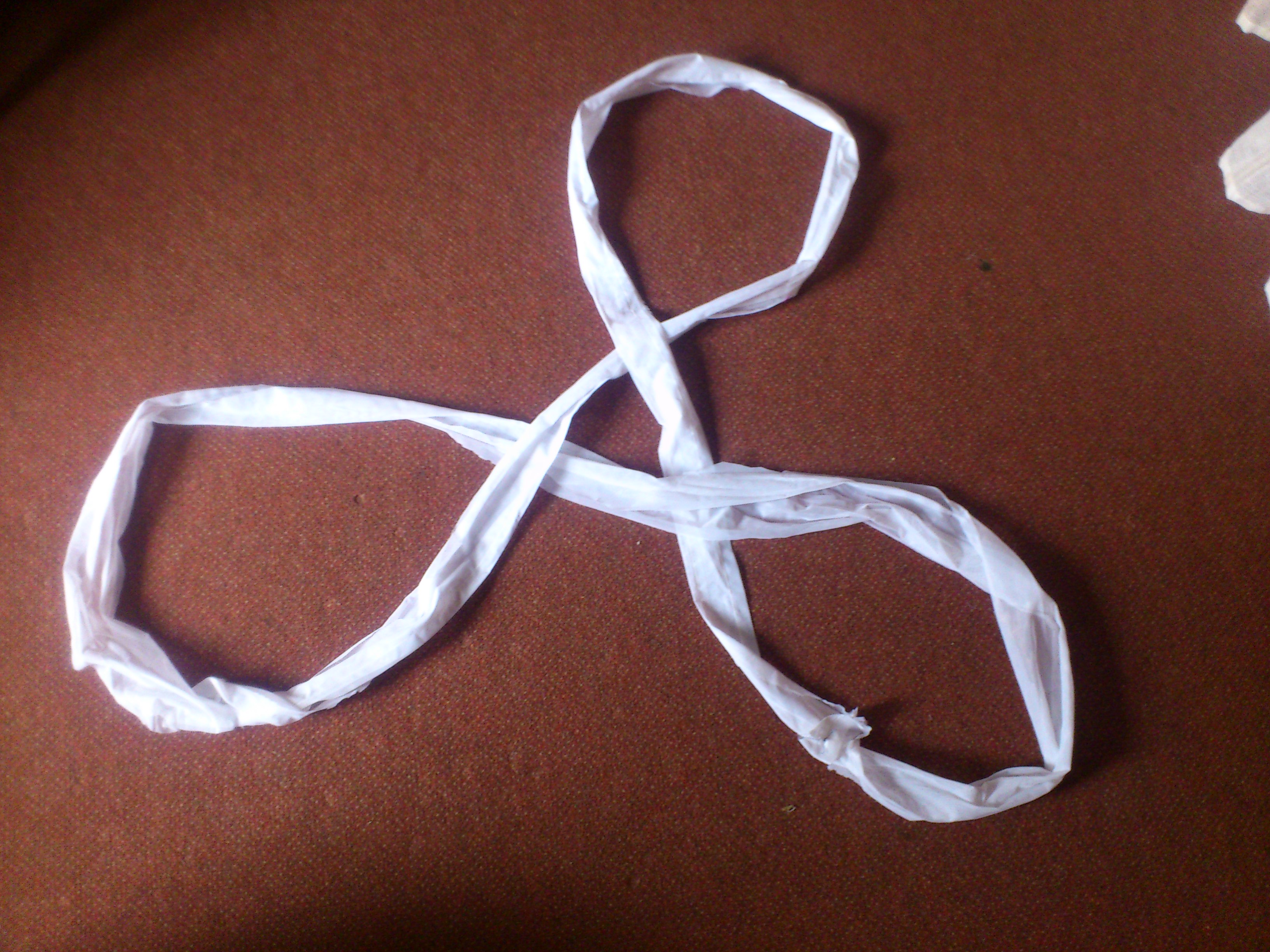
And now I’ve finished arranging this new loop, we can see another one of these illustrations of the Trinity – a mobius strip with three half-twists actually cuts up into a perfect interwoven trefoil!
DSC_0809

Yes, this does probably deserve a round of applause(!) but to be honest, it’s a clever trick and a quirk of maths. It doesn’t really tell us much more about the nature of God than a shamrock leaf or a jaffa cake.

We can use the same loop to make a tick to remind us that God is good:

DSC_0811

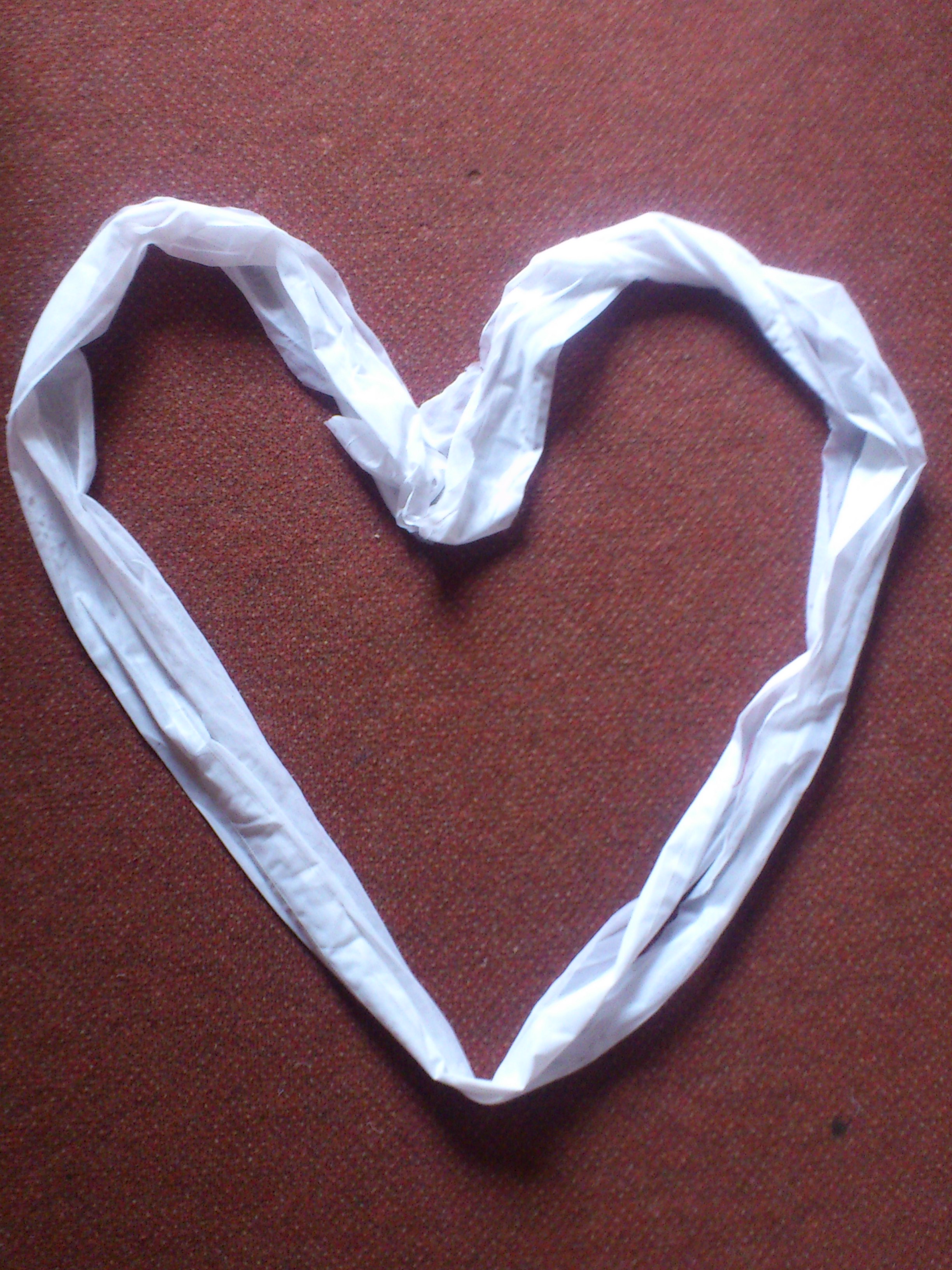
Or we can use it to make a heart to remind us of God’s love:
DSC_0812

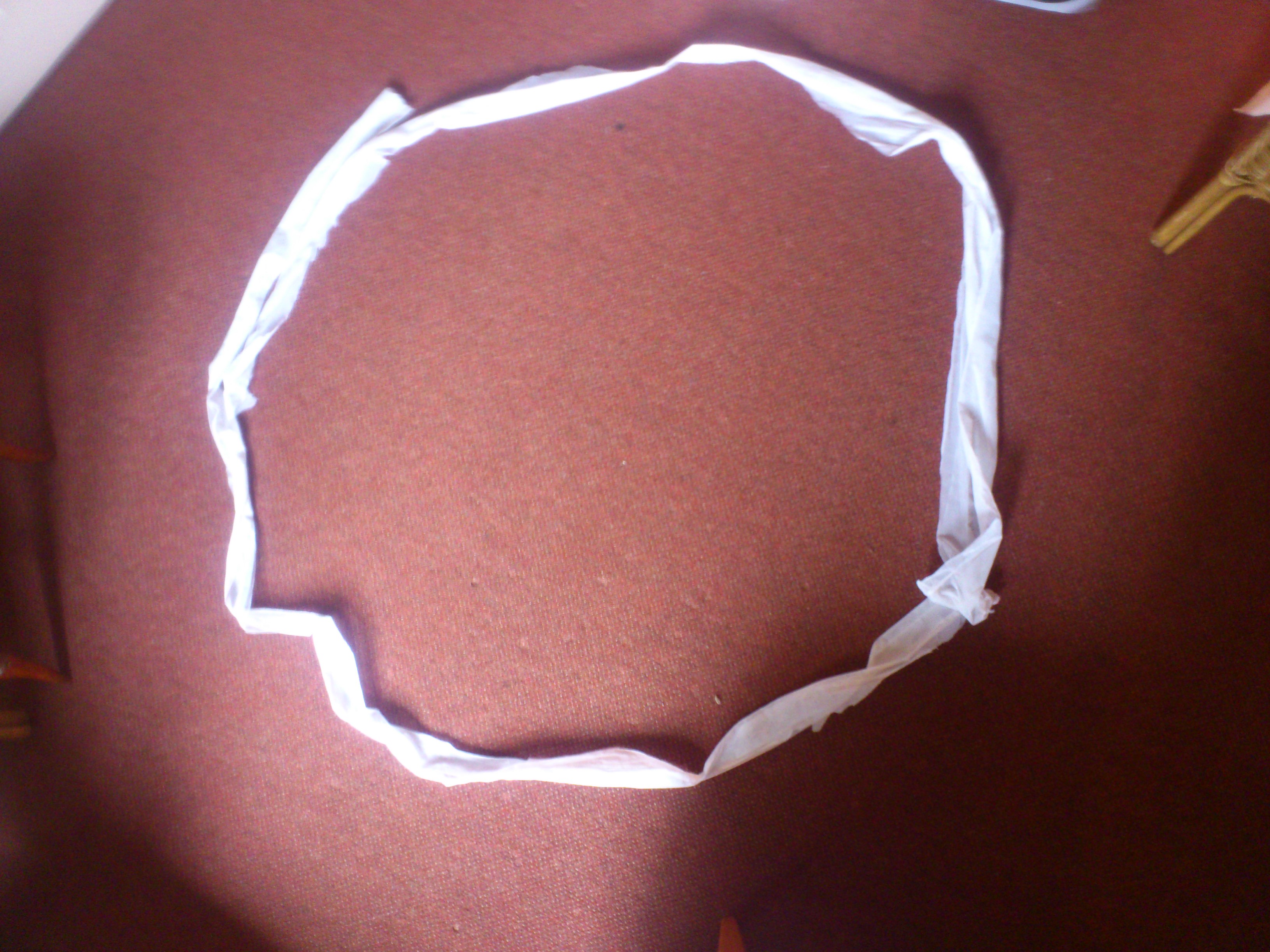
But most of all, we can do this: we can actually get into this loop – there’s room for every child here inside the loop – there is always room within God for all of us, and this is the most important thing about God that we can ever know!  We might even find that once we’re all inside the loop we actually find we suddenly want to hug each other – love can happen more easily when we’re in the heart of God.
 

DSC_0814

In this simple bit of fabric we’ve found some things that are pretty mind bending, that might help us get why God is a bit mind-bending, but we’ve also found out some of the things that really do matter most about God, and about us and God.


What can we take with us?

Today I got the chance to spend part of the service with the Junior Church (one of the Readers was preaching, and there wasn’t anyone else from the rota to be with the children). It was great fun. First we tried crawling through a table while dragging a chair behind us (we were being camels going through the eye of a needle).  We began to think about what sort of things we can take with us into eternal life, and what sort of things we need to leave behind. Then we made two little paper pots, labeled one ‘Take’ and the other ‘Leave’.

So, what did the children put in the pots?

Well, it started with the obvious things. They put ‘money’ and ‘TV’ in the ‘Leave’ pot.  And they put ‘love’ and ‘friends’ in the ‘Take’ pot.

But after that it got more interesting.  They found that there were good things about our life now that still might not have a place in heaven – we weren’t sure about toys, for instance. But we were quite clear that there was fun and laughter in heaven nonetheless.

Then we got rid of some things like war and bullying and cruelty and lies. They all went in the ‘Leave’ pot, because there’s no room for them in heaven. And we put ‘soul’ and ‘good memories’ in the ‘Take’ pot.

We put ‘everything bad we’ve ever done’ and ‘guilt’ in the ‘Leave pot. And we put ‘everything good we’ve ever done’ and ‘good memories’ in the ‘Take’ pot.

At that point we spotted a big hairy spider on the wall, and there was heated debate about whether we would take it to heaven. Then we remembered that God loves it and God made it, so we drew a picture of a spider and put it in the ‘Take’ pot.

Then someone asked about whether we could put ‘People we don’t like’ in the ‘Leave’ pot, and we thought about that together. We had to conclude that, just like the spider, the people we find difficult have to be able to come with us. We thought that the gift of heaven might be that we would come to love them just as God loves them.

We realised, finally, that the eternal life that the rich young man in the story was asking about doesn’t start when we die, it starts right now, and that loving the people that God loves was part of how we start to live as if we are in heaven.

Let there be light

The theme for collective worship this morning at my church school was ‘God speaks the universe into being’ – it’s part of a series on how God speaks, which will last all term.

Exploring the creation story in schools is challenging: some of the science behind the origins of the universe is well beyond my non-scientific mind, and it’s not always easy to convey the nuances of ‘metaphorical truth’ as opposed to fact when looking at biblical accounts of (pre-historic) events.

There is a simple but profound beauty in the biblical account of God speaking the word ‘Light’ at the moment of creation, just as there is (to a non-expert like me) a simple but profound beauty to the notion of the universe starting with a Big Bang – a sudden explosion of the potential into the actual.

But how to explore this with a school full of 5 to 11 year olds when you have 20 minutes to do it?

It was at that point that I turned to music, and specifically to the opening chorus of Haydn’s epic choral work, The Creation.

I asked the children to imagine a speck of something tiny, so small that they can barely see it, and yet they know that it’s going to be something amazing. I then played them just a minute’s worth of Haydn, inviting them to enjoy the mystery and the potential, and then really to enjoy the Big Bang.

“And the Spirit of God moved upon the face of the waters.
And God said, ‘Let there be light.’
And there was LIGHT!”

My reward? A school hall filled with faces that were full of awe – smiles, eyes like saucers. I tell them that when Genesis 1 was written down nobody knew about the Big Bang, but they somehow knew that life needed Light, and that there was a moment when everything came into being. And how people of faith believe that God has never stopped speaking light and life into his world.

My question to them?  “What makes you feel alive like that? What brings that kind of light and life into your world?”

The blanket of blessing

Anyone at Stepping Stones (that’s Buckden-speak for Messy Church) today was able to partake of the latest in multi-sensory prayer.

We have always used objects, actions and various items of a multi-sensory nature in Stepping Stones to express our prayers. Among the favourites is the prayer cushion: a large, squashy red heart-shaped cushion that we pass round, taking turns to hug it as we silently ask God to bless the people we love (or the people we find it hard to love, or those we feel might be most in need of God’s blessing).

Earlier in the summer I found the prayer cushion’s natural successor: the blanket of blessing. Like many of the best sermon illustrations, all age liturgical resources and prayer aids, he came from Dunelm Mill.  It is dark pinky-red. It has hearts on it. It is made of the softest of soft fleecy fabric. It is completely irresistible.

Unlike the prayer cushion which could be considered rather individualistic, the blanket of blessing is communal: whole piles of children can be encompassed in its soft embrace (and the blanket itself doesn’t even need to be CRB-checked) and best of all, when one person feels they have been sufficiently blessed, they can take the blanket from around their own shoulders, and drape it over someone else.  ‘God bless Denise’, said Daniel, as he wrapped our churchwarden up in the blanket this afternoon.  ‘God bless Ally, Daniel and Joanna,’ said Mia and William as my children and I were enveloped in fuzzy warm blessings.

The blanket of blessing is here to stay.  I now have to buy another two for my children, so they don’t argue about who gets to use the church one when Stepping Stones is over…

Have you got a blanket of blessing for your church yet?


Equality: Collective worship

Does equality mean everyone gets the same? Not always!

Imagine a row of chairs, each a different size. And imagine a line of people, all a different size.  The chairs and the people in Reception are all small, but the chairs for the adults are all big, just like the adults who sit in them!

Sometimes equality means getting something that fits us – the big people get big chairs and the little people get little chairs.

But what if a big person and a little person wanted to look each other in the eye?  If the adult’s on a big chair and the reception child is on the little chair, they can’t look each other in the eye so well!  But if the adult if they swap, they can see eye to eye – the big chair and the little person make the same height as the little chair and the big person!

And what if you’re trying to reach something?  If the reception child can’t reach the high shelf, is it because they are too small?  Or because the shelf is too high?  Just like if a person in a wheelchair can’t get through the door is it because they have a wheelchair that is too wide, or because the door is too narrow?  If we want things to be equal, we don’t make everything the same, we make sure everyone gets what they need.

So first we have to notice each other. Really really notice each other.  This is something we can all do.

But the best noticer is God.  He knows us each so well that he knows the number of hairs on our heads, and knows what we need before we even ask, and loves us all more than we can ever know.  He knows everything about us tha makes us special and unique.

Prayers:

Jesus said, God knows what you need before you even ask.

Think quietly about the things that worry you, about the things that challenge you, about the things that you are proud or, or afraid of.

Thank you God that you know all about us. Thank you that you hear us when we pray, and even when we don’t.Help us to notice what the people around us need, so that we can all be the best that we can be and do the best that we can do.

Jesus said, let the little children come to me.

Think about the opportunities you have, the chances to shine and be noticed, the people who care for you and love you and teach you.Think about children in other parts of the world who don’t haveall  the things we enjoy here.

Dear God, Thank you for all the ways that we are blessed here. Show us how to help others to have a chance to live life to the full.

Jesus said, not one of the little ones that belong to me will be lost.

Think about the people you know who are specially in need, because they are ill, or lonely, or afraid of something, or facing a big problem in their life. Think about the ways that you can show them they are cared for.

Dear God, thank you that you love every single one of us more than we can ever know. When we are feeling alone or when we think we’re not being noticed, help us remember that you are always watching over us.

SONG:

He’s got the whole world in his hands
He’s got the whole wide world in his hand,s
He’s got the whole world in his hands,
He’s got the whole world in his hands.

He’s got everybody here in his hands…