All age friendly sending out song

My train was delayed so while I waited I wrote this, to the tune of ‘I saw three ships’. It’s not profound, but it might be useful to someone somewhere.

Now send us out to serve you, Lord,
and show the love of heaven above,
We gladly go to serve you, Lord,
on this and every morning.

Now send us out to serve you, Lord,
Your peace to grow on earth below,
We gladly go to serve you, Lord,
on this and every morning.

Now send us out to serve you, Lord,
to share your grace in every place,
We gladly go to serve you, Lord,
on this and every morning.

Now send us out to serve you, Lord,
In all we say and think today
We gladly go to serve you, Lord,
on this and every morning.

Now send us out to serve you, Lord,
to live for you in all we do,
We gladly go to serve you, Lord,
on this and every morning.
Creative Stations of the Cross

This morning at church we worked together (all ages) to create the(biblical) Stations of the Cross.

Three of the stations were mine to plan, and I’m posting here what we did.

My first station was the betrayal and arrest of Jesus. We cut paper into strips, and used crayons to make rubbings of silver coins on the paper, while we talked about Judas’ story, and how he tried to take back what he had done, but the consequences were already happening. We thought about the consequences by making our strips of paper into a chain, representing Jesus as a prisoner. The chain and all its interlinked loops also reminded us that all our actions affect other people, but that we can make that a good thing, not a bad thing, by the way we are with our friends, and with the people we find it hard to get on with- especially when we have things to forgive, or when we need to say sorry.

My next station was Jesus’ trial before Pontius Pilate. Pilate was supposed to be the one responsible for justice, but he didn’t know what to do so he washed his hands as if to say ‘what happens to Jesus is nothing to do with me’. This is how injustice keeps happening, even today.

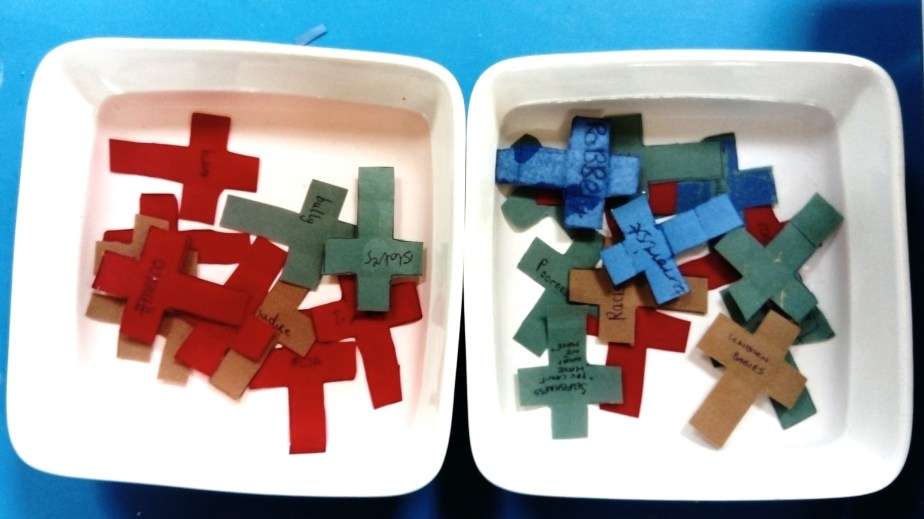
For this station we cut cross shapes out of sugar paper and wrote on them an issue to do with injustice that we felt strongly about: poverty, bullying, #metoo, racism, prejudice, being blamed for something that’s not your fault… We carefully folded the ‘stalk’ and then the ‘arms’ and then the ‘head’ of the crosses into the middle so we had a little folded square. We looked at how we had hidden the issue that we’d written on the Cross. Then we floated that square in a bowl of water and it opened again, revealing the truth hidden inside. Some of them opened slowly, some quickly. That’s how justice happens: someone dares to speak the truth, so that everyone can see it.

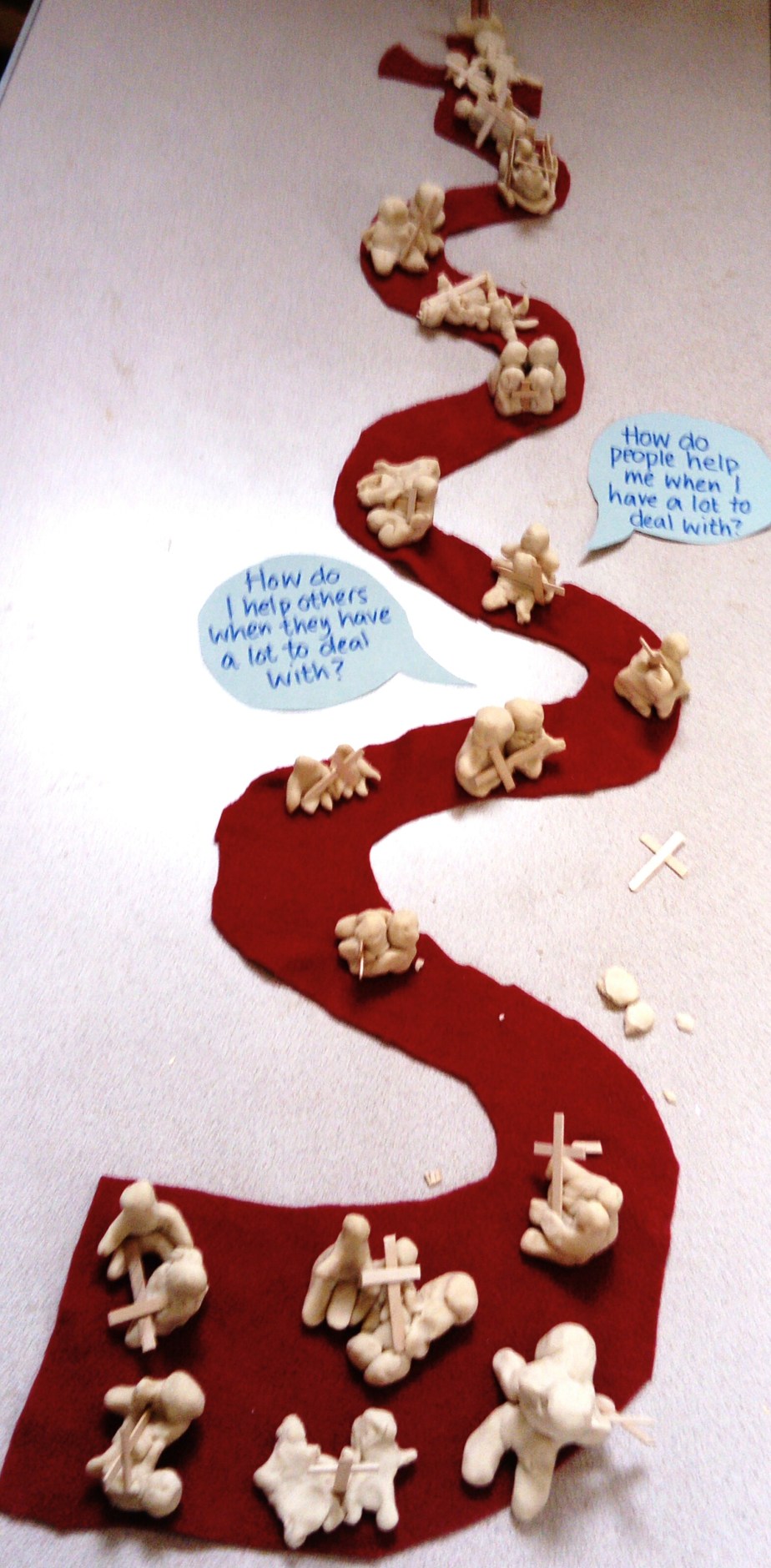
My final station was when Simon of Cyrene helped Jesus carry the cross. I cut the ‘way of the cross’ out of fabric, and everyone made little people out of salt dough. The people were placed on the fabric road, in groups, with a cross for each group so that they could share the burden. We talked a lot about how tired they were, and about who supports us on our life journey – and who we are able to support – especially when life is hard.

You can see some of the other stations on this film that my son made during the morning – he didn’t manage to catch all the Stations but here’s what he managed to photograph, in order. https://youtu.be/Df7LoKS83fI

The prodigal son

This is a way to tell the story of the prodigal son, using ribbons.
HEALTH WARNING: I’ve done this exercise with both with children and with adults, and it is quite powerful – essentially it’s psychodrama, and you should only do it if you’re confident about facilitating this kind of process. It’s always worth having people on standby for participants to talk to if it stirs up difficult emotions.
Begin with three people (representing the three characters in the story) standing in a triangle, each of them holding the end of a ribbon in their hands, so that the ribbons connect them to each other – ie the people are the corners of the triangle and the ribbons are the edges of the triangle.  I use really nice ribbon, and talk up how a loving relationship is something really precious and beautiful.
When we get to the bit about the younger son running off, I use a blunt pair of scissors to cut the ribbons connecting the younger son from the other two characters. I invite everyone to look at how the ends are raw and ragged, and how the father and the older son are left with the loose ends (and so is the younger son, though he is too busy having run to realise it!). When we get to the part about the younger son returning to his father, we hold up the two ends of the ribbon between those two characters, and look again at their frayed ends. We wonder about what it would take for them to be joined together, and how it looks like the ribbon will never be whole again – the ends are just too frayed. Then I point out that the son had walked home, and the father had run to meet him, and get the two people to take a step closer to each other – close enough that there is enough slack in the ribbon to tie the ends in a knot and then a bow. The ribbon is joined again, and it is more beautiful than before – and the father and son are closer than they had ever been. The son now knows the difference between being his father’s servant and being his father’s child.
Meanwhile, the older son is out in the fields. The ribbon between him and his brother is still in tatters. And when he refuses to come in, he is cutting himself off from them both – here, I cut the remaining ribbon, between the father and the older son. Now it’s the older one who is out on his own.  This is where Jesus ends the story, so that we can decide how to finish it. 
So we wonder together about how we want the story to end. We look at the sad, ragged ends of the ribbon, and the relationships that are still broken, and ask ourselves what it would take to mend all this in real life, not just in an illustration. We reflect that the older son still thinks of himself as a servant, and needs to realise, like his little brother eventually did, that he is his father’s child, and is loved beyond all measure.
Participants are usually desperate to tie up the remining ribbons, so we do that, in the same way, with the three people having to step closer to each other, so that there is enough ribbon for a nice bow on each side of the triangle. We see how the three characters are closer than ever, and we wonder whether that’s what happens with forgiveness – we each have to step towards each other, and the relationship at the end is truer and more beautiful than at the start. We tie the bows slowly to give us time to think about how we go about mending broken relationships in real life.
I end by giving everyone a small length of ribbon to take home – a reminder that sometimes we all have ‘loose ends’ and that forgiveness isn’t easy, but that they could trust God to help them hold the ragged ends, and help us find ways of mending things, but in ourselves and between ourselves and others.  We hold our ribbons as we pray in silence for a while, holding before God the things that are unresolved in our lives. We name silently the people we need to reconcile with, and the people who, for whatever reason, we can’t reconcile with, trusting God to hold their loose ends, too. 

All Age All Saints

This activity works really well using Hebrews 11, but could also be adaopted for other passages that mention multiple people of God.
Prepare some coloured paper people, several per colour and write names on them as follows: 
Red: the heroes of the faith in Heb 11
Orange: the first disciples, St Paul etc
Yellow: early/mediaval saints
Green: reformation and modern saints
Blue: ‘those who have influenced us or shared the faith with us’ – may be generic or left blank
Purple: blank (you need as many of these as there are people in the congregation)
Pink or brown or grey: blank (again, as many as there are in the congregation, with some spares)
Write the names on the people and hide them round the church before the service.During the sermon, send children out to gather one colour at a time, and bring them forward – pin them or stick them to a display at the front of the church (in the form of a rainbow, or just round the edge of the display area so you can put the purple ones in the middle, or round the pillars, or whatever works in your building).

For each colour, talk about some of the characters and what they did to share the love of God. For the blue ones you may have things like ‘mum’ or ‘grandad’ or ‘godparents’ or ‘teacher’ or you could leave those blank and ask for suggestions, writing them on at the time.

When it gets to the purple ones, get the children to give them out to everyone so that they can write their own names on, and then bring them forward to be added to the display. You might like to put the purple ones all together in the middle, with the ‘saints’ around them (like the great cloud of witnesses).

You can also have an extra set of people (also blank – maybe pink or brown or grey) that are ‘those who are get to come’ – the next generation, people who don’t know God yet, people we might invite to church. These people are to be taken home by the congregation (they don’t need to have names on them) to remind them to share the love of God with everyone they meet, because that’s what saints do.

It’s beginning to look a lot like Advent

Actually it isn’t. But I wrote this on the train the other day, as a very belated response to someone’s request for a song to go with the lighting of the Advent wreath, and I thought I might forget about if it I waited till November. 

Advent Wreath Song
to the tune ‘Father we place into your hands’

Mothers and fathers of the faith, who lived in time of old,
Leaders and judges, kings and queens were faithful, true and bold,
Travelers, heroes, shepherds, all with stories to be told:
Still they show us how to follow you.

Prophets and seers who spoke the truth in answer to your call,
finding new ways to bring your word to people great and small,
living their lives to show your love was meant for one and all,
still they show us how to follow you.

John, in the desert calling out, ‘The Kingdom has come near.’
‘Come and repent, and be baptised, there’s nothing then to fear.’
‘Jesus is coming now, the One you’re waiting for is here.’
Still he shows us how to follow you.

Mother of Jesus, angels called her favoured, full of grace,
Holding the Son of God, the Prince of Peace, in her embrace,
She is the one whose ‘yes’ helped God to save the human race,
still she shows us how to follow you.

And this last verse, for Christmas day, is by my friend and colleague Gill Robertson:

Jesus our Saviour, born a king, we welcome you today,
Lord of all time, Immanuel, with joyful hearts we say:
You are the Christ who came to earth for us; and now we pray,
Help us all to daily follow you.