A sparkly christingle talk!

How about this for a sparkly way of looking at the Light and the World:

You will need:
Christingles for everyone, and the means to light them
A small vial of iron powder – you can buy this online.  Use powder rather then iron filings. 

Start with your vial of iron powder – show it, sprinkle some between your fingers, back into the container. Explain what it is – it looks just like dust. In fact, it’s what the earth’s core is made of. It’s the most common element in our planet. It’s earth-dust, nothing more; we might remember that the Bible tells of God making the first human being from dust.  You can’t get anything more earthy than this. It’s grey and dull, really. It doesn’t look like anything special. It doesn’t look like it’s going to do anything cool.  Not on its own, anyway.

But look what happens when we introduce the dust of the earth to the light of the world. (Light your own Christingle at this point, dim the lights, and carefully sprinkle some of the iron powder into the flame – it’s worth practicing before the service so you get the right amount – the iron should turn to bright orange sparks, clearly visible in a dark church.  You may need to get someone to hold your christingle for you so you have your hands free to do the sprinkling).

The dust of the earth comes alive when it touches the light of Christ – Jesus came into the world to bring it to life, to bring energy and joy to places that were grey and lifeless.  When Jesus said, ‘I am the light of the world’ he meant that he was bringing the light of heaven right into the midst of earth’s darkness.  When he said ‘you are the light of the world’ he meant that he could transform our dull dustiness into bright shining sparks of God’s love in the world!

At this service, we turn from dust to sparkles! The light of Jesus is with us, and is bringing us to life, so that we can bring his light and life to the dark places of this world – that’s our life’s work, and we do it in the transforming love and power of Jesus.  So shine as lights in the world to the glory of God the Father!

As an added bonus, here’s an extra verse you can add to This Little Light of Mine, that reflects the message of the iron powder talk:

When I am feeling dull and grey,
and sunshine seems so far away,
when I don’t know quite where to start,
I remember the stardust in my heart:
all it needs is a tiny spark
to get me shining in the dark,
So Jesus, give me your fire divine
to let my little light shine!

Prayers for a baby at their baptism

Praying at Christenings – two ideas to involve the family and friends.

Christenings – whether they are in the main church services or separately – always involve a time of prayer for the child, and for their parents and godparents. Many people aren’t sure what sort of thing should be included in a prayer, especially if they don’t pray regularly themselves, but one thing that everyone has in common when they come to a christening is that they are part of a gathering in which there is a huge amount of goodwill focused on one person: the child who is being christened. There is often talk of christening being the start of a journey, so people will also be thinking about the future, and the potential of the child in their midst – the kind of person they will grow up to be, the kind of world they will grow up living in, and the life they will lead.

Here are two ways to harness this goodwill and these hopes, fears, and dreams, into prayer that can be part of the christening service itself, and have a lasting and wider impact afterwards.

A Parents’ Prayer

When you visit the family, don’t be afraid to talk about prayer – try and make connections between the promise to pray that they will make in the service and the hopes and dreams and thanksgivings and fears that all new (and not-so-new) parents have when they think about their children.  Invite the parents to work together to come up with either a fully-worked out prayer, or some key words or phrases that you can help them fashion into a prayer.

These prompts may be helpful:

When I think about…. [name of child]
I am thankful for……..
I hope for………..
I worry about………
I desire more than anything…………

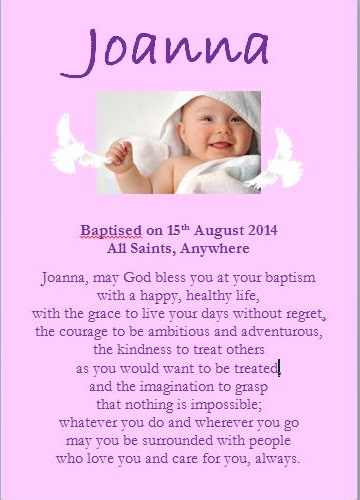
Baptism personal prayer for websiteAlso ask the parents to send you a photo of their child.  Once the prayer is finalised, use it, together with the photograph, the name of the child, and the date and place of the baptism, make it look attractive, and put it in a frame (about A6 size works well) so that you can present it to them on the day. Many families will keep this as a treasured possession, display it in their home, and even ask for more copies to send to godparents and grandparents.

  • If you save it as a jpeg and email it to the parents they can share it on social media.
  • You could also use it on a baptism anniversary card
  • How about printing out enough copies on paper (without the frame!) for the family and friends who have come to the christening?
  • If you get a chance to meet the godparents in advance of the service, you could invite them to write a prayer too.
  • You can use prayers written by parents or godparents in the christening itself – they may wish to read them out, or they may prefer the vicar to do it!

A Friends’ Prayer

At a christening there may be dozens of others, not just godparents, but wider family, friends and neighbours, who all have one thing in common: they have come to church to celebrate the life of a child, to be part of something, and to wish that child well.  This goodwill and presence is an immense gift.  How can it be ‘harnessed’ and enfolded prayerfully both in the service and beyond?

Here are a couple of ways you could enable all those who come to a christening to be involved, to contribute their own prayers and hopes:

  • stick a post-it note onto each order of service, and leave pencils in the pews, and invite people (at some point in the service) to write just one word on their post it note, expressing their prayer or hope for the child being baptised. You can ask them to leave their post-it note on the service sheet, and peel them off after the service, or you could gather them in at some point during the liturgy. If your church is well resourced you might even be able to afford ‘posh’ post-it notes (a nice colour, an interesting and appropriate shape etc).
  • Have a graffiti board as people come in (or as they go out, or both) inviting one-word hopes and prayers.

You may get multiple copies of ‘peace’ ‘love’ ‘friends’ ‘happiness’ ‘laughter’ etc, and that’s ok.  People don’t have to write something different from everyone else, they should be encouraged to write whatever feels most important. They can write several contributions if they like – but each should be one word long.

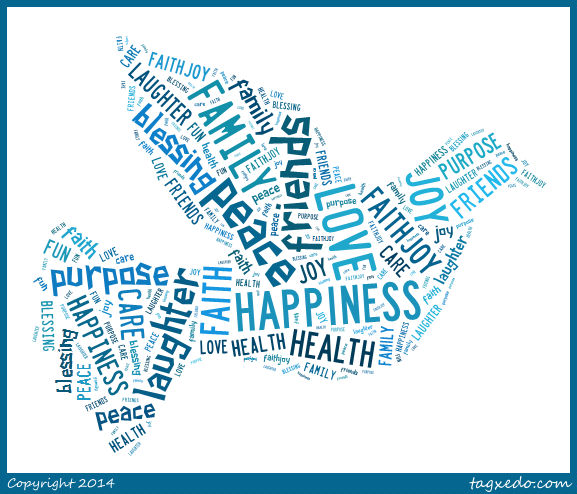
Baptism tag cloud - doveHowever you collect the words, it’s what you do with them after the service that makes this into something beautiful.  Go to www.tagxedo.com or a similar site and type in the words (include each word as many times as it was contributed – if 25 people all wrote ‘love’ then type it in 25 times!), then simply click to create a beautiful piece of word-art that is a prayer for the child written collectively by the whole gathering on the day.  On most tag-cloud creation sites you can configure colours, shapes, fonts etc.

  • If you save it as a jpeg, you can email it to the family and invite them to share it on social media or email it round to their friends who came on the day.
  • The illustration above is just a sample – when creating this for a real child, you could also type in their name (multiple times) so that it is featured in the finished piece of word art, to make it even more personal.
  • Again, you could keep the jpeg and send it to the family for the anniversary of the baptism, and encourage them to share it on social media.
  • The tag clouds don’t include photos, so an album of them could be kept in church without anyone having to worry about the child protection issues around keeping or displaying photographs of children.

Because these ideas involve computers and websites, it may be that you know a teenager who would like to make them for you, as their ministry….  They may have more ideas about how to create something beautiful as a lasting and net-share-able gift for those who come to church for baptism.

The solution to the votive candle problem you’ve all been worrying about

Actually, this solves two problems:
1. After All Souls you have a whole pile of half-used tea lights – you don’t feel right keeping them for next year because you want to give people a ‘fresh’ one, so what do you do with them all?
2. You want to give out those 10cm by 1cm votive candles at a service (let’s not go into why – maybe it’s Easter, or a baptism) but they just don’t stand up on their own, and you have to provide everyone with those little card circles to catch the drips, and it’s a bit of a faff.
So, what do you do?
Simple!
1. Re-light your tea-light, and wait for a small puddle of wax to form, approximately 1cm in diameter.
2. Stick the bottom of your 10cm votive candle into the puddle of hot wax (this will extinguish the flame as it squashes it) and hold it steady for a few seconds as the wax begins to harden.
3. Leave for 10 minutes to harden completely, and hey presto, you have a 10cm candle that stands up on its own, catches its own drips, and makes those old tea-lights feel as if they still have something to offer.
You don’t have to do one at a time, you can do large batches at once, and you can do it while you’re doing something else, such as talking on the phone.

The BCP: the Bus of Common Prayer

Warning: I am not absolutely sure myself about how much of this is a genuine suggestion and how much of it is a very silly piece of fantasy satire.

How many clergy (and indeed others) who are involved in rural parish ministry have lamented the Sunday morning rush between multiple tiny congregations, and the reluctance on the part of many parishioners to travel within a benefice in order to have fewer, more populous services?

The solution may be here!  All a benefice needs is an old bus, preferably one with a toilet, and a wheelchair friendly ramp.  Buses are already equipped with what basically amount to pews (and they’re an awful lot more comfortable than most church pews!), a heating system that works, an an area at the front where one could install a drop-down altar (rather like a caravan’s dining table).

And here’s the clever bit: You could devise a liturgy that begins and ends with hymns, which could be sung as the bus drives round the various villages picking people up and then dropping them off afterwards (you could even order the hymns and time them according to the legs of the journey so that everyone heard each one once).  Do most buses these days have a means to play music? They must do, surely – even an old cassette player would work for the hymn accompaniments.

Then, the main bit of your liturgy would take place once everyone has been picked up – it could be anywhere, to be honest, it doesn’t need to be anywhere near a church, it could be in a field, somewhere with a nice view, just somewhere convenient. It could even be in a different place each week…. So, you park up, stop singing hymns and get on with Matins, or Holy Communion, or whatever it is you’re doing, you put the collection in the bit where the bus fares would normally go, and then once you’re had the final blessing, you drive back round the villages dropping people off, and singing the hymns as you go.

Is this a mad idea?  Probably.

Is it more mad than the alternative?  Maybe not….

Is there anything that can enable rural communities to experience and enjoy worshipping together, give them confidence to stray beyond their usual boundaries, and think out of the box?

Everyone agrees the bus services to rural communities leaves a lot to be desired. But maybe that’s because they haven’t tried this kind of Bus Service.

Addendum: since posting I have been told about the phenomenon of spontaneous ‘churching’ of public buses in Jamaica, and you can read a bit about it here.

Resources for Bible Sunday

I thought I’d write up some ideas for All Age activities on Bible Sunday, in case they are useful.

1. Bible Timeline

You will need: washing line, clothespegs, and a whole bunch of pictures of bible stories (mix of Old and New Testament, ideally covering as much of the bible as possible, creation to Revelation) – if you like, also print out some bible verses or passages.  It’s not too hard to find suitable pictures by searching google images or similar. It works best if you laminate your printouts, so that you can use them again. Before the service, leave all the laminated pictures and bible verses around the church.

Introduce the idea that we often hear Bible stories on their own, but we don’t get many chances to look at the big story.  Get out the washing line and pegs – and ask for two people to hold the ends of the line.  Ask people to look at any pictures and verses that they find near them, and try and work out where on the Bible timeline they might go – establish which end of the washing line is creation, and which is revelation, then invite people to come forward and peg their picture or verse to the line. Chaos may ensue, but that’s OK – you can wander up and down the line pointing out some of the stories, wondering aloud about the order etc.

Have a look together at the finished timeline, and pose this question: if this were a song, and all the different pictures were the verses of the song, what sort of thing would you expect to find in the chorus?  Is there something that ties together all these different stories? Are there some key words or images that we’d expect to find in the chorus?  Ask for suggestions.  If you have someone poetic in the congregation (or if you’re good with words) you could have a go at writing a chorus – perhaps to a well known hymn tune, or set people the challenge of writing one after the service.

If you can display your timeline somewhere in church after the service, people who come in will be able to see it, enjoy it, and interact with it. You could leave the question there too, on a large piece of paper with a pen next to it, and invite anyone who comes by to add their suggestions for what they think should be in the chorus.

2. Scrapbook

Before the service, get hold of enough pens and coloured paper (approximately A6 size) for everyone in the congregation. You will also need a scrapbook (big enough to hold all the papers) and some glue, and someone who is willing to help stick paper into the scrapbook during the service after the talk.

Start by telling everyone what your favourite bible story is, and why – or it could be just a favourite verse. If you remember how you first heard or read that story, you can tell that, too – it might be that you remember it from a children’s bible, or it may be something that became important to you later in life.

Invite everyone to write on their piece of paper their favourite verse, or draw a picture of their favourite bible story. If they want to add a note about why it’s important to them that would be great, but they don’t have to. While everyone is busy drawing and writing, you could ask if anyone wants to share aloud what they’ve chosen.

Remind everyone that the stories in the Bible are meant for telling, for sharing, and if a story or a verse has been important to us, then it might be good for someone else, too.  Collect the papers, and ask your helper to stick all the pictures and verses into the scrapbook, so that it is ready for the end of the service. At the end of the service, just before the final blessing, hold up the scrap book and offer all that it contains to God, with this or another suitable prayer:

Father God,
you spoke your word to make the world,
you spoke your word to your prophets to guide us,
you spoke your word in scripture, to tell the story of your love,
and you gave us your living Word, Jesus Christ.
Bless us in our hearing and reading,
bless us in our writing and drawing,
bless us in our telling and sharing,
and may our work today be a blessing
to ourselves, to one another, and to all we meet. Amen.

Display the bible at the back of the church, near the door, and encourage everyone to look at it and enjoy it over coffee, or as they leave.

3. Story swap

You will need: small pieces of paper, as in the scrap book activity (approximately A6 size), and pens – enough for everyone in the congregation.

In this activity, you can encourage everyone to draw or write their favourite bible story or verse on their paper, as in the scrapbook activity above. But instead of collecting the papers and sticking them in the scrapbook, ask everyone to stand up, if they’re able, and move around the church so that they can start swapping their papers around.  As they swap papers with someone, encourage them to share why that verse or story is important to them. Everyone should end up with a different piece of paper from the one they started with – this is theirs to take home.

Wonder together about the variety of stories, wisdom, law, poetry etc that there is in the bible – and how parts of the bible may fill us with hope, or comfort, while others are challenging.  Wonder about how the Bible and shaped us, and taught us, and how we in turn shape and teach others in the words and images that mean most to us.

You may also wish to encourage people to take their new piece of paper home, and give it to someone who wasn’t at church, telling them the story that is depicted on it, or sharing the verse written on it. Or, they could put it somewhere prominent at home – on a notice board, or mantle piece, or stuck to the fridge with a magnet.

(The aim of this activity is to encourage the congregation to feel more confident about sharing something of their faith).

4. Bible Sunday Hymn

For anyone who missed it last year, here’s a hymn for Bible Sunday.
Usual rules apply: help yourself, no need for CCLI etc.
Tune: Regent Square, or other compatible 878787 tunes.

Word of life! Such transformation!
bringing light to darkest space;
loving mother of creation,
forging life in every place.
Shine that light on every nation,
gather us in your embrace.

Word of truth! You spoke though history,
prophets knew you as their friend;
As you shared with earth the mystery
of your love that knows no end.
Yet your fullest glory must be
More than words can comprehend.

Word made flesh! You came to meet us,
pitched your tent among our own,
Born on earth so heaven could greet us:
God in human heart and bone.
Teach us, lead us, tend us, feed us
with the life that’s yours alone.

Words of scripture, here you teach us,
All you speak is here received.
Shared by print and voice to reach us:
written, read and now believed;
Speak again to all and  each, as
faith is grown and life is lived.