
For what, exactly, are we supposed to be ready?

A sermon on Luke 12.32-40

What matters most to you?  Take a moment to think about it.
People?  Values?  Things?  “Where your treasure is, there your heart will be also,” says Jesus in today’s gospel.  But he’s not making some simplistic division between earthly things (= bad) and heavenly things (=good) but rather inviting us to live as heavenly people, to live in acknowledgement of the fact that by virtue of being part of God’s creation, we are heavenly people, created to enjoy God for ever and to be part of his family and household. Our treasure is with God because God holds in his hands all that he made, all that really matters.

So how does that relate to the next bit of the reading, the part about the slaves. We may be very uncomfortable with the language, and it may have quite different connotations in our modern society in which we (mostly) tend to assume that slavery is a thing of the past.  But the difference between a slave and a more palatably-titled “servant” is that a slave actually belongs to the household, to the master of the house.  And if the master of the house is God, then belonging to him and to his household may not be such a bad thing after all.

And the work of the slaves is mind-blowingly important work – the master has entrusted his whole household to us, the care of everything that belongs to him, everything that he values. What an awesome responsibility, and what an awesome display of trust and affirmation!  In the household of God the work of the slaves isn’t polishing the silver and sweeping the floor, it’s building the kingdom, it’s working to make sure that everything that belongs to God (and that really is everything!) is how God wants it to be.

To do that work means we have to have some idea of what God wants his household to be like. What are the values by which God would like this household to run itself?  These are the values to which we work. Our work is no less than shaping God’s household into the sort of household he wants. Between us all, that means doing everything, and working out what our own task is within this great and noble work is the most crucial thing we’ll ever work out. And then getting on and doing it is our life’s work.

That’s why we won’t misunderstand all that stuff about being ready.  I have a friend who has a T-shirt with a picture of the Holman Hunt ‘Light of the world’ painting, with the caption, “Jesus is coming, look busy!”  That’s not it at all, being ready isn’t a clever guessing game about when precisely to get off our collective backsides and look as if we’re working hard just as the boss comes home. It’s about simply getting on with the task that God’s given us to do, because it’s the whole household that’s got to be ready, not just individual people in it.  The master doesn’t want to come and find slaves that look busy in a house that’s still a tip.  Being ready means getting on with our part in making God’s world nearer to how he created it to be.

And that incorporates our care and compassion for one another, for the environment and natural world, our economic choices and the impact they have on the world economy, and our lifestyle choices and their impact on our society and community, and much more besides.  We might look on the world around us and despair of it ever becoming more like the kingdom of God.  And we might long for a Revelation-like vision of the whole earth being recreated perfect.  And then we remember that God does, in fact, have a whole army of slaves whose job it is at least to begin this process of transformation and renewal.  It is we who build the kingdom according to God’s design.

Working out what that looks like can be hard – what does God actually most care about?  We should ask him.  We should pray, and read scripture, and think together and discern, and start to develop our own understanding of the values of God’s kingdom, God’s household, so that we know what we’re working towards.

And the end result of all this?  The story doesn’t talk about judgement, about failure, about bad slaves being sacked, or cast into outer darkness. It talks about how the slaves were ready, and that when the master comes home they’re invited to sit round his table and he serves them their dinner.   The slaves weren’t working for some other person’s benefit at all –  it turned out that all that preparation, all that cleaning and clearing of the table, all that polishing of chairs, all that washing up, was so that when the master came home he could sit down with his whole household and be a family.  That’s what they had to be ready for. That’s what they were preparing for all this time.  They had to be ready to be part of the family and household of God.  We have to be ready to be part of the household and family of our beloved heavenly Father.  And I sometimes wonder if we are.

We work to make earth like heaven because we want to be part of it; and the more we help to create the kingdom of heaven the more ready we are for it.  Everything we do here in church is supposed to be a foretaste of heaven, from the welcome when you come in to the sharing of coffee afterwards.  But more than that, everything we do in the rest of life is also supposed to be making earth a little more like heaven  – the encounters we have at work, in the street, in the shops, these are all opportunities for kingdom-making and kingdom-growing and kingdom-building.

And that’s what the story of the ‘ready slaves’ has to do with the treasure in heaven, and why far from being an injunction to separate a bad world from a good heaven it’s actually about being part of God’s ongoing work of reuniting the two.  And it’s about our own readiness to be wholly part of earth at the same time as we are children of heaven.
A sermon for Mothering Sunday (with baptism) – John 19.25-27 & Colossians 3.12-17

I have to admit that I’ve never done a baptism on Mothering Sunday before, but it’s great today to have baby Hannah and her mum, Sam, with us – living breathing witnesses to the joy and miracle of motherhood, but also of its challenges.

Because this is Mothering Sunday, everyone here today comes with a different set of experiences – some of us come with thanksgivings, others with sadness, some with guilt, and others with worries and concerns, some of us come in joy, and others come with a whole mix of confusing feelings.  Because of this it can be hard to find the right words to meet everyone where they are, and I rely even more than usual on God’s unerring ability to reach out to people’s hearts, whether through my words or in spite of them.

Colossians 3 seems like the easier reading this morning: it’s a list of good characteristics and habits that we probably all wish we had more of or were better at. Sam will need every single one of them as she embarks on the lifetime’s vocation of being Hannah’s mum.  And she’ll hope to teach Hannah to grow into those characteristics, too.  The reading talks about these things as if they were clothes: “Clothe yourself with compassion, kindness, patience… above all clothe yourselves with love…”  At the moment Hannah can’t dress herself, but as she grows, she’ll need to learn not only how to put on socks properly and how to do the buttons on her school shirt, but also how to start every day by clothing herself in all the virtues in this reading, and more besides.  Like all of us, some of them she’ll find easier to wear than others. Hopefully most of them will become so familiar that they are like old clothes, well-worn and comfy.

If Colossians 3 is the easy reading, then the very short gospel reading we heard from John 19 is the hard one – in this reading we see Jesus on the cross, about to die, and his mum standing there beside him, together with his best friend.

In a way, John 19 is the ultimate test of Colossians 3.  Are those ‘clothes’ in Colossians 3 really up to the task of real mothering?  The sort of mothering that’s done at the foot of the cross?  Sometimes it seems as if the ‘clothes’ of patience, kindness, and the rest are worn so thin by the challenges of life that they go beyond the ‘old and comfy’ stage and become no more than rags.  Maybe that’s how Mary felt at that moment.

Mothering Sunday contains within it not only thanksgiving for the great gift of motherhood, but also:

–        The patience of the person who longs to be a parent and the frustration and heartache if it doesn’t come to be;

–        The love of a parent that turns to overwhelming grief at the loss of a child – or a child at the loss of their parent;

–        The wisdom of a parent in teaching their child right from wrong, and the endless worry of that same parent about whether those lessons will stand up to the rigours of real life decision-making;

–        The forgiveness by a parent of their child’s misdemeanours, but the often crushing guilt about their own failings as a parent.

–        The compassion of those who care for others, often at great cost, and the anger at those who were supposed to care, but didn’t.

Mothering Sunday is all this and more.  It is complex and ambiguous for most of us – an annual nightmare for some, and an occasion for great joy and thanksgiving for others. Can all of these things possibly be reflected in our readings?

What we see in Colossians 3 is a model to live up to, a list of virtues that we know would make the world an infinitely better place if only we could all live up to them.  It is the gold standard not just for motherhood, not just for parenting, but for human existence.

But what we see in John 19 is God’s way of dealing with it when it doesn’t work, when we fail to be all that we’re called to be.  Jesus is only on the cross because humanity isn’t living up to that call to compassion and kindness, patience, humility, peace, wisdom, and the rest.  The cross is what happens when God meets all our failings head-on.

And in this one tiny moment during the passion of Jesus we see God’s unstoppable and creative capacity for redemption and new life. Even from the cross, Jesus looks down at his mum and at his best friend, and entrusts them to each other, creating a new family out of what looked like irreparably broken pieces.

John 19 tests Colossians 3 to the limits, and finds that actually, a narrow definition of motherhood and mothering is not enough.  There’s a well-known saying, origin unknown, “It takes a village to raise a child,” in other words, every single one of us needs more mothering than any one mother could ever provide.  And although motherhood is a unique honour and challenge, all mothering takes place within families and communities and networks of support and influence.

All through his ministry, Jesus redefined the idea of our accountability to one another, he challenged people to rethink what compassion and forgiveness meant, and showed again and again that love has no limits.  He kept on doing all of this even up to the moment of his death.

Jesus was starting to create a community that really did live up to the ideals of ancient Israel, and the commandments to respect and care for all people, including the widows, the orphans, and the strangers. The letters in the New Testament pick up where Jesus left off, showing the embryonic church how to order itself in such a way that every single person gave and received love and care, every single person was provided for, every single person reached their potential, and fulfilled their God-given calling.

Parents have a unique role in shaping their children to be the people God made them to be – as Hannah’s mum, Sam’s responsibility is immense.  But she is not alone.  Not only does Hannah have grandparents who love her to bits, she also has five godparents, each of whom, I know, has taken their role seriously, and in a moment will promise to be there for Sam and for Hannah not just for today, but for a lifetime, to walk with them on their journey of life and faith, and to work out what the baptism promises mean in real life, at every stage of life.

The huge importance of Godparents at baptism points to the role of the whole church community in the formation of children (and indeed of adults, too) into individuals who ‘wear well’ the patience, kindness, love, peace and humility of Colossians 3.  At the same time the church is also called to become a community that is defined by those same characteristics.

In the old days, before Mothers’ Day was invented, Mothering Sunday was a feast of the Church, celebrating ‘Mother Church’, drawing her children to her like chicks under the hen’s wing.  If we live by the values in Colossians 3, and test them in the fire of John 19 and of all the most difficult and hard-to-bear situations faced both by the people close to us, and by our fellow human beings across the world, then we really will have a church that lives up to the ideal of motherhood, and we’ll have a church that supports all those upon whom the burden of care falls most heavily.

Whatever feelings this Mothering Sunday brings for you, may this be a place and a time for you to receive through the grace of Christ in scripture, in holy communion, and in fellowship with one another, the assurance of the overwhelming, creative, mothering love of a God who would and did do anything and everything for her children, and in whose arms we are all, living and departed, held and treasured for all eternity.

Amen.

Ash Wednesday sermon 2013

What do we actually do today?

For want of a better way of putting it, I think we turn ourselves inside out. For one day, we show each other and ourselves what we’re really like. We put a messy cross on our foreheads to say, publicly, ‘I have mess. I have sin. I am not right. I need help.’

Today is about honesty. About admitting that we’re not perfect. Admitting that there is much in us which, left unchecked, will prove destructive for us, for those around us, and perhaps beyond, too.

Ash Wednesday can be seen as a service that condemns, that concentrates on what is wrong.  But as some of you may have noticed from what I tend to preach, I have this unrelenting urge to find good news in things, and I want to find good news in the ash, too.   When you start looking, there’s lots of it.

The first bit is that this service doesn’t work if only one person comes.  If I was on my own tonight (which I might well have been, given the snow), it would not work. Why? Because the ash cross is a great leveller. It says, my sin is my own, but I am not alone in being a sinner.  It’s precisely what we see in today’s gospel reading: the woman taken in adultery is not alone. Her sin is her own, but she is not alone in having sinned. That’s the first bit of good news.

The second bit of good news is that although this is the day when we tell ourselves and each other than we are messy people, full of dirt and sin and shame, the fact is that God already knew.  The fact that we are sinful, that humanity as a whole is sinful, is not news to God. He sees us for who we are – perhaps God is the only one in the universe who truly sees us as we really are, inside – and he still loves us. Infinitely. That’s the second bit of good news.

The third bit of good news is that when we receive the ash on our foreheads we are told ‘remember that you are dust and to dust you shall return.’  We hear these words and we might remember the second account of creation in Genesis, in which God lovingly puts his hands in the earth and shapes a human being out of the dirt, breathing life into its nostrils.  The fact that we are dust is testament to God’s creativity, and God’s ability to bring life out of that which seems dead.  God has done it once. He can do it again. And again.  That’s the third bit of good news.

The fourth bit of good news is that the ash cross is tangible, and visible. It feels real.  It’s an action which changes us on the inside – the church would call what we do tonight ‘sacramental’.  The classic definition of a sacrament is an outward and visible sign of an inward invisible grace, whereas the ash cross is almost the opposite: an outward and visible sign of an inward and invisible lack of grace!  It means that our ‘sorry’ isn’t empty, but feels real.  And that reality is something that needs to be carried forward into our thoughts and words and actions beyond our repentance tonight. The ash reminds us that what we do, our action, the things that people see when they look at us, and what they hear when we speak – these things shape who we are inside as well as changing the world around us. We have a lent’s worth of actions ahead of us that can help us become more who God created us to be.  We may not be able to make good on all our past sins, but our actions and words can bring us closer to being who we are meant to be.  That’s the fourth bit of good news.

And finally, the fifth bit of good news is that we can wipe the ash off our forehead.  It’s not a brand, there for ever as a reminder that we are sinners. It’s a temporary mark, which rubs off to remind us that we sinners who can be forgiven.  Whether you keep your ash on for the rest of the evening, or wipe it off later in the service, there comes that moment when you remove the sign of your sin.  At school, on ascension day, we draw a cross in glitter on our foreheads – to remind ourselves and each other that we are called to ‘shine as a light in the world to the glory of God the Father’.  It’s a long way to go till Ascension Day, but that commission, to be the body of Christ, to witness to the peace which can, against all the odds, exist between earth and heaven, and to reveal the glory of God, starts now.  That’s the fifth bit of good news.

The Transfiguration

Some thoughts on Luke 9.28-36

I wonder if you’ve ever had a moment of absolute awe and wonder? A moment when time had no meaning, when it seemed as if the universe was in technicolour, and you were swept up by it, even overwhelmed?

Wedding couples often tell me that their marriage service felt like this – they expected it to feel special, but it surpassed their ability to imagine.  For that glorious day, and especially for that glorious 35 minutes or so, they are transported out of their normal existence and are part of something that is far bigger and more magnificent than any of us.

If you’ve been blessed by such a moment, you may well have wanted to hold onto it, to make it last for ever. But such moments tend to be glimpses, slipping through our grasp, or dissolving like mist. Those who experience many such moments may find that they are hugely important to them, crucial in their spirituality and faith. Others may never experience such a moment, and may be acutely aware of missing out on something very special.

Jesus’ disciples saw a lot of things during their time with him, many of them strange, many of them challenging, some of them downright incredible. I wonder how significant it was that when it came to his transfiguration he took only his closest friends with him?  This wasn’t just a revelation kept to the disciples rather than the larger crowds who followed Jesus around; it was kept even from the rest of the Twelve.  I wonder if they knew that they had missed something significant?  And, what was it, precisely, that they had missed?  What was it, that Peter, James and John, and actually witnessed?

My experience of reading the gospels and then preaching on them has been that everything that’s included is there for a reason – each verse, each little story, each saying, each event that’s narrated, tells us something about Christ. My confirmation candidate and I tested this theory the other day, by reading just one chapter of Mark and writing down everything about Jesus that we discovered in the chapter.

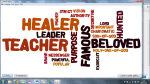
Mark 1 wordle

We used single words, and used them to create a wordle – this is a wordle that represents Mark chapter 1.

If we had read Luke 9 and done the same thing, I wonder if the worldle would have looked very different?  It’s a chapter which is rich in stories, sayings, happenings, miracles, arguments, and more; reading it, we learn a great deal about Jesus, just as the crowds and the disciples and his most trusted friends must have done. It’s a chapter in which more of Jesus’ identity is revealed, layer by layer. So what is it that we learn about Christ in this most mysterious of happenings?  

It’s as if for one moment the veil comes off, and we see Christ in all his glory, timeless, awe-inspiring. In short, God. That’s what Peter, James and John see.  And they want it to last. They’ve been granted a glimpse of heaven, and they want it. As ever, Peter is the one to put his foot in it, talking about making dwellings for the three figures, but he’s only saying what they’re all thinking: if only we could keep this moment, if only we could stay here, in this little patch of heaven, for ever.

And you can see why.  I remember reading C S Lewis’s The Great Divorce when I was a teenager, and falling in love with his vision of heaven, and then crying my eyes out when the central character discovers that his time in heaven had been all a dream and that he has to return to a world that is not only terribly earthly, but also frightening, and dangerous. Peter and the others knew what their world was like, and that it was a very hard place to live and to thrive.  They, along with all God’s people, longed for a time when the Messiah would come and save them – for some this was a very practical desire for God to defeat their current oppressors, the Romans, but for others it was a much more eschatalogical hope, that God would finally bring about his heavenly order in the wayward world and that there would be a real and lasting peace with the people of God at the beloved centre of it all.

Can you blame Peter, James and John for wanting that moment to be right then? And for them to have been just the first stage of the salvation of Israel? And then finding out that the whole thing was only a glimpse?

That walk down the mountain must have been a long one. No wonder they were able to avoid talking about their experience with anyone.  It may well have been a long time before their disappointment gave way to courage and hope again, and they could recapture the joy and awe of the vision – by the time the story was told and the gospel was written down, they’d had time to interpret what they’d experienced, but at the time…?

So why give them this glimpse? Why show a tantalising snapshot of heaven and then not let them stay?  There are probably a million answers to this question, but mine I think has to be this:

Heaven is eternal, beyond time and space.  But there are aspects of the character of heaven that can be nurtured on earth.  Jesus talks a lot about the Kingdom of God, about how it is already near, but that our own behaviour, our own choices, bring us, and the world around us, closer to heaven, or drive us further from it.

Perhaps the transfiguration is a reminder of the truth of how near heaven is, that it might break through any moment. But perhaps it is also a reminder that our experiences of ecstasy, if we have them, are there not only for our own edification and spiritual growth, but for the transformation of ourselves, inside and out, so that we can be part of what transforms the world.  I have no doubt that Peter, James and John, were transformed by their experience on the mountain.  But their calling wasn’t merely to be transformed, it was to let their own transformation become something that guided their words and actions, making them part of how God was bringing earth and heaven closer together.

I’m not even going to ask whether coming to Holy Communion constitutes a powerful spiritual experience. Perhaps sometimes it does, and other times it doesn’t. Perhaps it’s to do with whether the sunshine has broken through the clouds by 8.30 to illuminate the chancel, perhaps it’s to do with us arriving with just the right openness of mind and heart, perhaps it’s to do with the quality of the poetry in the epistle, or the quality of the silence just before the Lord’s Prayer  – these are all things that can lift the ordinary into something special that can start to transform our mundane souls.

Whether we feel it emotionally and spiritually or not, in a service of Holy Communion we come into contact with something profound, and we receive the grace of God, so we shouldn’t leave church as exactly the same people we were as we came in.  And we should be able to take a little of that heaven with us when we go.  What will we do with it? With whom will we share it?  Not by talking about what it felt like taking communion (remember Jesus told his friends not to talk about what they’d seen) but by letting our closeness with heaven rub off in our dealings with others, and with ourselves.  And that’s something that could change our little bit of the world and beyond.

What do those words look like in real life?

A sermon for Epiphany 4 (C) 2013: Luke 4.14-21 & 1 Cor 12

I wonder how many of us have ever had that feeling after reading or hearing a Bible passage, that it was ‘all about me’ – you know, that feeling that it was somehow either fate or God’s plan that that particular reading was read on that particular day, with you sitting there hearing it, and realising how much it applied to you? That it challenged you in just the way you needed to be challenged? That it brought you the exact words of comfort that you most needed to hear? That it gave you that bit of guidance that set you on the path that God had in mind for you? Often it’s bible passages that are very familiar to us that can strike us differently and unexpectedly at such moments. We may have heard a verse a hundred times, but the hundred and first time  it hits us between the eyes, and we think, ‘That verse was written for me, today.’

Jesus must have had that feeling a lot. While he was in the wilderness he had relied hugely on scripture – as a witness to God’s enduring love and faithfulness – to withstand the temptations of the Devil.  Now, he’s back in civilisation, in fact, he’s back in his home town, and it’s another well-known passage from the Hebrew Bible that happens to be set for that day, and Jesus is the one whose turn it is to read.

Jesus is full of the Holy Spirit – still from his baptism, and then again from his wilderness experience. And he reads Isaiah’s words ‘The Spirit of the Lord is upon me’ and knows at once that this passage doesn’t just feel like it’s written for him. It really is for him, and about him.  It’s another of those moments (and those moments are now coming thick and fast in Jesus’ life) when his sense of identity as the Messiah is deepened, strengthened, broadened.  Those words from Isaiah are for him. They are part of what will help him set the agenda for the next three years  – for the whole of his earthly ministry.

So what Isaiah goes on to write next is of crucial importance, because it’s Jesus’ manifesto, it’s his vocation.  He is to be one who brings good news to the poor, release to the captives, recovery of sight to the blind, and freedom for the oppressed, and who is to proclaim the year of the Lord’s favour.

So, Jesus reads the words of Isaiah, and already as he reads it seems as if some of the congregation realise that there is more going on here – that this is more than just another reading, this is something else. He confirms it – his first sermon begins by telling the people that Isaiah’s prophecy is now being fulfilled . In him.  No wonder all their eyes are fixed on him.

These are the words that turn Jesus turns from carpenter’s son to Rabbi, from local boy to itinerant preacher and healer, from ordinary man to Son of Man. These are the words that set him on his way. These are the words that must have reminded him, again and again, of the nature of his calling: freedom, healing, the favour of the Lord, good news…. These are the words that come to life in Jesus’ own life, and these are the words that he uses to start his work of transforming the world. It was as if he said to the people gathered in that Nazareth synagogue, “You’re about to see what Isaiah’s words look like in real life.”

It seems right that Jesus’s ministry begins in his own home town, especially since Nazareth wasn’t a particularly important or nice town, it was no Jerusalem, it had no track record of producing great leaders and teachers. It was ordinariness itself.  It is in keeping with the God who chose to become a human being that he also chose to set out the manifesto of the Messiah in a downmarket provincial town, and that the people who heard it were just those faithful gathered that particular Sabbath.

There are Nazareths all over the world. Certainly all over England. Ordinary places, full of ordinary people, who know that all the exciting things happen Somewhere Else, and who do not expect the Messiah to appear in their midst.  If that’s us, then this gospel reading should stir us up a bit.  Especially if we put it together with today’s epistle, which speaks of the church as the Body of Christ.

Why? Because in the gospel reading we start to see the first stage of Jesus’ transformation – the body of Christ gradually turns from being the physical body of a carpenters’ son and eventually becomes the metaphorical worldwide body of the church, who meets in Christ’s name and undertakes to continue his work.  There is absolutely continuity between the work of God that Jesus started and the work of God that we are supposed to be doing, right now. If Isaiah has set out Jesus’ manifesto, then he’s also set out ours.

And that’s another reason why it’s good that all this happened in Nazareth.  Because Nazareth is here. It’s Huntingdon, it’s St Neots.  It’s all the places that most people would say probably aren’t the centre of the universe.  An ordinary place is where Jesus started his work, and this ordinary place is where we are to begin our work.

Jesus went out from that place and spent three years seeking out those who needed healing, three years proclaiming the good news, three years helping people find freedom from the many things that were oppressing them, and ultimately on the cross, enacted the good news of the sacrificial love of God in his own body, experiencing death so that we could might never be captive to it again.

But it starts here.  In the place that we are. In these familiar streets, with these familiar people.  So it is also our calling to proclaim the good news we have heard, and not only that but to live it out, as Jesus did. To be people, and to be a church, which will bring healing, peace and reconciliation, that will fight for justice and freedom for those who are oppressed in any way, or held captive by their own condition or by the actions of others, that will show by how we live that this is the year of the Lord’s favour, that God’s love for the world is real and active, and that his blessings are manifold.  We, too, need to show the world what Isaiah’s words look like in real life.

This is what it means to be the Body of Christ.  No less. But crucially it is by being who we are, in our ordinary situations, that we can do this best.  Jesus’  manifesto was made public in the most ordinary place. So, in whatever ordinary places we find ourselves today and tomorrow, next week, next month, and next year, let us pray that God would help us to see how we might be the Body of Christ and continue Christ’s work of transformation, healing, renewal and love in our ordinary corner of the world. For when we do that, there are no ordinary places, and there are no ordinary people.