Hymns for All Souls

First, a new one that is simple but functional, and can be sung to Tallis Canon or similar (just help yourself, it’s not on CCLI yet):

O God of love, at close of day,
we gather here to watch and pray;
be present through the hours of night,
to all our shadows, bring your light.

Through song and silence, word and prayer,
we place this world and all its care,
beneath the shadow of your wings,
O God from whom all blessing springs.

We place into your hands to hold
and, in your arms of love, enfold
each lost and grieving weary soul,
that by your grace we may be whole.

We pray for rest and peace at last
for those whose earthly life is past;
may we with them be met with love,
and find our home in heav’n above.

O God, Creator, Christ, the Son,
and Holy Spirit, three in one:
to you our gathered voices raise,
as earth and heav’n unite in praise. Amen.

And one a wrote a while ago, that’s now on Jubilate (so you can stick it on your CCLI):

https://www.jubilate.co.uk/songs/o-lord-your-loving-hands-can-hold-

O Lord, your loving hands can hold
this world and all its care,
the grief and loss and pain we feel,
when desperation makes us kneel
in silent, wordless prayer,
in silent, wordless prayer.

O Lord, your loving hands can hold
the burdens that we bear,
each sorrow, every past regret; 
we ask that in our hearts you’ll set
your peace beyond compare,
your peace beyond compare. 

O Lord, your loving hands can hold
the souls of those we love:
our trust in you is not in vain
that all, through grace and faith, may gain
a place in heaven above,
a place in heaven above.

O Lord, your loving hands can hold
our future and our past:
And as you bless us on our way,
and travel with us night and day,
your love will hold us fast,
your love will hold us fast.

Who is Jesus? Who are we?

A sermon for 15th September 2024 (Trinity 16 B – proper 19)
Isaiah 50.4–9a, James 3.1–12, Mark 8.27–38

I haven’t posted a sermon for ages, as I don’t usually write them out in full, but here goes.

‘Who do people say that I am?’ Jesus asks.

He knows that people have strong views about him – by this point in Mark’s Gospel he has been adored, admired and believed, but also criticized, doubted, misunderstood, even threatened. The disciples aren’t sure how to answer Jesus’ question because the answer would depend very much on who you ask!

Maybe because they’re his friends, they don’t remind him that he’s been called him a lawbreaker or that some people think he’s possessed, but stick to the more positive things they’ve heard: that Jesus might be John the Baptist or Elijah or another of the prophets come back from the dead. These aren’t unreasonable suggestions. Jesus speaks and acts powerfully: so far in Mark’s Gospel he’s controlled the weather, healed people, miraculously fed a crowd of several thousand, and challenged those in authority. He absolutely comes across as a prophet.

‘And who do you say that I am?’ Jesus then asks. Peter is the one who dares to speak. ‘You are the Messiah,’ he says. Not just a prophet but more than that, the one who is anointed by God, in whom there is hope for salvation, specifically freedom from oppression.

So, Peter is kind of right.
He has the right word, but hasn’t fully understood what it means, and it’s likely that others won’t either, so Jesus sort of sets that word aside in order to explain more.

Perhaps Peter should have remembered the words from Isaiah. The figure that Isaiah identifies as ‘the servant of God’ declares ‘I gave my back to those who struck me and my cheeks to those who pulled out the beard; I did not hide my face from insult and spitting’.  If those words sound familiar it may be because (in a slightly different translation) they are used in Handel’s great Oratorio, The Messiah. Today’s passage from Isaiah connects prophetic speaking with a willingness to endure suffering – a connection which all the old testament prophets would have recognised in their own experience, and which Jesus also sees as intrinsic to his vocation:   And so he begins to teach them that he must undergo great suffering, and be rejected. 

Peter could simply have turned the question round and asked Jesus, ‘well, who do you say that you are?’ But Jesus beats him to it, describing himself as Son of Man – on one level this is just ‘ben adam’ as in ‘human being’ or ‘a mere human being’ – that is,  someone who is vulnerable to suffering. But it also echoes the apocalyptic vision in the book of Daniel in which the Son of Man embodies the salvation and glory of God’s people no longer suffering but vindicated. Jesus as Son of Man makes perfect sense in today’s gospel because he’s talking about both his coming suffering, and the glory of the resurrection. 

So there is a lot going on behind Jesus’ original questions. They’re not trick questions but they are complex and multi-layered, so it’s not surprising that Peter misses the mark, or that the rest of the disciples don’t even feel confident answering at all! It feels like Jesus is bringing together a lot of important ideas that won’t truly make sense even to his closest followers until the whole story has unfolded.

What they need right now is to understand what it all means for them as disciples. Let’s start with Peter, and who he is.

In Matthew’s gospel, Jesus calls Peter as a disciple, drawing attention to his name, which means ‘rock’ to commend his faith.  ‘On this rock I will build my Church’ he says. By contrast, today when Peter questions Jesus’ coming suffering, he is given a rather more disturbing name: ‘Get behind me, Satan’ Jesus says. Seems a little harsh, right?.

We met actual Satan earlier in the gospels when Jesus is tempted by him while fasting for forty days in the wilderness. Matthew and Luke both provide more detail than Mark does, outlining three temptations, of which two are particularly relevant: Satan tries to get the very hungry Jesus to turn stones into bread, then tells Jesus that if he jumps off the top of the Temple it’ll prove that God won’t let him get hurt – Satan quotes Psalm 91, ‘his angels will bear you up, lest you dash your foot against a stone’. Jesus resists all three temptations and Satan gives up – for the time being.

Notice that two of the temptations mention stones, and remember that Peter has been named by Jesus as ‘the rock’.  This is a really key material image in scripture, with a lot of meanings attached to stones.  I don’t think it’s a huge stretch here to suggest that when Peter the rock tells Jesus that he shouldn’t suffer, Jesus realises it’s the same temptation again and it’s as if Satan is back for another go.  No wonder he reacts so harshly. Jesus resisted that temptation before and he does so again now. He’ll have to resist the same temptation in Gethsemane and on the cross.

So who is Peter in this whole incident? He is the rock, the one with the courage the speak and the insight to name Jesus as Messiah. But he’s also potentially a stumbling block, a temptation, someone whose words seeks to pull Jesus away from his vocation and purpose. Fortunately through the grace of God stumbling blocks can be repositioned to become the most amazing cornerstones. That’s what Jesus seeks to do: he is turning Peter from a dangerous temptation into someone who can grasp not just Jesus’ coming suffering but also his own.

Jesus rebukes Peter in front of all the disciples not to shame him, but because all he did is put into words what the others were probably thinking, and what many of us might be thinking too: this misunderstanding and mis-speaking isn’t a Peter thing, it’s an everyone thing, and we all need to hear the next bit of what Jesus has to say.

Which is where we move from asking ‘who is Jesus’ and ‘who is Peter’ to the question of  ‘so who are we?’

We may be, at times, people who wish that faith  protects people from the thorns about our path or from life’s storms.  As one of my favourite hymns points out, it is not that the journey is objectively easier if we have faith, it’s that we’re not alone in it: ‘be our strength in hours of weakness, in our wanderings be our guide, through endeavour, failure, danger, Father be thou at our side’. 

Who are we? We are people with someone to follow, someone who in his incarnation embraced the inevitability of suffering that comes with living a human life, as well as embracing the necessity of suffering in the story of salvation; a Saviour who stilled the storm not from the safety of the shore but in the company of his friends, from a flimsy, sinking boat.

We may be, at times, people who are tempted to deny or downplay the costliness of discipleship, of the life of faith.  We may be in denial in a global context about the ongoing threat of death or serious harm that faith can bring, or about the much lower level friction we may experience when we try to live faithfully in a complex world, or the emotional pain of trying to reconcile human suffering with what we believe about the love of God. We may sometimes be people who are (as he puts it) ashamed of Jesus and his teaching, especially when it difficult, or when we don’t feel equipped to express our faith in a way that will make sense to people. In the light of today’s reading from the letter of James, which is all about the power of speech and how we spend that power, it’s worth noting that Peter’s mistake is only in words, and yet Jesus recognises its potential for great harm. 

I don’t know if you’ve heard the saying about budgeting, that if you look after the pennies, the pounds will look after themselves? For most of us in this context the cost of discipleship is counted in pennies, but they still add up. Our words or lack of words, especially on behalf of those for whom the cost is counted in pounds – these express and shape who we are.  So who are we?

We are fallible: we are people who sometimes – often – misunderstand and mis-speak, who fail to realise the power of what we say and that our words can undermine the vocation of others, or downplay the crosses that others bear – we are all of us capable of being stumbling blocks.

We are also called by God, to follow Jesus, to discern what is the particular cross that we must pick up, and then walk the difficult path before us alongside one another with Christ as our guide.

We are works in progress: we are people with questions, for whom the most important answers are rarely fully understood in theory or captured in propositional statements, but are worked out over the course of a life’s journey, and often during the times when we find that journey most challenging.

Who are we? In the end, it is less about who we are, and more about whose we are. Knowing that we are made and named by God, we will know who we are most truly when we grasp who God believes us to be. This was Peter’s journey, and it can be our journey too.

Letter from America (1)

I think we experienced a pretty broad range of church today.

This morning we were at St Mark’s, the church we have made our home while we are here in Columbus.  God was there in the serenity of the building, the echo of the music, in the depth and unfussiness of the liturgy, and in the warmth of the people.  This morning was more special than usual because Joanna and Daniel sang in a robed choir for the first time (and in parts, too!).  I had a proud parent moment at how grown up they are getting (even though Daniel looked tiny in his cassock!).  I saw them take their place as ministers not just as children but as musicians and worship leaders, and I rejoiced at how their music brought heaven and earth closer. 

Then this afternoon we went to our neighbours’ garden to witness their teenage daughter baptise one of her friends in the swimming pool, alongside five other baptism candidates from their church, each of whom had chosen who would baptise them – often the people who had been most instrumental in bringing them to faith. It was an occasion full of joy, completely informal, completely humane, and completely full of God. 

I was moved by both events: I saw my own children take a step in their journey of life and faith this morning, and then as I heard the testimonies this afternoon I found myself hoping that my children will grow up to speak and sing of God and life so fearlessly and with such love.  The words and gestures that we use and the ways that we express our faith are so richly diverse, yet it is the same love, the same life, the same grace that animates all praise. 

Sermon for Easter 1 (John 20.19-end)

I posted a snippet from this last week. Here’s the whole thing. Now I’ve actually written it....

St John reports that at Jesus’ mockery-of-a-trial, Pilate asked at one point, “What is truth?”  That enigmatic question finds an unexpected echo in today’s gospel, in Thomas’ own need to know what truth really is.  He is not just asking his friends whether what they have told him is literally true, that Jesus is actually live. He’s asking for an experience of the reality of that fact.

Thomas is remembered for his doubt. But should we not rather remember him for his extraordinary desire to experience the fullness of the resurrection for himself?  Blessed are those who have not seen and yet have believed, certainly, but blessed also are they who undertake a journey of discovery in doubt, in order that they might experience more fully the truth they seek.  I admit it, I admire Thomas, and I am glad that the gospel records the fact that Jesus granted him his very own resurrection moment.

And in truth, there were many people to whom Jesus granted such a moment.  Yes, the resurrection was a one-off historical event which occurred at some point shortly before dawn on the first day of the week, as we know from the accounts of scripture. That’s a fact that we may either accept or choose not to accept. But the truth of the resurrection is that it was not one moment but many moments. Nobody witnessed the ‘real’ resurrection, but every one of Jesus’ disciples had their own moment where it became real for them.  Mary in the garden, the disciples (minus Thomas) in the room, Thomas himself a week later, the two friends of Jesus on the road to Emmaus, and most poignantly of all, Peter on the beach in John 21, finally being released from the guilt of his betrayal and given his commission.

Yes, in factual terms the resurrection was a one-off event, but in spiritual terms it took time – time for Jesus’ friends to see it, to understand it, to believe it. And in fact, I would go as far as to say that in spiritual terms, the resurrection is still happening. Because it happens every time a modern-day disciple has a resurrection moment – a moment when it becomes real, when the truth that is sought is suddenly found, and found to be more deep and broad and high than the seeker ever dreamed.

So which of these is the ‘real’ resurrection?  The historical moment of Jesus’ own death turning to life, or the spiritual moment of our own death turning to life, each one of us, as it becomes real in our lives?

Which leads us back to Pilate’s question, and  back to Thomas’ doubt.

Attendances in church over Easter were up on last year.  Not just here, but all over the country. And the number of people attending worship in Cathedrals – where mystery and awe and wonder are most clearly in evidence in worship – has increased 30% in the last ten years. Among all the fears that as a society we are becoming ever more materialistic, ever more secular, there is good evidence that there is still – and perhaps more than ever – a desire to engage with God, to engage with things that go far beyond the world of the senses, and yet are revealed in what we see and experience in the world.

We might well feel like the gathered few behind the closed door sometimes, but we gather in expectation:  that there is a truth that is bigger and deeper and broader and higher than we can imagine.  We want some token of our doubtful seeking that, yes, we can see and hear and touch.  But we also want something that shows us that what we see and hear and touch is not the highest reality that there is, but can point us to that greater reality.

We may tend to think of material, physical reality as the most ‘real’ form of reality there is. If we were to see someone walk through a solid wall or a locked door, we, like the disciples, might assume that the person was somehow insubstantial, less ‘real’ than the physical barrier they just passed through.

But what if the reason why the risen Christ can walk through walls is not because he is insubstantial, but because his risen form is so real, so substantial, that the wall is insubstantial in comparison?

This physical reality – the material world around us – cannot be at odds with God. I’m not trying to advocate some kind of ‘spiritual is good, material world is bad’ kind of dualism.  Rather, what we see around us can help to show who and what God really is.  Again, that’s why cathedral worship does it so well – it’s absolutely about saturating the senses with beauty.  And that’s why people often feel close to God in gardens, on mountain tops, and so on. They are places where our senses are assailed by such beauty that we start to be able to see beyond it.

In today’s gospel the disciples see in the person of Jesus just a glimpse of that greater reality.  May we too, be granted such glimpses, and be changed by them, so that as the resurrection becomes real for us, so the light and life and love of God made real in us can spill out and become real for the whole of God’s creation.


The Way of Life

Way of LifeIn Ely Cathedral there is a simple, yet spectacular, relief sculpture in cast Aluminium.  It  is mounted on what used to be the blank north wall of the area at the west end of the cathedral.  When people look at it, they see many things:

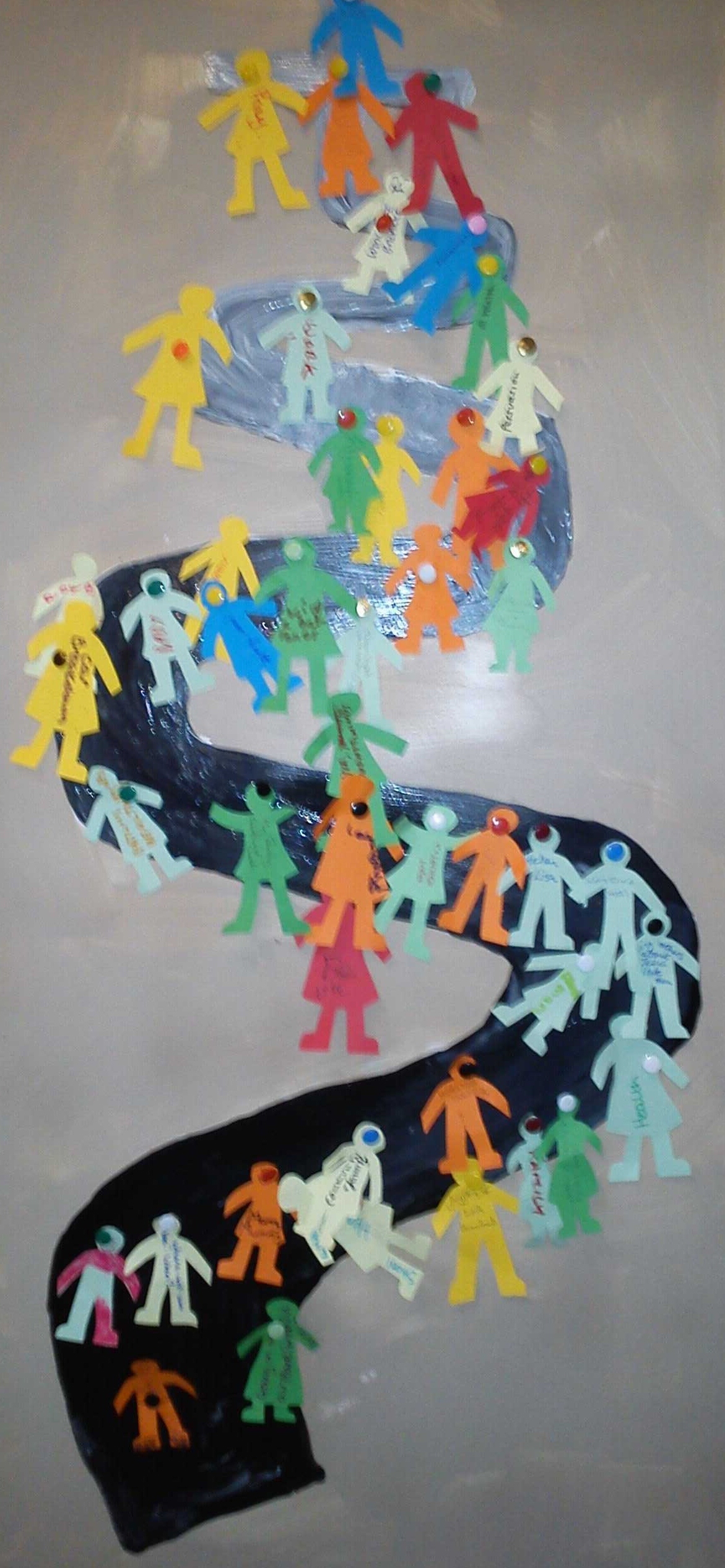
  • a winding path – the journey of life is not a straight line
  • dark areas and light areas – the journey of life is not all all in the light
  • a cross at the end – there are moments of suffering, as well as a sense that we are travelling towards God
  • a rough texture – the road is not always easy
  • a very tiny crucifix, very near the top of the sculpture, almost too small to be seen with the naked eye


The image of the Way of Life quickly became iconic of Ely Cathedral as a place of pilgrimage and iconic of the journey of life. Its simplicity makes it immediately appealing and fascinating.  The fact that its creator, Jonathan Clarke, was himself exploring faith during the time the sculpture was being conceived and made, may also contribute towards the appeal of the work to all who see it.

This time of year we might see the winding path, with its pits rough edges, twists and turns, as the journey of Jesus to the cross.

We might see it as our own journey – and we might identify the twists and turns that we have faced, or are about to face, the challenges that we can foresee, and those that may confront us with no warning.

ImageWe might see the path as our own journey of faith, for the progression of faith is rarely straight and smooth either.

We might even see the path as a sport relief mile: a short (but for many people, hugely challenging) journey undertaken in order that so many people whose life journey is unimaginably hard might find their path made a little easier. 

ImageIf there is one thing about this image that leaves me troubled, it is that the tiny crucifix is so alone.  Christ’s path to the cross was lonlier than it might have been (to the mortification of the disciples who failed to stand by him) and our own paths of suffering, or of doubting enquiry, can seem equally lonely.

But we are not alone. When we look around us in church, or at school, or at work, or to our neighbours, our friends, our families, we see fellow travellers. Their path and ours will not be identical, but they are nevertheless travellling, if not with us, then at least near us.  And we are also not alone because the fact that Jesus has already been on the human journey of life, all the way to the cross means that there is no height, no depth and no breadth of suffering (or indeed of joy, or thinking, or challenge, or worry or any other human experience) that is beyond the scope of his love.