
Ash Wednesday – a Love-Life-Live-Lent-flavoured sermon

It’s not mess…

There was an advert a few years ago for Persil automatic.  It was on TV and on billboards everywhere, so most of you will probably have seen it.  It features a film of children happily painting a wall in splashes of multicoloured paint.  Inevitably, more of the paint gets on their clothes, their hands and faces, and on each other, than on the wall.  The captions read “It’s not mess, it’s creativity, it’s not mess it’s learning,” and so on.

An Ash Wednesday service is a messy one: it involves marking our foreheads with the sign of the cross in a very messy mixture of ash and oil.  This service is messy because we are: sin is a messy business, and the ash reminds us of all the mess that we make of our own lives, of other people’s lives and of this world.  If a sacrament is an outward and visible sign of an inward and invisible grace, then the ash cross is the reverse: an outwards and visible sign of an inward and invisible lack of grace. We sign ourselves with this messy mix of ash and oil because all of us are in a mess.  It helps us be honest about the disparity between what we appear to be and what we feel we are.  Many of us may sometimes feel uncomfortable with the respect that people give us – that we don’t quite match up to the person people think we are – the person we want to be.  When people praise us we may feel, ‘if only they knew…’   So the cross of ash helps us reconcile the person we feel we are with the person that others see.  It helps us remember that God sees us as we are – the good stuff and the not so good stuff – and he still loves us, even having seen the truth. Lent is a time for us to learn to see ourselves just as God does: as beloved sinners.

But the washing powder  advert puts an altogether more positive slant on mess, which is worth exploring.

One of the captions reads, ‘it’s not mess, it’s creativity’.

When we receive the ash cross on our forehead, we hear the words, ‘remember that you are dust’.  And so with the ash perhaps we can recall that wonderful picture of God’s creativity in Genesis 2, lovingly molding the earth into human beings, and breathing life into what was dry and lifeless.  And so as we receive the ash on our foreheads we can give thanks that God can still breathe new life into us even in the dirt and dust and deathliness of our sin.

One of the key themes of Love Life Live Lent is being creative and imaginative – whether that’s making cakes and sharing them or trying something you’ve never done before: when we do so, we reflect something of our creator God, and we give a little bit of life to the world as well as becoming a little more alive ourselves.

Another of the captions reads, ‘it’s not mess, it’s pride’. Pride is perhaps not quite the right word.  But the sign of the cross that we carry is certainly not something that we are ashamed of.  At our baptism, Christ claimed us as his own, and so we are glad to be marked with his sign of the cross.  Because Jesus took the shame of death on a cross and transformed it into hope and victory, he can also transform the shame of our sinfulness into the triumph over it.

Many of the Love Live Live Lent actions are also about our own identity as human beings and as beloved children of God; learning to be ourselves, making the most of who we are, and giving thanks for the way that we have been blessed – even if it’s just for the food we eat.

The TV advert ends with one of the children accidentally on purpose painting another’s nose – at first she looks cross, but then starts to smile.  The caption reads, ‘it’s not mess, it’s forgiveness’.  When we have the sign of the cross on our foreheads, we are a walking testimony to the fact that everyone can be forgiven.

Again, within Love Life Live Lent there are actions that bring real peace and reconciliation – between us and other people, and between humanity and the earth.  Ash Wednesday’s action is to say sorry for something we have done wrong: it may be enough simply to say sorry to God, or it may be that there are others who need to hear it too, and we may also need to acknowledge and repent of the harm we’ve done to ourselves, for sin has a habit of harming the sinner, too.

We are messy people.  The messes we make in our lives are real messes.  They are dark and dirty, and if left unchecked they will be the death of us.  And God does not condone our mess.  It is not that God does not mind about sin – on the contrary, it grieves him that we hurt and abuse ourselves and others, that we deface and corrupt the very air, water and land of this world he has given us. We take heart, and take courage, because we believe in a God who already knows the secrets of our hearts.

Guilt is a prison with sin as the bars, trapping us inside our past mistakes, but true repentance allows us to receive the forgiveness that God always offers, and it may even start to rebuild relationships that we had given up on.  Forgiveness is just as real as sin – and indeed is stronger. Life is stronger than death, light is stronger than darkness, and love is stronger than hate.

The actions in LLLL are all about the triumph of life over death, of light over darkness, of love over hatred.  Just as sin harms the sinner, so random acts of kindness, creativity and love can help repair the wounds on the soul.  This Lent, let us ask God to breathe life into our dust, that we may live lives of love, for our own sake, for each other’s sake, and for the sake of God’s world.
The Transfiguration

Some thoughts on Luke 9.28-36

I wonder if you’ve ever had a moment of absolute awe and wonder? A moment when time had no meaning, when it seemed as if the universe was in technicolour, and you were swept up by it, even overwhelmed?

Wedding couples often tell me that their marriage service felt like this – they expected it to feel special, but it surpassed their ability to imagine.  For that glorious day, and especially for that glorious 35 minutes or so, they are transported out of their normal existence and are part of something that is far bigger and more magnificent than any of us.

If you’ve been blessed by such a moment, you may well have wanted to hold onto it, to make it last for ever. But such moments tend to be glimpses, slipping through our grasp, or dissolving like mist. Those who experience many such moments may find that they are hugely important to them, crucial in their spirituality and faith. Others may never experience such a moment, and may be acutely aware of missing out on something very special.

Jesus’ disciples saw a lot of things during their time with him, many of them strange, many of them challenging, some of them downright incredible. I wonder how significant it was that when it came to his transfiguration he took only his closest friends with him?  This wasn’t just a revelation kept to the disciples rather than the larger crowds who followed Jesus around; it was kept even from the rest of the Twelve.  I wonder if they knew that they had missed something significant?  And, what was it, precisely, that they had missed?  What was it, that Peter, James and John, and actually witnessed?

My experience of reading the gospels and then preaching on them has been that everything that’s included is there for a reason – each verse, each little story, each saying, each event that’s narrated, tells us something about Christ. My confirmation candidate and I tested this theory the other day, by reading just one chapter of Mark and writing down everything about Jesus that we discovered in the chapter.

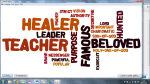
Mark 1 wordle

We used single words, and used them to create a wordle – this is a wordle that represents Mark chapter 1.

If we had read Luke 9 and done the same thing, I wonder if the worldle would have looked very different?  It’s a chapter which is rich in stories, sayings, happenings, miracles, arguments, and more; reading it, we learn a great deal about Jesus, just as the crowds and the disciples and his most trusted friends must have done. It’s a chapter in which more of Jesus’ identity is revealed, layer by layer. So what is it that we learn about Christ in this most mysterious of happenings?  

It’s as if for one moment the veil comes off, and we see Christ in all his glory, timeless, awe-inspiring. In short, God. That’s what Peter, James and John see.  And they want it to last. They’ve been granted a glimpse of heaven, and they want it. As ever, Peter is the one to put his foot in it, talking about making dwellings for the three figures, but he’s only saying what they’re all thinking: if only we could keep this moment, if only we could stay here, in this little patch of heaven, for ever.

And you can see why.  I remember reading C S Lewis’s The Great Divorce when I was a teenager, and falling in love with his vision of heaven, and then crying my eyes out when the central character discovers that his time in heaven had been all a dream and that he has to return to a world that is not only terribly earthly, but also frightening, and dangerous. Peter and the others knew what their world was like, and that it was a very hard place to live and to thrive.  They, along with all God’s people, longed for a time when the Messiah would come and save them – for some this was a very practical desire for God to defeat their current oppressors, the Romans, but for others it was a much more eschatalogical hope, that God would finally bring about his heavenly order in the wayward world and that there would be a real and lasting peace with the people of God at the beloved centre of it all.

Can you blame Peter, James and John for wanting that moment to be right then? And for them to have been just the first stage of the salvation of Israel? And then finding out that the whole thing was only a glimpse?

That walk down the mountain must have been a long one. No wonder they were able to avoid talking about their experience with anyone.  It may well have been a long time before their disappointment gave way to courage and hope again, and they could recapture the joy and awe of the vision – by the time the story was told and the gospel was written down, they’d had time to interpret what they’d experienced, but at the time…?

So why give them this glimpse? Why show a tantalising snapshot of heaven and then not let them stay?  There are probably a million answers to this question, but mine I think has to be this:

Heaven is eternal, beyond time and space.  But there are aspects of the character of heaven that can be nurtured on earth.  Jesus talks a lot about the Kingdom of God, about how it is already near, but that our own behaviour, our own choices, bring us, and the world around us, closer to heaven, or drive us further from it.

Perhaps the transfiguration is a reminder of the truth of how near heaven is, that it might break through any moment. But perhaps it is also a reminder that our experiences of ecstasy, if we have them, are there not only for our own edification and spiritual growth, but for the transformation of ourselves, inside and out, so that we can be part of what transforms the world.  I have no doubt that Peter, James and John, were transformed by their experience on the mountain.  But their calling wasn’t merely to be transformed, it was to let their own transformation become something that guided their words and actions, making them part of how God was bringing earth and heaven closer together.

I’m not even going to ask whether coming to Holy Communion constitutes a powerful spiritual experience. Perhaps sometimes it does, and other times it doesn’t. Perhaps it’s to do with whether the sunshine has broken through the clouds by 8.30 to illuminate the chancel, perhaps it’s to do with us arriving with just the right openness of mind and heart, perhaps it’s to do with the quality of the poetry in the epistle, or the quality of the silence just before the Lord’s Prayer  – these are all things that can lift the ordinary into something special that can start to transform our mundane souls.

Whether we feel it emotionally and spiritually or not, in a service of Holy Communion we come into contact with something profound, and we receive the grace of God, so we shouldn’t leave church as exactly the same people we were as we came in.  And we should be able to take a little of that heaven with us when we go.  What will we do with it? With whom will we share it?  Not by talking about what it felt like taking communion (remember Jesus told his friends not to talk about what they’d seen) but by letting our closeness with heaven rub off in our dealings with others, and with ourselves.  And that’s something that could change our little bit of the world and beyond.

What do those words look like in real life?

A sermon for Epiphany 4 (C) 2013: Luke 4.14-21 & 1 Cor 12

I wonder how many of us have ever had that feeling after reading or hearing a Bible passage, that it was ‘all about me’ – you know, that feeling that it was somehow either fate or God’s plan that that particular reading was read on that particular day, with you sitting there hearing it, and realising how much it applied to you? That it challenged you in just the way you needed to be challenged? That it brought you the exact words of comfort that you most needed to hear? That it gave you that bit of guidance that set you on the path that God had in mind for you? Often it’s bible passages that are very familiar to us that can strike us differently and unexpectedly at such moments. We may have heard a verse a hundred times, but the hundred and first time  it hits us between the eyes, and we think, ‘That verse was written for me, today.’

Jesus must have had that feeling a lot. While he was in the wilderness he had relied hugely on scripture – as a witness to God’s enduring love and faithfulness – to withstand the temptations of the Devil.  Now, he’s back in civilisation, in fact, he’s back in his home town, and it’s another well-known passage from the Hebrew Bible that happens to be set for that day, and Jesus is the one whose turn it is to read.

Jesus is full of the Holy Spirit – still from his baptism, and then again from his wilderness experience. And he reads Isaiah’s words ‘The Spirit of the Lord is upon me’ and knows at once that this passage doesn’t just feel like it’s written for him. It really is for him, and about him.  It’s another of those moments (and those moments are now coming thick and fast in Jesus’ life) when his sense of identity as the Messiah is deepened, strengthened, broadened.  Those words from Isaiah are for him. They are part of what will help him set the agenda for the next three years  – for the whole of his earthly ministry.

So what Isaiah goes on to write next is of crucial importance, because it’s Jesus’ manifesto, it’s his vocation.  He is to be one who brings good news to the poor, release to the captives, recovery of sight to the blind, and freedom for the oppressed, and who is to proclaim the year of the Lord’s favour.

So, Jesus reads the words of Isaiah, and already as he reads it seems as if some of the congregation realise that there is more going on here – that this is more than just another reading, this is something else. He confirms it – his first sermon begins by telling the people that Isaiah’s prophecy is now being fulfilled . In him.  No wonder all their eyes are fixed on him.

These are the words that turn Jesus turns from carpenter’s son to Rabbi, from local boy to itinerant preacher and healer, from ordinary man to Son of Man. These are the words that set him on his way. These are the words that must have reminded him, again and again, of the nature of his calling: freedom, healing, the favour of the Lord, good news…. These are the words that come to life in Jesus’ own life, and these are the words that he uses to start his work of transforming the world. It was as if he said to the people gathered in that Nazareth synagogue, “You’re about to see what Isaiah’s words look like in real life.”

It seems right that Jesus’s ministry begins in his own home town, especially since Nazareth wasn’t a particularly important or nice town, it was no Jerusalem, it had no track record of producing great leaders and teachers. It was ordinariness itself.  It is in keeping with the God who chose to become a human being that he also chose to set out the manifesto of the Messiah in a downmarket provincial town, and that the people who heard it were just those faithful gathered that particular Sabbath.

There are Nazareths all over the world. Certainly all over England. Ordinary places, full of ordinary people, who know that all the exciting things happen Somewhere Else, and who do not expect the Messiah to appear in their midst.  If that’s us, then this gospel reading should stir us up a bit.  Especially if we put it together with today’s epistle, which speaks of the church as the Body of Christ.

Why? Because in the gospel reading we start to see the first stage of Jesus’ transformation – the body of Christ gradually turns from being the physical body of a carpenters’ son and eventually becomes the metaphorical worldwide body of the church, who meets in Christ’s name and undertakes to continue his work.  There is absolutely continuity between the work of God that Jesus started and the work of God that we are supposed to be doing, right now. If Isaiah has set out Jesus’ manifesto, then he’s also set out ours.

And that’s another reason why it’s good that all this happened in Nazareth.  Because Nazareth is here. It’s Huntingdon, it’s St Neots.  It’s all the places that most people would say probably aren’t the centre of the universe.  An ordinary place is where Jesus started his work, and this ordinary place is where we are to begin our work.

Jesus went out from that place and spent three years seeking out those who needed healing, three years proclaiming the good news, three years helping people find freedom from the many things that were oppressing them, and ultimately on the cross, enacted the good news of the sacrificial love of God in his own body, experiencing death so that we could might never be captive to it again.

But it starts here.  In the place that we are. In these familiar streets, with these familiar people.  So it is also our calling to proclaim the good news we have heard, and not only that but to live it out, as Jesus did. To be people, and to be a church, which will bring healing, peace and reconciliation, that will fight for justice and freedom for those who are oppressed in any way, or held captive by their own condition or by the actions of others, that will show by how we live that this is the year of the Lord’s favour, that God’s love for the world is real and active, and that his blessings are manifold.  We, too, need to show the world what Isaiah’s words look like in real life.

This is what it means to be the Body of Christ.  No less. But crucially it is by being who we are, in our ordinary situations, that we can do this best.  Jesus’  manifesto was made public in the most ordinary place. So, in whatever ordinary places we find ourselves today and tomorrow, next week, next month, and next year, let us pray that God would help us to see how we might be the Body of Christ and continue Christ’s work of transformation, healing, renewal and love in our ordinary corner of the world. For when we do that, there are no ordinary places, and there are no ordinary people.

The Baptism of Christ (Luke 3.15-17,21-22)

John the baptist’s job – his entire vocation – was to prepare people for Jesus’ arrival, to sow the seeds about baptism, about repentance, and about the coming kingdom.  I read the verses 15-17, and think, on Jesus’ behalf, “So, no pressure then?”

Four verses later, Jesus is there, and his first act is to submit to John’s baptism. Not because he has sinned, but because it’s the right way to start his ministry.  All that pressure, all that expectation. All that taking on the identity of the Messiah, but knowing that you’re not going to be quite what everyone’s hoping for.  All that promise. All that that work to do. No wonder Jesus needs to be baptised before he starts doing it all.

And he would be glad that he did.  Because when Jesus left the water, he heard the most wonderful words:

“You are my son, my beloved, and with you I am well pleased.”

If you’re the Messiah, if you’re confronted by all that pressure, all that expectation, all that promise, all that work to do, what you need most in the whole world is to know that you are loved, not because of what you have achieved, nor even because of what you will go on to achieve, but simply because you exist.

Every child needs to hear those words. And I tell every parent that as they bring their children for baptism.

And Jesus needed them too.

In the strength of those words, he faced temptation in the wilderness, beating the Devil hands down.

In the strength of those words, he emerged from his ordinary family to embrace Isaiah’s prophecy and announce the manifesto for his mission – to bring release to captives, recovery of sight to the blind, and proclamation of the year of the Lord’s favour.

In the strength of those words, he went three years of ceaseless ministry, healing, teaching, embracing, arguing, challenging, and bringing life and love to those who needed it most.

In the strength of those words he walked the Way of the Cross, and accepted the suffering that was God’s love for the world, written in blood.

If anyone needed to hear those words, it was Jesus.

You are my son, I love you, and I am pleased with you.

But those words were not just for him. They are for all of us. We are not the Messiah. We do not have to face the Devil in person, we do not have to work miracles, we do not have to bring the dead to life.  But whatever we do face today, this week, over these next months, we need a safe place to stand, something to hang on to that is utterly reliable.

Today, we can put our own name on the front of God’s affirmation.  Because, like Jesus, we’ve lived half a lifetime or more, but today is the first day of the rest of our life. And we have God’s affirmation not because of what we have done, nor because of what we will do, but as a free gift, in the strength of which we can face whatever life will bring us.


Quiet Christmas 2012

Our Quiet Christmas service is for all those who find the festive spirit hard to come by. This is my talk/reflection for it.

It’s good that we’re here tonight.

Because tonight is about us, about you. Each of us has our own burdens that we carry on our hearts: for some it is physical pain, of illness or injury; for others it is grief, as we miss the presence of someone dear to us who has died; for others it is anxiety at what the future may bring for us, and for those we love and for the world. For still others, it may be a sense of disconnection with the festivities of the season, and we may not even know why; or an urge to get back to the heart of things, without the tinsel.

Whatever burden you bring tonight – and we will have each brought something – this service is for us, this service is for you.

But this is one of those services that we’d still do even if nobody came.

But it’s also about everyone who isn’t here: those who were too tired, or too sad, or too shy, to come.  Those stuck in hospitals and hospices and prisons and at home.  Those afraid to come out in the dark, those who don’t feel that church is for them.  Those for whom some hurt or grief is so recent or so painful that they daren’t re-open the wound. Some of those people you may know, and think ‘if only so-and-so had thought to come to this’.  For some, their burdens are known only to God. We bring their burdens too.

Every candle we light, every note we sing, every prayer we say, every silence spent in reflection, is for ourselves, for our loved ones, and for the countless multitudes who know their need but feel that they have nobody to care or pray for them.

So it can seem as if this service is more about absence than anything else: the people who could be here but did not come; the people who we are separated from by distance, by conflict and disagreement, or by death. And in a way, it is.

But tonight is more about presence.

Not our presence here, coming to find God, but his presence in the world, already coming to find us. When we feel lost or alone, remember that God is the great seeker after souls.  He is the one who came to us, and who chose to come into what is still one of the earth’s darkest most difficult places, because when you are the light of the world, the darkness is where you are needed most.

Into all our emptinesses, all our absences, all our lostness, may the presence of God come and dwell and settle.  The hopes and fears of all the years, and our own hopes and fears, can indeed be met in him tonight.