
Love Life Live Advent – 10th December – Feed the birds!

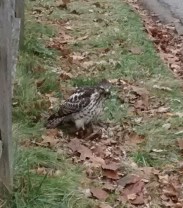
Ibird made my fat balls quite a while ago, and was still wondering whether I could find anything profound to say about them in today’s blog post, when I was distracted by a loud squawking from the front garden.  When I looked out I was treated to the sight of three crows fighting what I’ve since found out was probably a red-tailed hawk, for custody of a long-dead opossum.  The birds were being fed but somehow this lacked the poetic warm feeling I had been hoping for. And the opossum was really stinky.

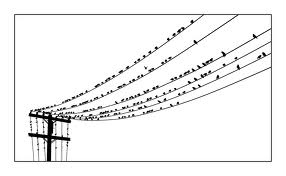
The fight over the opossum corpse had also scared all the regular garden birds away, so for today’s blog post there are some birds that we see on the school run.  They are very ordinary urban sparrows, and they like to gather together on the telegraph wires. We see them every day, and we really really like them, because they’re ordinary, and small, and birdsonawirebecause we think the poor things must stick around for the long, cold Ohio winters (otherwise they would have left by now).  Also, sparrows are very biblical (see Matthew 10.29).  So, here’s a not very good poetic tribute to them, but a little sonnet is the best I could do – sorry birds, you deserve better!
Sparrows

If two are worth a penny – no great cost –
then this great crowd is worth at least a quid;
I’d pay far more to know that I’d not lost
such life, by winter’s frost and cold outbid.

They thickly fur the wires overhead
like iron filings on a magnet’s pole,
Grey-brown against the sky looks black instead
and all the parts blur dark within the whole.

This testament to fragile nature’s strength
in numbers: cold alone, together warm,
as all along the endless cable’s length
they huddle, side by side, before the storm.

A noise – a whir of wings – and then, as one,
the whole great flock lifts skywards, and is gone.

Harvest Festival Poems

I’ve posted these before, but as it’s that time of year again, here are the two versions of my harvest poem – as always, help yourself if you’d like to use them in worship, print them in notice sheets or use them in home groups, or whatever. I’d love to know how you decide to use them, if you do.

The poem comes in two sizes: the original one is the longer of the two, and then there’s a ‘lite’ version for those who like their poems shorter. It still didn’t end up short enough for a sonnet though!

Here is the original (longer) version:

We bring our gifts:
The first-fruits of our labour,
or perhaps the spare we do not need,
(an offering to mitigate against our greed).

To the church we bring them,
and into the hands of Christ we place them,
and we say, ‘Take this,
and do with it some miracle:
Turn water into wine again,
or multiply my loaves and fish
to feed a crowd again.’

And Jesus takes them from our hand,
this fruit of the ocean, this product of the land,
and blesses them, accepting back
what always was the Lord’s.
Our gifts will fill the lack
of hungry people,
putting flesh on words
of charity, and making folk
in our small corner of the world
more equal.

We know there is enough for everyone.
But once the leftovers are gone –
taken to the homeless, hungry poor –
what of those twelve empty baskets standing idly by?
Can there yet be more
that we can ask our Lord to multiply?

Into those baskets therefore let us place ourselves,
those parts of us that need transforming,
grace and strength and healing,
the gifts in us that need to be increased and shared
with a greater generosity than we may be prepared
to offer on our own account.

For we are God’s rich and splendid bounty,
seeds, sown and scattered by the Lord in every place.
the human race:
the crowning glory
of the ever-evolving creation story.
We thank the Lord
that he does not just separate wheat from tare,
but takes our very best
then turns us into far more than we are.

And here is the shorter version:

We bring the spare we do not really need
(for surely God will honour all we bring
although it cannot make up for our greed).
And place into Christs’s hands our offering:
“Turn water into wine again,” we say,
“and multiply my token loaves and fish
to feed another hungry crowd today.”
Our gifts, we know, will put some flesh
on words of charity. Then into those
twelve empty baskets, let us place the gifts in us
that need to be increased and shared
with greater generosity than we may be prepared
to offer on our own account.
For we are God’s most rich and splendid bounty,
sown as seeds and scattered by the Lord
in every place.
the human race:
the crowning glory
of the ever-evolving creation story.
We thank God that he does not only separate the wheat from tare,
but takes our very best then turns us into far more than we are.

Christmas poem

I’ve posted this before, but just in case anyone’s planning carol services and needs a poem they’ve not used a million times before, here is one:

Prophetic visions since the world began
(so long before salvation’s human birth)
would speak of God’s tremendous loving plan
for heav’n to touch the long-estrangèd earth.
Those ancient words at last began to be
in flesh and skin and bone and blood unfurled
In maiden womb and half-made family –
so heaven stooped to touch a fallen world.
Amongst the stable beasts behind the inn,
the baby’s eyes saw first a loving mother;
and even though their world was full of sin,
yet heav’n touched earth for each in one another.
Tonight we cry for peace, goodwill to men,
and for God’s heaven to touch his earth again.

Harvest festival poem

I posted a version of this poem rather after all the harvest festivals last year, so I thought I’d post this shorter version again in case it’s any use to anyone planning harvest songs-of-praise type services in which you need multiple readings!

We bring the spare we do not really need
(for surely God will honour all we bring
although it cannot make up for our greed).
And place into Christs’s hands our offering:
“Turn water into wine again,” we say,
“and multiply my token loaves and fish
to feed another hungry crowd today.”
Our gifts, we know, will put some flesh
on words of charity. Then into those
twelve empty baskets, let us place the gifts in us
that need to be increased and shared
with greater generosity than we may be prepared
to offer on our own account.
For we are God’s most rich and splendid bounty,
sown as seeds in every place
the human race:
the crowning glory
of the ever-evolving creation story.
We thank God that he does not only separate the wheat from tare,
but takes our very best then turns us into far more than we are.

A Psalm of repentance (ii)

Again with apologies and thanks to whoever wrote Psalms 22 and 139.

My God, my God, why do I forsake you?
When your salvation was so near,
so near to the words of my distress?
O my God, you cry to me in the daytime,
but I have not answered,
by night also, but instead I took my rest.
Yet you are the Holy One of Israel,
enthroned on their praises,
my forebears trusted in you
and you delivered them.
But as for me I am a worm and no man,
worthy of the people’s scorn.
Why do those who see me not laugh me to scorn?
Why do they take pity on me, saying,
“If only she would trust in God,
for God delights in her, and will deliver her.”
For it is you that took me out of the womb,
and laid me safe upon my mother’s breast.
On you was I cast ever since I was born,
you are my God even from my mother’s womb.
And you are never far from me,
even when trouble is near at hand,
especially when trouble is near at hand.
But instead I run to the mighty oxen,
and to the fat bulls of Bashan.
I have poured out myself like water,
and I have put my own bones out of joint.
I have turned the heart of flesh you gave me
into a heart of stone.
My mouth and my tongue are free
Yet I chose to choke on the dust of death,
And have not called on you for help.
I have joined with the hounds and with the pack of evildoers,
And I have pierced your hands and your feet.
I cannot look on as your bones accuse me,
While I cast lots for my own life.
And yet you are not far from me,
You are still my strength when I call upon your name,
Deliver my soul from myself,
My poor life from the snares that I have laid myself,
For you have always answered me:
My God, my God, why have you never forsaken me?